Review
. 2025 Feb 20;17(5):564.
doi: 10.3390/polym17050564.

Proposal of a Modular Classification System for Direct Dental Resin Composites Based on Clinical Applications

Affiliations
Review

Proposal of a Modular Classification System for Direct Dental Resin Composites Based on Clinical Applications

Philippe Francois et al. Polymers (Basel). .

Abstract

The adhesive-resin composite pair has been the cornerstone of direct restorations in dentistry for many years. Resin composites are traditionally classified in three ways based on their inorganic structure, their organic composition and their viscosity. While these classifications have long been associated with the optical, mechanical, and clinical properties of resin composites, recent studies indicate that this classification is not always valid. In recent years, a significant expansion of the range of clinical resin composite families has occurred, each with varying degrees of validation through in vitro and clinical studies. As a result, new resin composites with distinct structures, viscosities, and clinical indications have emerged. Despite this progress, a formal classification of the clinical features of all resin composites is still lacking, leading to terminological inconsistencies in research and potential confusion among clinicians. This brief review, supported by an exhaustive search of the dental literature, proposes a new clinical classification system for resin composites based on their key clinical features to help clinicians and researchers easily identify the key clinical characteristics of formulations. This modular classification, encompassing eight main families and 14 characteristics, is particularly suited to future developments, as current trends aim to simplify procedures by integrating multiple formulations into single products.

Keywords: bisphenol-free; bulk-fill; fiber-reinforced; flowable; highly filled; ion-releasing; layering; resin composite; simplified color integration; viscous.


Conflict of interest statement

The authors declare no conflicts of interest.

Figures

Figure 1
Figure 1
Schematic representation of the structure of a dental resin composite. The majority of these resin composites are therefore composed of inorganic fillers embedded in an organic polymer matrix, with a coupling agent called silane acting as the binder between the two. In the context of direct resin composites, the degree of conversion is never 100%, and thus residual free monomers remain present after polymerization.
Figure 2
Figure 2
Illustration inspired and slightly modified by the authors of “Resin composite–state of the art”, 2011 [9]. The progressive evolution of resin composite formulations has involved a gradual reduction in the average size of fillers, the inclusion of prepolymerized fillers (which gradually tend to disappear) and the incorporation of nanofillers. The three most common families used today are microhybrids, nanohybrids and nanofills.
Figure 3
Figure 3
Developed formulas of the main monomers found in the resin composites.
Figure 4
Figure 4
Major indications for resin composites as proposed by the historical classification based on viscosity. Flowable resin composites are primarily used for their self-leveling and self-spreading properties in thin layers and as liners. In contrast, viscous and packable resin composites are better suited for larger cavities subject to occlusal stress. Packable resin composites, in particular, are designed to work with firm pressure, similar to the handling of amalgams.
Figure 5
Figure 5
Representation of the location of use classification, considering both the location and the type of restoration class that the resin composite can effectively address. Universal resin composites are therefore considered suitable for use in both the anterior and posterior sectors, depending on their major characteristics.
Figure 6
Figure 6
Classification of direct dental resin composites according to their clinical features. Importantly, as the future of chemical development aims to combine multiple clinical features within a single formulation, this classification may include several clinical characteristics to describe the same formulation.
Figure 7
Figure 7
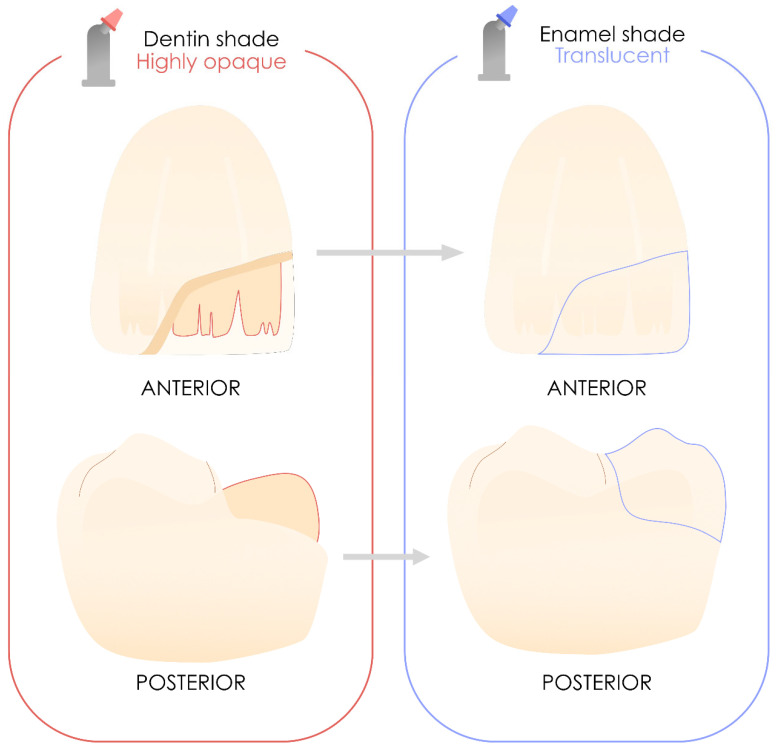
Use of layering resin composites in the anterior and posterior sectors. When properly used, they will deliver the best aesthetic results.
Figure 8
Figure 8
Illustration of the benefits of using a masking liner, including its ability to mask a metallic intended to be permanent. It is also effective for concealing discolored areas of the tooth, such as those following amalgam removal or when discoloration persists in structurally anomalous tissues.
Figure 9
Figure 9
Proper use of these stains on an anterior tooth between the dentin and enamel layers. The concept is simplified but the same in the posterior area.
Figure 10
Figure 10
Proposed concept of crack deviation to a more favorable pattern using these short fiber-reinforced resin composites.
Figure 11
Figure 11
Clinical illustration of the additional clinical indications of highly filled flowable resin composites compared with historical flowable resin composites used as liners. Two major new features are the need to perform extensive fillings, such as posterior Class I and Class II cavities, which are subject to high occlusal stress, and their use for injection treatments.
Figure 12
Figure 12
Modifications of the resin composite to increase the photopolymerization depth without developing excessive stresses.
Figure 13
Figure 13
Differences between simplified color envelope resin composites and chameleon resin composites. Although these two materials arrived on the market in the same time frame, they have very different indications and operating systems.
Figure 14
Figure 14
Inspired by the diagram proposed by Ivoclar for the mechanism of action of Cention Forte, this image illustrates the concept of the currently available ion-releasing resin composites, which are capable of ion release, the characteristics of which vary according to the formulation and can be accentuated under specific intraoral conditions, notably acidity.

References

    1. Ferracane J.L. A historical perspective on dental composite restorative materials. J. Funct. Biomater. 2024;15:173. doi: 10.3390/jfb15070173. - DOI - PMC - PubMed
    1. Bompolaki D., Lubisich E.B., Fugolin A.P. Resin-based composites for direct and indirect restorations: Clinical applications, recent advances, and future trends. Dent. Clin. N. Am. 2022;66:517–536. doi: 10.1016/j.cden.2022.05.003. - DOI - PubMed
    1. Shah Y.R., Shiraguppi V.L., Deosarkar B.A., Shelke U.R. Long-term survival and reasons for failure in direct anterior composite restorations: A systematic review. J. Conserv. Dent. 2021;24:415–420. doi: 10.4103/jcd.jcd_527_21. - DOI - PMC - PubMed
    1. Borgia E., Baron R., Borgia J.L. Quality and survival of direct light-activated composite resin restorations in posterior teeth: A 5- to 20-year retrospective longitudinal study. J. Prosthodont. 2019;28:e195–e203. doi: 10.1111/jopr.12630. - DOI - PubMed
    1. Heintze S.D., Loguercio A.D., Hanzen T.A., Reis A., Rousson V. Clinical efficacy of resin-based direct posterior restorations and glass-ionomer restorations—An updated meta-analysis of clinical outcome parameters. Dent. Mater. 2022;38:e109–e135. doi: 10.1016/j.dental.2021.10.018. - DOI - PubMed

LinkOut - more resources