


Scutellarin Alleviates Neuronal Apoptosis in Ischemic Stroke via Activation of the PI3K/AKT Signaling Pathway
- PMID: 40076795
- PMCID: PMC11901123
- DOI: 10.3390/ijms26052175
Scutellarin Alleviates Neuronal Apoptosis in Ischemic Stroke via Activation of the PI3K/AKT Signaling Pathway
Abstract
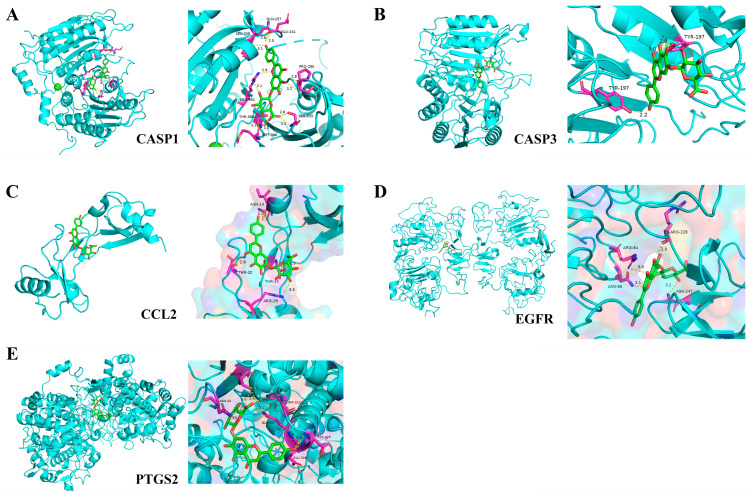
Among all stroke types, ischemic stroke (IS) occurs most frequently, resulting in neuronal death and tissue injury within both the central infarct region and surrounding areas. This study explored the neuroprotective mechanisms of scutellarin, a flavonoid compound, through an integrated strategy that merged in silico analyses (including network pharmacology and molecular docking simulations) with both in vitro and in vivo experimental verification. We identified 1887 IS-related targets and 129 scutellarin targets, with 23 overlapping targets. PPI network analysis revealed five core targets, and molecular docking demonstrated strong binding affinities between scutellarin and these targets. Bioinformatic analyses, including GO functional annotation and KEGG pathway mapping, indicated that the PI3K/AKT cascade represents the primary signaling mechanism. An in vitro experimental system was developed using PC12 cells under oxygen-glucose deprivation conditions to investigate how scutellarin regulates neuronal cell death via the PI3K/AKT pathway. Western blot quantification demonstrated that treatment with scutellarin enhanced the expression of p-PI3K, p-AKT, and Bcl-2 proteins, while simultaneously reducing levels of apoptotic markers Bax and cleaved caspase-3. Furthermore, pharmacological intervention with the selective PI3K inhibitor LY294002 attenuated these molecular alterations, resulting in diminished expression of p-PI3K, p-AKT, and Bcl-2, accompanied by elevated levels of Bax and cleaved caspase-3. In a rat model of middle cerebral artery occlusion, scutellarin administration demonstrated comparable neuroprotective effects, maintaining neuronal survival and modulating apoptotic protein expression via PI3K/AKT pathway activation. Collectively, this study demonstrates the therapeutic potential of scutellarin in cerebral ischemia through PI3K/AKT pathway modulation, suggesting its possible application in treating ischemic disorders.
Keywords: PI3K/AKT pathway; ischemic stroke; molecular docking; network pharmacology; neuronal apoptosis; scutellarin.
Conflict of interest statement
The authors declare no conflicts of interest.
Figures




References
-
- Wu P., Cheng L.H., Liu Y.L., Zhang J.L., Dong X.M., Chen L., Xu Y.X., Ren Y.Y., Zhang H.M., Liu Z.Q., et al. Elemene mitigates oxidative stress and neuronal apoptosis induced by cerebral ischemia-reperfusion injury through the regulation of glutathione metabolism. J. Ethnopharmacol. 2024;340:119166. doi: 10.1016/j.jep.2024.119166. - DOI - PubMed
MeSH terms
Substances
Grants and funding
LinkOut - more resources
Full Text Sources
Medical
Research Materials
