


Interventions to Improve Adherence to Clinical Guidelines for the Management and Follow-Up of Pulmonary Nodules: A Systematic Review
- PMID: 40081655
- PMCID: PMC12264345
- DOI: 10.1016/j.chest.2025.02.031
Interventions to Improve Adherence to Clinical Guidelines for the Management and Follow-Up of Pulmonary Nodules: A Systematic Review
Abstract
Background: Lung cancer is the leading cause of global cancer mortality. It is also the third most common cancer in the United Kingdom and the most prevalent worldwide. Pulmonary nodules can indicate early-stage lung cancer, but adherence to guidelines for radiologic surveillance is suboptimal, which affects early detection and treatment. Although interventions have been developed to improve follow-up, it remains unclear which approaches are most effective.
Research question: Which interventions have been developed for improving adherence to guidelines for the management of pulmonary nodules and/or the follow-up of patients, and how effective are they?
Study design and methods: A systematic review was conducted by searching the Ovid MEDLINE, Cochrane, and Embase databases in March 2024. Reports were included of interventions of all designs that measured outcomes, including follow-up completion, guideline adherence, or early diagnosis of lung cancer. Studies relating to diagnosis, reporting screening programs, or not in English were excluded. Screening and data extraction were performed independently. Risk of bias was assessed by using three measures depending on study design.
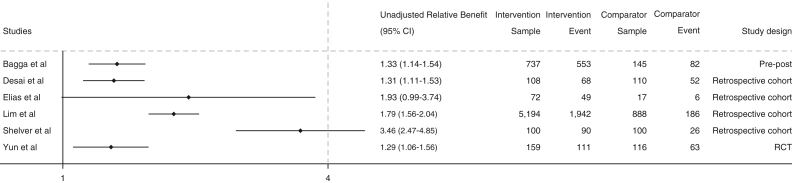
Results: A total of 3,664 titles and abstracts, including 31 studies, were identified. Six intervention types were identified: tracking systems, process improvement approaches, natural language processing systems, radiologist reporting templates, clinical decision-making support tools, and patient involvement improvements. All studies reported being effective. Tracking systems and clinical decision support tools showed significant improvements in follow-up, guideline adherence, and early cancer detection. Tracking systems may have the most potential for effectiveness because they modify more of the care pathway and use automation, reducing human error. Risk of bias was serious or critical in most nonrandomized studies.
Interpretation: Our results show that there was significant variation in achieved follow-up rates across interventions; however, tracking systems seemed most effective in improving patient follow-up. Review limitations included high risk of bias and heterogeneity of included studies. Future evaluations should include more comprehensive outcome measures and rigorous designs.
Keywords: guideline adherence; incidental; interventions; lung cancer; prevention; pulmonary nodules; surveillance.
Copyright © 2025 The Author(s). Published by Elsevier Inc. All rights reserved.
Conflict of interest statement
Financial/Nonfinancial Disclosures The authors have reported to CHEST the following: A. M. T. and J. A. received financial support for this work from the National Institute for Health and Care Research. M. N. has received other grant funding from the National Institute for Health and Care Research. A. M. T. also declares grant funding from GSK, Chiesi, CSL Behring, Grifols, and Takeda; speaking and lecture fees as well as travel reimbursement from Takeda; consulting or advisory roles and speaking fees from AstraZeneca and AiRNA; and board memberships with Beam, Korrobio, and the Alpha-1 Foundation. None declared (K. P. Y., K. D., K. S., B. U.).
Figures




References
-
- Bray F., Laversanne M., Sung H., et al. Global cancer statistics 2022: GLOBOCAN estimates of incidence and mortality worldwide for 36 cancers in 185 countries. CA Cancer J Clin. 2024;74(3):229–263. - PubMed
-
- Callister M., Baldwin D., Akram A., et al. British Thoracic Society guidelines for the investigation and management of pulmonary nodules: accredited by NICE. Thorax. 2015;70(suppl 2):ii1–ii54. - PubMed
Publication types
MeSH terms
LinkOut - more resources
Full Text Sources
Medical
