


Association between periodontal disease and age-related cognitive impairment: a narrative review
- PMID: 40082811
- PMCID: PMC11907832
- DOI: 10.1186/s12903-025-05632-z
Association between periodontal disease and age-related cognitive impairment: a narrative review
Abstract
Background: Previous studies have shown associations between periodontal disease and age-related cognitive impairment. However, little is known about the different cognitive functions that may be affected in patients with periodontal disease.
Methods: We reviewed the recent literature to better understand the bidirectional relationship between cognitive function and periodontal disease, and to explore the cognitive assessments that may be useful when investigating this relationship. We also reviewed the literature around improving periodontal health in older adults presenting with cognitive impairment, which may improve their cognition.
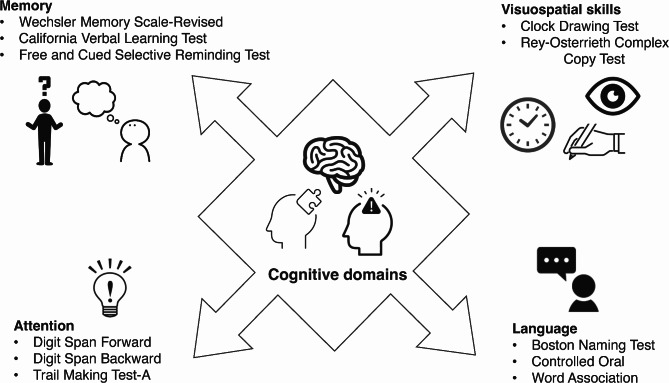
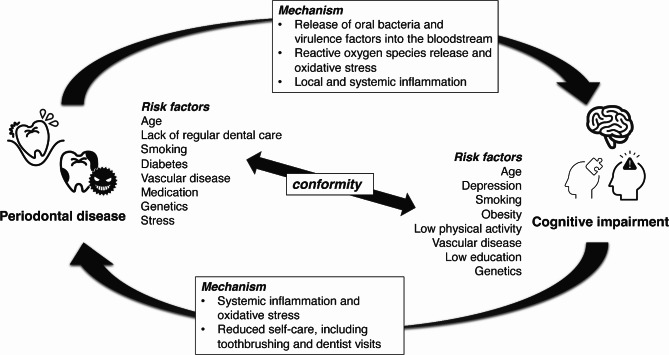
Results: There is a bidirectional relationship between periodontal disease and cognitive impairment. We also found that visuospatial function, attention, memory, and language are important cognitive domains that may be impaired in older people with periodontal disease, possibly because these factors are associated with the ability to adequately brush one's teeth. Furthermore, we noted that the choice of cognitive assessment may be particularly important when studying cognitive function in relation to periodontal health. To improve periodontal health in older people with cognitive impairment, partner-assisted interventions, adequate toothbrushing, and the use of a powered toothbrush have all been proposed. The early initiation of regular oral care visits, education for individuals, improving cooking skills, and dietary/caloric restrictions may also contribute to improving periodontal health.
Conclusions: The bidirectional nature of the relationship between periodontal health and cognitive function is important for older adults presenting with cognitive impairment. Furthermore, improvements in periodontal health may help to improve cognitive impairment. The appropriate assessment of cognitive function will contribute to preserving and improving oral health in older people with periodontal disease.
Keywords: Cognitive impairment; Dementia; Oral health; Oral hygiene; Periodontal disease.
© 2025. The Author(s).
Conflict of interest statement
Declarations. Ethics approval and consent to participate: Not applicable. Clinical trial number: not applicable. Consent for publication: Not applicable. Competing interests: The authors declare no competing interests.
Figures
References
-
- Chapple ILC, Mealey BL, Van Dyke TE, Bartold PM, Dommisch H, Eickholz P, et al. Periodontal health and gingival diseases and conditions on an intact and a reduced periodontium: consensus report of workgroup 1 of the 2017 World workshop on the classification of periodontal and peri-implant diseases and conditions. J Periodontol. 2018;89(Suppl 1):S74–84. 10.1111/jcpe.12940 - PubMed
-
- World Health Organization. Global oral health status report: Towards universal health coverage for oral health by 2030. https://www.who.int/publications/i/item/9789240061484. Accessed 10 Jan 2025.
-
- Dibello V, Lobbezoo F, Solfrizzi V, Custodero C, Lozupone M, Pilotto A, et al. Oral health indicators and bone mineral density disorders in older age: a systematic review. Ageing Res Rev. 2024;100:102412. 10.1016/j.arr.2024.102412 - PubMed
Publication types
MeSH terms
Grants and funding
LinkOut - more resources
Full Text Sources
Medical
