. 2025 Mar;11(3):410-420.
doi: 10.1038/s41477-025-01920-2. Epub 2025 Mar 14.

Septoria tritici blotch resistance gene Stb15 encodes a lectin receptor-like kinase

Affiliations

Septoria tritici blotch resistance gene Stb15 encodes a lectin receptor-like kinase

Amber N Hafeez et al. Nat Plants. 2025 Mar.

Abstract

Septoria tritici blotch (STB), caused by the Dothideomycete fungus Zymoseptoria tritici, is one of the most damaging diseases of bread wheat (Triticum aestivum)1 and the target of costly fungicide applications2. In line with the fungus's apoplastic lifestyle, STB resistance genes isolated to date encode receptor-like kinases (RLKs) including a wall-associated kinase (Stb6) and a cysteine-rich kinase (Stb16q)3,4. Here we used genome-wide association studies on a diverse panel of 300 whole-genome shotgun-sequenced wheat landraces (WatSeq consortium5) to identify a 99-kb region containing six candidates for the Stb15 resistance gene. Mutagenesis and transgenesis confirmed a gene encoding an intronless G-type lectin RLK as Stb15. The characterization of Stb15 exemplifies the unexpected diversity of RLKs conferring Z. tritici resistance in wheat.


Conflict of interest statement

Competing interests: The authors declare no competing interests.

Figures
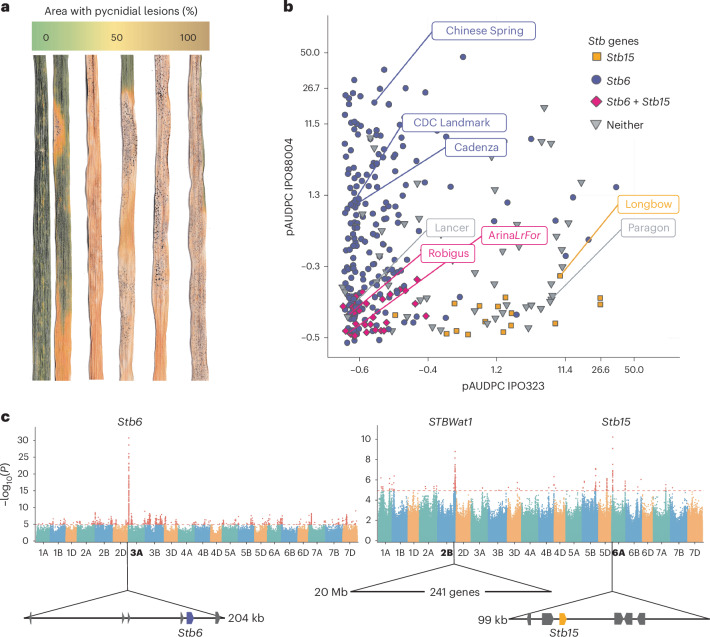
Fig. 1
Fig. 1. Race-specific resistance to Z. tritici in the wheat Watkins landrace panel associates with discrete disequilibrium blocks.
a, Quantitative variation in pycnidia and necrosis phenotypes. Pictured are leaves arranged by pycnidial coverage (0–100%). b, Effects of Stb6 and Stb15 on pycnidia scores with Z. tritici isolates IPO88004 and IPO323. The logit pycnidial area under the disease progress curve (pAUDPC) values of the axes are back-transformed to give pAUDPC (0–100%). c, Manhattan plots showing the association of logit pAUDPC in response to Z. tritici isolates IPO323 (left) and IPO88004 (right) with SNPs mapped to Chinese Spring, in terms of Wald test P values, not adjusted for multiple comparisons. LD blocks associated with STB resistance are drawn as arrows beneath the chromosomes (marked in bold) with the 6A Stb15 candidate gene marked in orange and Stb6 in purple. The large interval for the locus STBWat1 is also shown.
Fig. 2
Fig. 2. Structure and function of Stb15.
a, The functional resistance allele of Stb15 in wheat cv. Arina and ArinaLrFor compared to the susceptible allele in cv. Chinese Spring. The predicted exons and introns are shown as rounded rectangles and lines, respectively, for Chinese Spring (RefSeq v.1.1 (ref. )) and ArinaLrFor (Methods). Domains are highlighted: SP, signal peptide; TM, transmembrane; S/TPK, serine/threonine receptor-like protein kinase. InterProScan was used to predict protein domains, with additional adjustments made for ArinaLrFor on the basis of the AlphaFold model (c). The white boxes indicate untranslated regions. The sequence variants of three EMS-induced loss-of-function mutants inoculated with Z. tritici isolate IPO88004 are indicated. b, STB phenotypes of the three EMS mutants. c, AlphaFold-augmented 3D structural model of Stb15. The domains are coloured as in a. The locations of the three EMS-induced mutations are shown in red and indicated by labelled red arrows. d, Cultivar Fielder stably transformed with an Stb15 construct and inoculated with isolate IPO88004. Null-2.1:0 is a null wherein the transgene segregated out in the T2 family, while GRF-5:4 was transformed with the same vector backbone minus Stb15. Further details about the transgenic line names are provided in Supplementary Table 10. The copy number of Stb15 is given as a fixed number or range. In b and d, the leaf sections outlined with dashed boxes and labelled 1, 2 and 3 are enlarged on the right side for improved visibility of pycnidia.
Fig. 3
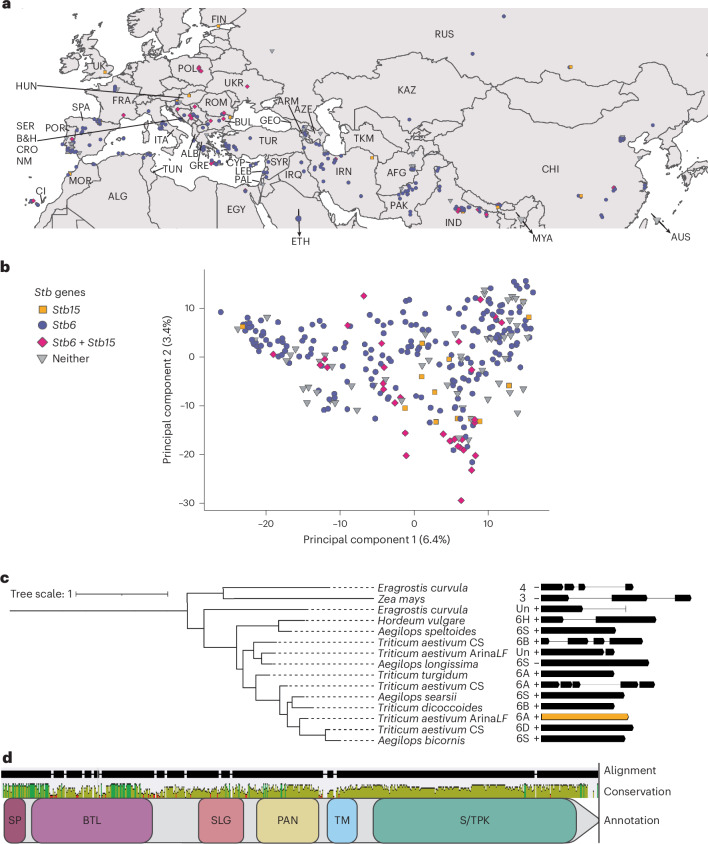
Fig. 3. Geographic distribution and intra- and inter-species structural diversity of Stb15.
a, Distribution of Stb6 and Stb15 in the Watkins 300 core collection. The map indicates the coordinates of local markets from which grain of landraces was obtained. Only countries from which landraces were collected are labelled. The country abbreviations are expanded in Supplementary Text 1. b, Principal component analysis plot of Axiom array SNPs from 300 Watkins landraces with lines containing predicted functional alleles of Stb6 (purple), Stb15 (orange), both (pink) or neither (grey) indicated. c, Maximum likelihood phylogenetic tree of proteins with homology to the ArinaLrFor (ArinaLF) Stb15-encoded allele from selected Poaceae species, including the wheat reference genome Chinese Spring (CS). The smallest non-repetitive (‘inner’) clade containing Stb15 is shown. The intron/exon structure of Stb15 homologues and their relative nucleotide lengths are presented (arrows indicate exon coding sequences; lines indicate introns). Species names and chromosomes are given; Un indicates homologues within scaffolds that have not yet been mapped to chromosomes. Gene IDs for homologues are given in Supplementary Table 17. d, Protein alignment of the homologues from c with alignment gaps, sequence conservation and predicted protein domains indicated. Taller, greener bars in the conservation panel indicate more conserved regions.

References

    1. Savary, S. et al. The global burden of pathogens and pests on major food crops. Nat. Ecol. Evol.3, 430–439 (2019). - PubMed
    1. O’Driscoll, A., Kildea, S., Doohan, F., Spink, J. & Mullins, E. The wheat–Septoria conflict: a new front opening up? Trends Plant Sci.19, 602–610 (2014). - PubMed
    1. Saintenac, C. et al. Wheat receptor-kinase-like protein Stb6 controls gene-for-gene resistance to fungal pathogen Zymoseptoria tritici. Nat. Genet.50, 368–374 (2018). - PubMed
    1. Saintenac, C. et al. A wheat cysteine-rich receptor-like kinase confers broad-spectrum resistance against Septoria tritici blotch. Nat. Commun.12, 433 (2021). - PMC - PubMed
    1. Cheng, S. et al. Harnessing landrace diversity empowers wheat breeding. Nature632, 823–831 (2024). - PMC - PubMed

Publication types

Supplementary concepts

LinkOut - more resources