


Global Burden of substance use disorders among adolescents during 1990-2021 and a forecast for 2022-2030: an analysis for the Global Burden of Disease 2021
- PMID: 40087641
- PMCID: PMC11909827
- DOI: 10.1186/s12889-025-22107-6
Global Burden of substance use disorders among adolescents during 1990-2021 and a forecast for 2022-2030: an analysis for the Global Burden of Disease 2021
Abstract
Background: Despite the increasing attention paid to adolescents with substance use disorders (SUD), the financial investment does not appear to align with the escalating demand for its prevention and treatment services. This study aims to provide comprehensive and up-to-date estimates of the burden of SUD among adolescents globally, regionally, and nationally over the last 32 years.
Methods: Utilizing data from the Global Burden of Disease, Injuries, and Risk Factors Study 2021, we concentrated on adolescents aged 10 to 24 years with SUD. We conducted a Bayesian age-period-cohort analysis and Nordpred model that encompasses age-standardized prevalence rates (ASPR), age-standardized incidence rates (ASIR), disability-adjusted life years (DALYs) rates, and estimated annual percentage change (EAPC) across various demographic factors, including regions, age groups, gender, and socio-demographic index (SDI), covering the period from 1990 to 2021.
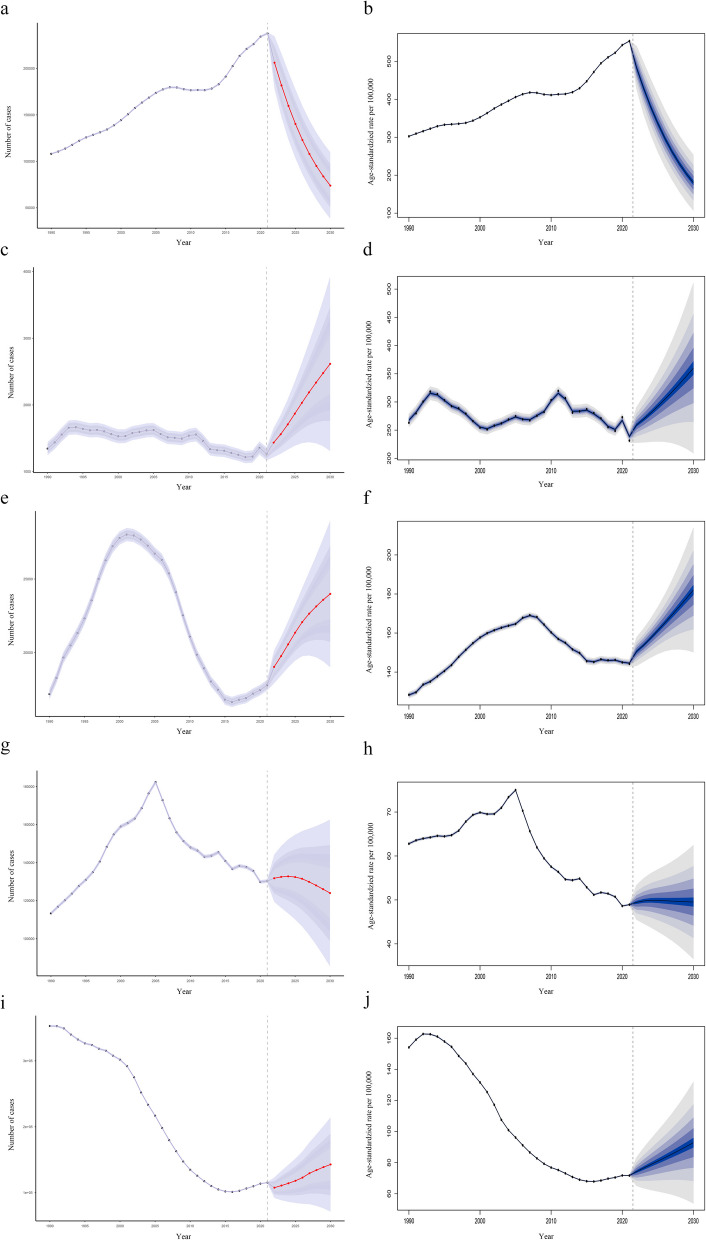
Results: From 1990 to 2021, there was a significant decrease in the burden of adolescent SUD (EAPC = -1.17, 95%CI: -1.29 to -1.05). However, tremendously increasing trends of rate of DALYs were observed in high SDI regions (EAPC = 1.21, 95%CI: 1.11 to 1.32). Substantially increasing trend of burden attributable to adolescent SUD was detected in the United States of America (EAPC = 1.78, 95%CI: 1.64 to 1.92). Mongolia exhibited significantly increasing trend of ASPR (EAPC = 1.33, 95%CI: 1.10 to 1.56) and ASIR (EAPC = 1.21, 95%CI: 1.02 to 1.39). By 2030, the age-standardized DALYs rate of global adolescent SUD will decline from 88.49 to 79.27 per 100,000 individuals.
Conclusions: The burden of adolescent SUD shows diversity among SDI regions and countries. It ought to set a series of strict policies for adolescent substance control and precise financial management in prevention programs.
Keywords: Adolescents; Age-period-cohort; Global burden of disease; Substance use disorders.
© 2025. The Author(s).
Conflict of interest statement
Declarations. Ethics approval and consent to participate: Not applicable. Competing interests: The authors declare no competing interests.
Figures


References
-
- 2023 National Survey on Drug Use and Health (NSDUH) releases. (n.d.). Retrieved 8 October 2024, from https://www.samhsa.gov/data/release/2023-national-survey-drug-use-and-he....
-
- Adolescent and young adult health. n.d. Retrieved from https://www.who.int/news-room/fact-sheets/detail/adolescents-health-risk....
-
- Adolescents Statistics—UNICEF DATA. (n.d.). Retrieved 15 October 2024, from https://data.unicef.org/topic/adolescents/overview/.
-
- Age-Period-Cohort Effect Analysis | Columbia Public Health. 2016,. Retrieved 8 October 2024, from Columbia University Mailman School of Public Health website: https://www.publichealth.columbia.edu/research/population-health-methods....
MeSH terms
LinkOut - more resources
Full Text Sources
Medical
