


Efficacy of high-dose vs. low-dose vitamin D₃ supplementation in children with chronic tic disorders: a randomized controlled trial
- PMID: 40091021
- PMCID: PMC11912708
- DOI: 10.1186/s12937-025-01112-w
Efficacy of high-dose vs. low-dose vitamin D₃ supplementation in children with chronic tic disorders: a randomized controlled trial
Abstract
Background: Vitamin D₃ has emerged as a potential therapeutic agent for alleviating tic symptoms in children with chronic tic disorders (CTDs). This study aims to evaluate the comparative efficacy of high-dose and low-dose vitamin D₃ supplementation on tic severity and serum 25-hydroxyvitamin D 25(OH)D levels in children with CTDs.
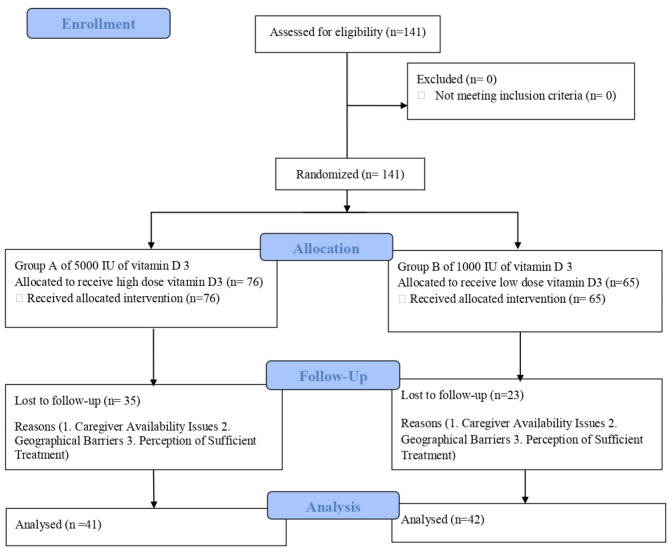
Methods: A randomized controlled trial was conducted with 83 children aged 4 to 15 years diagnosed with CTDs. Participants were randomly assigned to receive either high-dose vitamin D₃ (5,000 IU/day) or low-dose vitamin D₃ (1,000 IU/day) for three months. The primary outcome was tic severity, assessed using the Yale Global Tic Severity Scale (YGTSS), while secondary outcomes included changes in serum 25(OH)D and calcium levels. Tic severity and biochemical markers were measured at baseline and after the intervention to assess the effects of vitamin D₃ supplementation.
Results: Both the high-dose and low-dose groups showed significant improvements in tic severity and increases in serum 25(OH)D levels (𝑝 < 0.05). The high-dose group exhibited a significantly greater reduction in tic severity and a more substantial increase in serum 25(OH)D levels compared to the low-dose group (𝑝 < 0.05). No significant differences were observed in serum calcium levels between the group (𝑝 > 0.05). Furthermore, multivariate linear regression analysis revealed a significant negative association between increases in serum 25(OH)D levels and reductions in tic severity (𝑡 = -2.816, 𝑝 < 0.05).
Conclusion: High-dose vitamin D₃ supplementation is more effective than low-dose supplementation in reducing tic severity and increasing serum 25(OH)D levels in children with CTDs. These findings suggest that high-dose vitamin D₃ may serve as a valuable adjunctive therapy for managing CTDs.
Keywords: Chronic tic disorder; Serum 25(OH)D levels; Tic severity; Vitamin D supplementation.
© 2025. The Author(s).
Conflict of interest statement
Declarations. Ethics approval and consent to participate: This study was conducted in accordance with the Declaration of Helsinki guidelines and received approval from the Ethics Committee of the First Hospital of Jilin University, Changchun, China (Approval Number: 22K106-001). It was registered with the Chinese Clinical Trial Registry (Registration Number: ChiCTR2200056482, Registration Date: 2022-02-06). Written informed consent was obtained from the parents or guardians of all participants. Consent for publication: Not Applicable. Competing interests: The authors declare no competing interests.
References
-
- American Psychiatric Association. Diagnostic and statistical manual of mental disorders. Fifth edition. American Psychiatric Association. 2013.
-
- Knight T, Steeves T, Day L, Lowerison M, Jette N, Pringsheim T. Prevalence of tic disorders: a systematic review and meta-analysis. Pediatr Neurol. 2012;47:77–90. - PubMed
-
- Freeman-Ferguson M. Tourette’s syndrome: challenging misconceptions and improving Understanding. Nurs Child Young People. 2022;34:34–42. - PubMed
Publication types
MeSH terms
Substances
Grants and funding
LinkOut - more resources
Full Text Sources
Medical
