[Preprint]. 2025 Mar 3:2025.02.27.25323002.
doi: 10.1101/2025.02.27.25323002.

Overlap of high-risk individuals across family history, genetic & non-genetic breast cancer risk models: Analysis of 180,398 women from European & Asian ancestries

Peh Joo Ho  1   2 Christine Kim Yan Loo  1 Meng Huang Goh  1 Mustapha Abubakar  3 Thomas U Ahearn  3 Irene L Andrulis  4   5 Natalia N Antonenkova  6 Kristan J Aronson  7 Annelie Augustinsson  8 Sabine Behrens  9 Clara Bodelon  10 Natalia V Bogdanova  6   11   12 Manjeet K Bolla  13 Kristen Brantley  14 Hermann Brenner  15   16 Helen Byers  17 Nicola J Camp  18 Jose E Castelao  19 Melissa H Cessna  20 Jenny Chang-Claude  9   21 Stephen J Chanock  3 Georgia Chenevix-Trench  22 Ji-Yeob Choi  23   24   25 Sarah V Colonna  18 Kamila Czene  26 Mary B Daly  27 Francoise Derouane  28 Thilo Dörk  12 A Heather Eliassen  14   29   30 Christoph Engel  31   32 Mikael Eriksson  26 D Gareth Evans  17   33 Olivia Fletcher  34 Lin Fritschi  35 Manuela Gago-Dominguez  36 Jeanine M Genkinger  37   38 Willemina R R Geurts-Giele  39 Gord Glendon  4 Per Hall  26   40 Ute Hamann  41 Cecilia Y S Ho  42 Weang-Kee Ho  43   44 Maartje J Hooning  39   45 Reiner Hoppe  46   47 Anthony Howell  48 Keith Humphreys  26 ABCTB InvestigatorskConFab InvestigatorsSGBCC InvestigatorsMyBrCa InvestigatorsHidemi Ito  49   50 Motoki Iwasaki  51 Anna Jakubowska  52   53 Helena Jernström  8 Esther M John  54   55 Nichola Johnson  34 Daehee Kang  24   56 Sung-Won Kim  57 Cari M Kitahara  58 Yon-Dschun Ko  59 Peter Kraft  3 Ava Kwong  60   61   62 Diether Lambrechts  63   64 Susanna Larsson  65   66 Shuai Li  13   67   68 Annika Lindblom  69   70 Martha Linet  58 Jolanta Lissowska  71 Artitaya Lophatananon  72 Robert J MacInnis  67   73 Arto Mannermaa  74   75   76 Siranoush Manoukian  77 Sara Margolin  40   78 Keitaro Matsuo  50   79 Kyriaki Michailidou  13   80 Roger L Milne  67   68   73 Nur Aishah Mohd Taib  81 Kenneth Muir  72 Rachel A Murphy  82   83 William G Newman  17   33 Katie M O'Brien  84 Nadia Obi  85   86 Olufunmilayo I Olopade  87 Mihalis I Panayiotidis  88 Sue K Park  24   56   89 Tjoung-Won Park-Simon  12 Alpa V Patel  10 Paolo Peterlongo  90 Dijana Plaseska-Karanfilska  91 Katri Pylkäs  92   93 Muhammad U Rashid  41   94 Gad Rennert  95 Juan Rodriguez  26 Emmanouil Saloustros  96 Dale P Sandler  84 Elinor J Sawyer  97 Christopher G Scott  98 Shamim Shahi  82 Xiao-Ou Shu  99 Katerina Shulman  100 Jacques Simard  101 Melissa C Southey  68   73   102 Jennifer Stone  67   103 Jack A Taylor  84   104 Soo-Hwang Teo  44   81 Lauren R Teras  10 Mary Beth Terry  37 Diana Torres  41   105 Celine M Vachon  106 Maxime Van Houdt  28 Jelle Verhoeven  28 Clarice R Weinberg  107 Alicja Wolk  65 Taiki Yamaji  51 Cheng Har Yip  81   108 Wei Zheng  99 Mikael Hartman  2   109   110 Jingmei Li  1   110   111
Affiliations

Overlap of high-risk individuals across family history, genetic & non-genetic breast cancer risk models: Analysis of 180,398 women from European & Asian ancestries

Peh Joo Ho et al. medRxiv. .

Abstract

Background: Breast cancer is multifactorial. Focusing on limited risk factors may miss high-risk individuals.

Methods: We assessed the performance and overlap of various risk factors in identifying high-risk individuals for invasive breast cancer (BrCa) and ductal carcinoma in situ (DCIS) in 161,849 European-ancestry and 18,549 Asian-ancestry women. Discriminatory ability was evaluated using the area under the receiver operating characteristic curve (AUC). High-risk criteria included: 5-year absolute risk ≥1·66% by the Gail model [GAILbinary]; first-degree family history of breast cancer [FHbinary]; 5-year absolute risk ≥1·66% by a 313-variants polygenic risk score [PRSbinary]; and carriers of pathogenic variants in breast cancer predisposition genes [PTVbinary].

Findings: The 5-year absolute risk by PRS outperformed the Gail model in predicting BrCa (Europeansvs controls: AUCPRS=0·635 [0·632-0·638] vs AUCGail=0·492 [0·489-0·495]; Asiansvs controls: AUCPRS=0·564 [0·556-0·573] vs AUCGail=0·506 [0·497-0·514]). PRSbinary and GAILbinary identified more high-risk European than Asia individuals. High-risk proportions were higher among BrCa (16-26%) and DCIS (20-33%) compared to controls (9-15%) among young Europeans and all Asians. Fewer than 7% of BrCa, 10% of DCIS, and 3% of controls were classified as high-risk by multiple risk classifiers. Overlap between PRSbinary and PTVbinary was minimal (<0·65% Europeans, <0·15% Asians) compared to the proportion at high risk using PTVbinary alone (Europeans: 4·6%, Asians: 4·4%) and PRSbinary alone (Europeans: 13·9%, Asians: 8·5%). PRSbinary and FHbinary uniquely identified 5-6% and 9-11% of young BrCa, respectively.

Interpretation: The incomplete overlap between high-risk individuals identified by PRSbinary, GAILbinary, FHbinary, and PTVbinary highlights the need for a comprehensive approach to breast cancer risk prediction.

Keywords: BRCA1; BRCA2; Breast cancer; Ductal Carcinoma In Situ (DCIS); Gail model; Polygenic risk score (PRS); Risk stratification; risk-based screening.


Conflict of interest statement

Conflict of interest The authors declare no potential conflicts of interest.

Figures
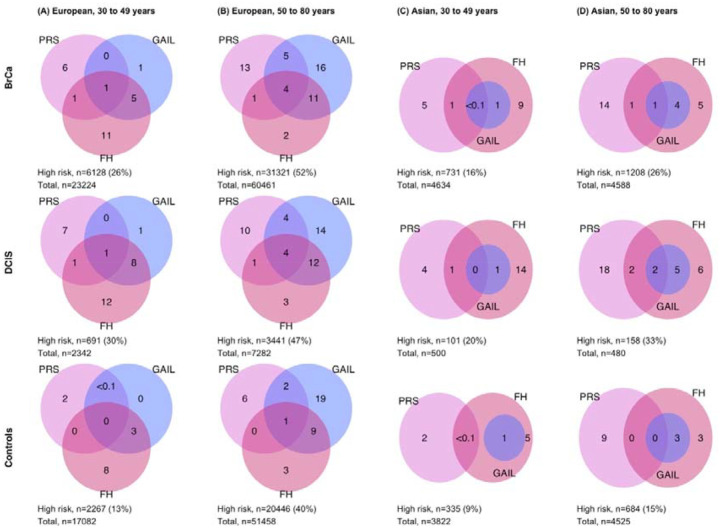
Figure 1·
Figure 1·
Venn diagram depicting the overlaps between individuals identified as high risk by the three criteria. Breast cancer polygenic risk score (PRS, 5-year absolute risk using polygenic risk score ≥1·66%), the Gail model (GAIL, 5-year absolute risk using the Gail model ≥1·66%), and family history (FH, having at least one first-degree family history of breast cancer). European: women of European ancestry; Asian: women of Asian ancestry.
Figure 2·
Figure 2·
The proportion of individuals identified as at high risk by the breast cancer polygenic risk score (PRS) and the Gail model (GAIL), by country and age. The proportion of individuals identified as high risk by both criteria is indicated in grey. PRS: 5-year absolute risk using polygenic risk score ≥1·66%. GAIL: 5-year absolute risk using the Gail model ≥1·66%. Numbers adjacent to the bars represent the number of high-risk individuals identified by respective risk tools. European: women of European ancestry; Asian: women of Asian ancestry.
Figure 3·
Figure 3·
Discriminatory ability of risk factor combinations in the Gail model. The five-year absolute risk was calculated using the R package “BCRA” and used to predict the invasive breast cancer case-control status of the individuals. Dots represent risk factors included in the model, and crosses indicate the model with all risk factors with the addition of atypical hyperplasia. European: women of European ancestry; Asian: women of Asian ancestry.

References

    1. Sedeta E. T., Jobre B. & Avezbakiyev B. Breast cancer: Global patterns of incidence, mortality, and trends. Journal of Clinical Oncology 41, 10528–10528, doi:10.1200/JCO.2023.41.16_suppl.10528 (2023). - DOI
    1. Ginsburg O., Yip C. H., Brooks A., Cabanes A., Caleffi M., Dunstan Yataco J. A. et al. Breast cancer early detection: A phased approach to implementation. Cancer 126 Suppl 10, 2379–2393, doi:10.1002/cncr.32887 (2020). - DOI - PMC - PubMed
    1. Lim Y. X., Lim Z. L., Ho P. J. & Li J. Breast Cancer in Asia: Incidence, Mortality, Early Detection, Mammography Programs, and Risk-Based Screening Initiatives. Cancers (Basel) 14, doi:10.3390/cancers14174218 (2022). - DOI - PMC - PubMed
    1. Lim Z. L., Ho P. J., Khng A. J., Yeoh Y. S., Ong A. T. W., Tan B. K. T. et al. Mammography screening is associated with more favorable breast cancer tumor characteristics and better overall survival: case-only analysis of 3739 Asian breast cancer patients. BMC Med 20, 239, doi:10.1186/s12916-022-02440-y (2022). - DOI - PMC - PubMed
    1. Evans A. & Whelehan P. Breast screening policy: are we heading in the right direction? Clin Radiol 66, 915–919, doi:10.1016/j.crad.2011.03.024 (2011). - DOI - PubMed

Publication types

LinkOut - more resources