


Impact of the COVID-19 Pandemic on the Treatment of Head and Neck Cancers
- PMID: 40094865
- PMCID: PMC11899811
- DOI: 10.3390/jcm14051424
Impact of the COVID-19 Pandemic on the Treatment of Head and Neck Cancers
Abstract
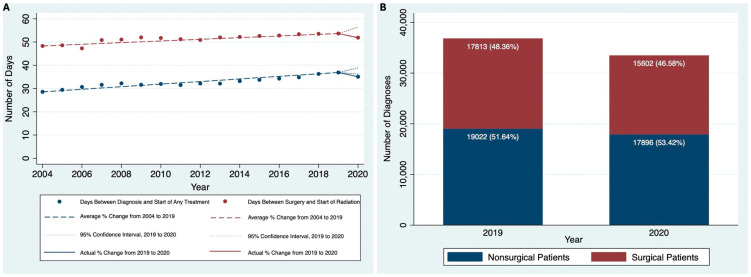
Background/Objectives: The COVID-19 pandemic led to unprecedented disruptions to cancer care, including the care of head and neck cancer. Given the necessity of timely treatment for mucosal cancers, it is important to understand how the pandemic affected the diagnosis, presentation, and treatment of mucosal head and neck cancer. Methods: The National Cancer Database was queried for patients with primary head and neck mucosal cancer. The number of annual diagnoses and the number of days between diagnosis and the start and end of any treatment were tracked over time from 2004 to 2020. Chi-square tests were used to compare differences in patient clinical and demographic characteristics in 2019 and 2020 to provide the most direct comparison. Multivariable linear regression and logic regression analyses were also used to compare three treatment quality measures between 2019 and 2020: number of days between diagnosis and start of treatment, number of days between surgery and start of postoperative radiation, and number of days between surgery and end of radiation. Results: The number of mucosal cancer diagnoses decreased (9.1%) during the early stages of the pandemic, with a larger decrease (12.4%) among patients receiving surgery. On multivariable analysis comparing 2020 to 2019, time to treatment was shorter (2.3 days; 95% CI, 1.69 to 2.85 days), and time from surgery to start of postoperative radiation was less likely to be delayed (OR, 0.91 of radiation greater than 42 days from surgery; 95% CI, 0.85 to 0.97). However, patients who were black, female, older, or uninsured were more likely to experience treatment delays. Conclusions: Overall, there were no treatment delays for patients with surgical head cancer and patients with neck cancer during the COVID-19 pandemic. However, vulnerable groups, such as patients who were black, female, older, and uninsured, were at higher risk of experiencing treatment delays.
Keywords: COVID-19; disparities; otolaryngology; outcomes; pandemic; squamous cell carcinoma of head and neck.
Conflict of interest statement
The authors have no conflicts of interest to declare.
Figures
References
-
- Hartnett K.P., Kite-Powell A., DeVies J., Coletta M.A., Boehmer T.K., Adjemian J., Gundlapalli A.V. National Syndromic Surveillance Program Community of Practice Impact of the COVID-19 Pandemic on Emergency Department Visits—United States, 1 January 2019–30 May 2020. MMWR Morb. Mortal. Wkly. Rep. 2020;69:699–704. doi: 10.15585/mmwr.mm6923e1. - DOI - PMC - PubMed
LinkOut - more resources
Full Text Sources
