


Perioperative teriparatide for preventing proximal junctional kyphosis and failure in patients with osteoporosis after adult thoracolumbar spinal deformity surgery: a prospective randomized controlled trial
- PMID: 40100350
- PMCID: PMC12089185
- DOI: 10.1007/s00198-025-07449-6
Perioperative teriparatide for preventing proximal junctional kyphosis and failure in patients with osteoporosis after adult thoracolumbar spinal deformity surgery: a prospective randomized controlled trial
Abstract
We conducted a randomized controlled trial to assess the preventive effect of perioperative teriparatide on proximal junctional kyphosis and proximal junctional failure (PJF) in osteoporosis patients undergoing adult spinal deformity surgery. Teriparatide (experimental group) and denosumab (active control) were administered. The teriparatide group demonstrated significantly better PJF incidence and VAS for back pain, EQ-5D than the control group.
Purpose: This randomized controlled trial is aimed at investigating and comparing the effects of perioperative teriparatide and denosumab as an active control for preventing proximal junctional kyphosis (PJK) and proximal junctional failure (PJF) in patients with osteoporosis after adult spinal deformity (ASD) surgery.
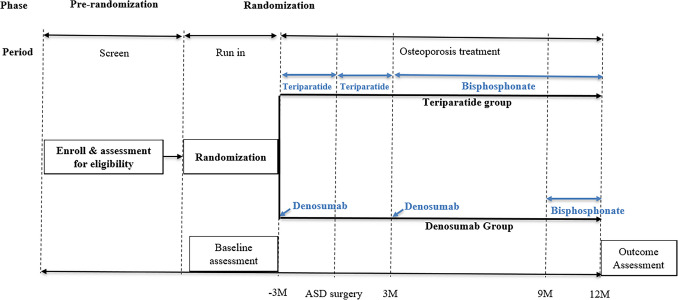
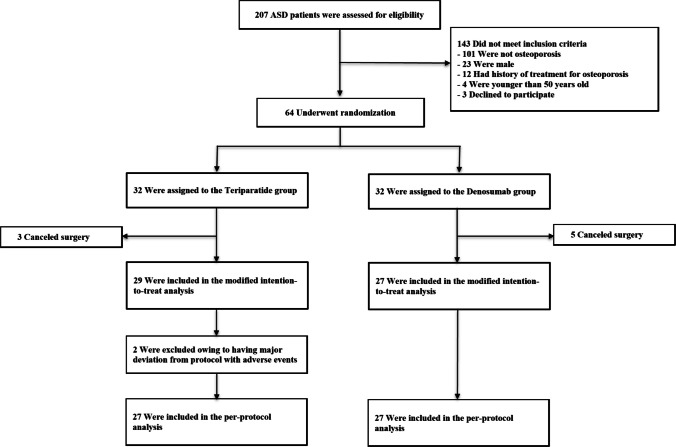
Methods: A total of 64 patients with osteoporosis, who planned to undergo ASD surgery, were randomly assigned to the teriparatide and denosumab groups. Treatment with teriparatide or denosumab in both groups was conducted from 3 months preoperatively to 3 months postoperatively based on the standard regimen for each medication. The primary outcome was PJK and PJF incidence within 1 year after ASD surgery. The secondary outcomes were patient-reported outcomes (PROs), bone mineral density (BMD), and dual-energy X-ray absorptiometry (DEXA) t-score of the hip.
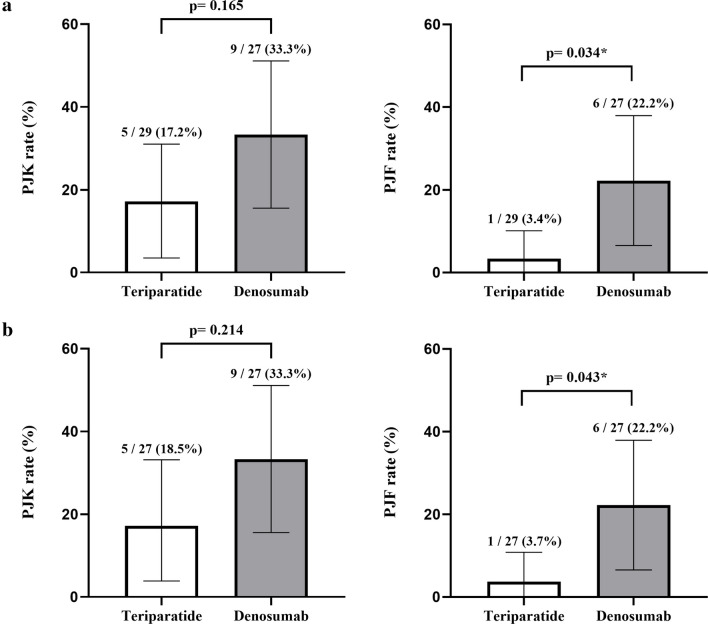
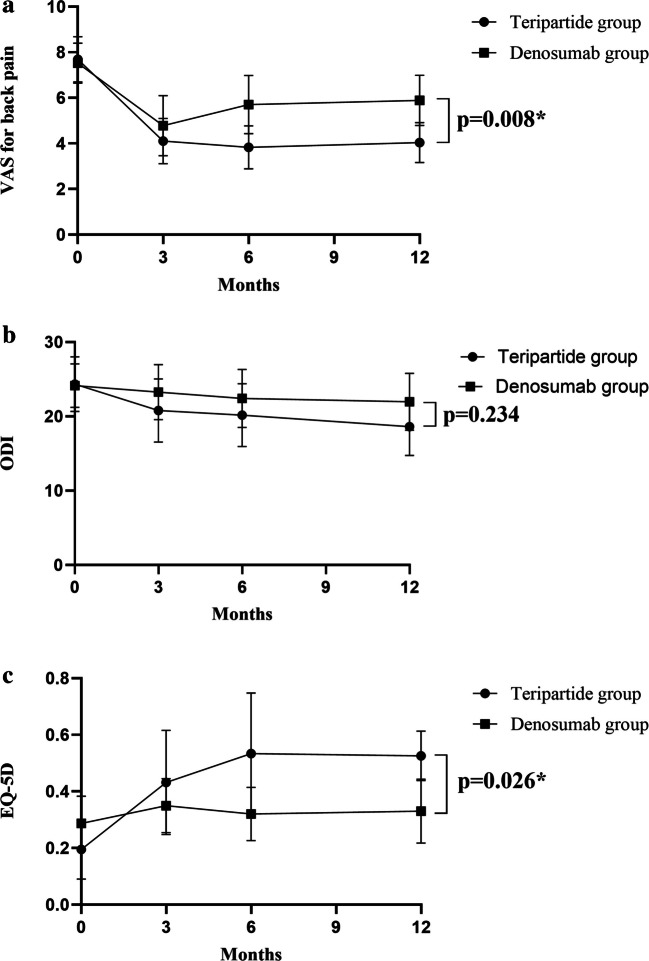
Results: The teriparatide group showed a lower incidence of PJK than the denosumab group (17.2% vs. 33.3%), although this difference was not statistically significant (p = 0.165 in a modified intention-to-treat (mITT) analysis). Furthermore, the teriparatide group exhibited a significantly lower incidence of PJF than the denosumab group (3.4% vs. 22.2%; p = 0.034 in the mITT analysis). As for the secondary outcomes, no significant differences in BMD of the hip were observed between the two groups at the 1-year follow-up. The teriparatide group showed significantly improved postoperative VAS for back pain and EQ-5D score.
Conclusions: Perioperative teriparatide treatment of patients with osteoporosis after ASD surgery effectively reduced PJF incidence and postoperative back pain.
Keywords: Adult spinal deformity; Osteoporosis; PJF; PJK; Teriparatide.
© 2025. The Author(s).
Conflict of interest statement
Declarations. Competing interest: Jin-Ho Park, Ohsang Kwon, Jae Heouk Choi, Jin S. Yeom, Sang-Min Park, Cheol Hyun Kim, and Ho-Joong Kim declare that they have no conflict of interest.
Figures
References
-
- Bridwell KH, Lenke LG, Cho SK, Pahys JM, Zebala LP, Dorward IG, Cho W, Baldus C, Hill BW, Kang MM (2013) Proximal junctional kyphosis in primary adult deformity surgery: evaluation of 20 degrees as a critical angle. Neurosurgery 72:899–906 - PubMed
-
- Park SJ, Lee CS, Chung SS, Lee JY, Kang SS, Park SH (2017) Different risk factors of proximal junctional kyphosis and proximal junctional failure following long instrumented fusion to the sacrum for adult spinal deformity: survivorship analysis of 160 patients. Neurosurgery 80:279–286 - PubMed
-
- Cho SK, Shin JI, Kim YJ (2014) Proximal junctional kyphosis following adult spinal deformity surgery. Eur Spine J 23:2726–2736 - PubMed
-
- Glattes RC, Bridwell KH, Lenke LG, Kim YJ, Rinella A, Edwards C, 2nd (2005) Proximal junctional kyphosis in adult spinal deformity following long instrumented posterior spinal fusion: incidence, outcomes, and risk factor analysis. Spine (Phila Pa 1976) 30:1643–1649 - PubMed
-
- Hart RA, McCarthy I, Ames CP, Shaffrey CI, Hamilton DK, Hostin R (2013) Proximal junctional kyphosis and proximal junctional failure. Neurosurg Clin N Am 24:213–218 - PubMed
Publication types
MeSH terms
Substances
LinkOut - more resources
Full Text Sources
Medical
Research Materials
Miscellaneous
