


[Effectiveness of guide plate with mortise-tenon joint structure combined with off-axis fixation in treatment of Pauwels type Ⅲ femoral neck fractures]
- PMID: 40101902
- PMCID: PMC11919516
- DOI: 10.7507/1002-1892.202411083
[Effectiveness of guide plate with mortise-tenon joint structure combined with off-axis fixation in treatment of Pauwels type Ⅲ femoral neck fractures]
Abstract
Objective: To investigate the effectiveness of using 3 hollow compression screws combined with 1 screw off-axis fixation under the guidance of three-dimensional (3D) printed guide plate with mortise-tenon joint structure (mortise-tenon joint plate) for the treatment of Pauwels type Ⅲ femoral neck fractures.
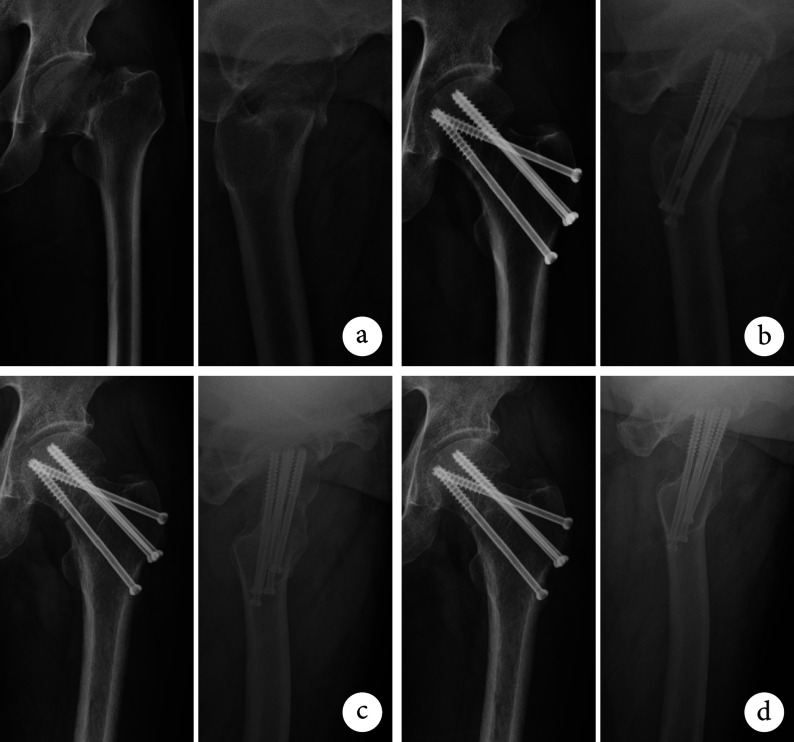
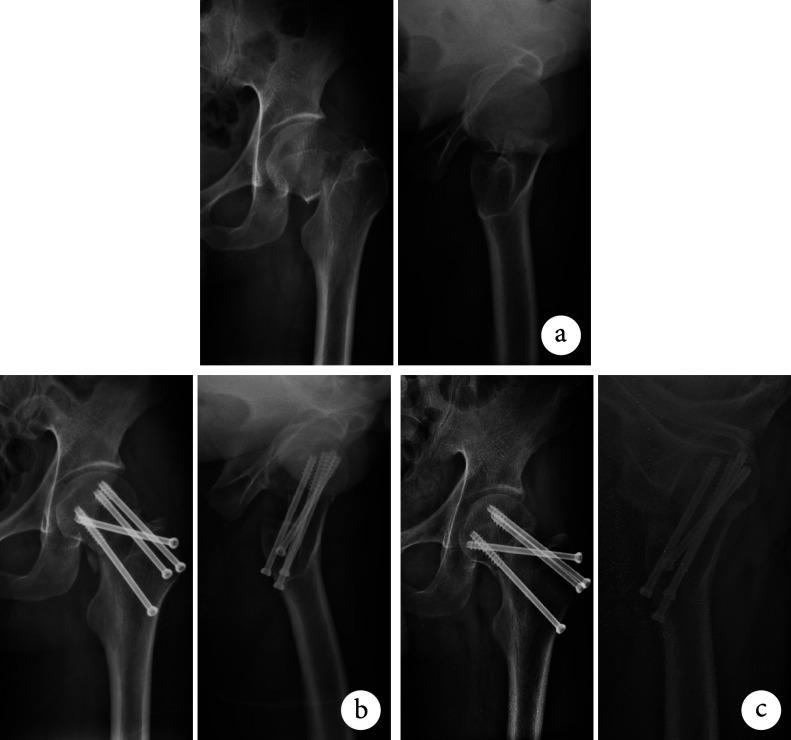
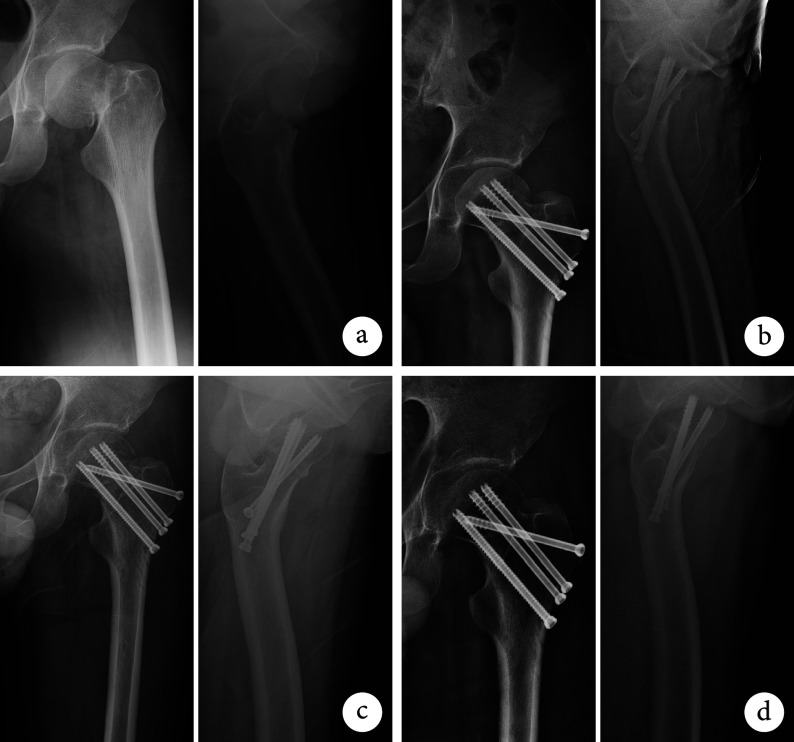
Methods: A clinical data of 78 patients with Pauwels type Ⅲ femoral neck fractures, who were admitted between August 2022 and August 2023 and met the selection criteria, was retrospectively analyzed. The operations were assisted with mortise-tenon joint plates in 26 cases (mortise-tenon joint plate group) and traditional guide plates in 28 cases (traditional plate group), and without guide plates in 24 cases (control group). There was no significant difference in the baseline data of gender, age, body mass index, cause of injury, and fracture side between groups ( P>0.05). The operation time, intraoperative blood loss, frequency of intraoperative fluoroscopy, incision length, incidence of postoperative deep vein thrombosis of lower extremity, pain visual analogue scale (VAS) score at 1 week after operation, and Harris score of hip joint at 3 months after operation were recorded and compared. X-ray re-examination was taken to check the quality of fracture reduction, fracture healing, and the shortening length of the femoral neck at 3 months after operation, and the incidences of internal fixation failure and osteonecrosis of the femoral head during operation.
Results: Compared with the control group, the operation time, intraoperative blood loss, and frequency of intraoperative fluoroscopy reduced in the two plate groups, and the quality of fracture reduction was better, but the incision was longer, and the differences were significant ( P<0.05). The operation time and intraoperative blood loss were significantly higher in the traditional plate group than in the mortise-tenon joint plate group ( P<0.05), the incision was significantly longer ( P<0.05); and the difference in fracture reduction quality and the frequency of intraoperative fluoroscopy was not significant between two plate groups ( P>0.05). There was 1 case of deep vein thrombosis of lower extremity in the traditional plate group and 1 case in the control group, while there was no thrombosis in the mortise-tenon joint plate group. There was no significant difference in the incidence between groups ( P>0.05). All patients were followed up 12-15 months (mean, 13 months). There was no significant difference in VAS score at 1 week and Harris score at 3 months between groups ( P>0.05). Compared with the control group, the fracture healing time and the length of femoral neck shortening at 3 months after operation were significantly shorter in the two plate groups ( P<0.05). There was no significant difference between the two plate groups ( P>0.05). There was no significant difference in the incidences of non-union fractures, osteonecrosis of the femoral head, or internal fixation failure between groups ( P>0.05).
Conclusion: For Pauwels type Ⅲ femoral neck fractures, the use of 3D printed guide plate assisted reduction and fixation can shorten the fracture healing time, reduce the incidence of postoperative complications, and be more conducive to the early functional exercise of the affected limb. Compared with the traditional guide plate, the mortise-tenon joint plate can reduce the intraoperative bleeding and shorten the operation time.
目的: 探讨3D打印榫卯结构导板引导下采用3枚空心加压螺钉结合1枚螺钉偏轴固定治疗Pauwels Ⅲ型股骨颈骨折的疗效。.
方法: 回顾性分析2022年8月—2023年8月收治且符合选择标准的78例Pauwels Ⅲ型股骨颈骨折患者临床资料,均采用3枚空心加压螺钉结合1枚螺钉偏轴固定治疗。术中26例采用榫卯结构导板辅助固定(榫卯结构导板组),28例采用传统导板(传统导板组),24例不使用导板(对照组)。3组患者性别、年龄、身体质量指数、致伤原因及骨折侧别等基线资料比较,差异均无统计学意义( P>0.05)。记录并比较3组手术时间、术中出血量、术中透视次数、手术切口长度、术后下肢深静脉血栓形成发生情况,术后1周疼痛视觉模拟评分(VAS)、术后 3 个月髋关节Harris 评分;X 线片复查骨折复位质量、骨折愈合,以及术后3个月股骨颈短缩长度、随访期间内固定失效及股骨头坏死发生情况。.
结果: 与对照组相比,两导板组手术时间、术中出血量、透视次数均减少,骨折复位质量更好,但手术切口更长,差异均有统计学意义( P<0.05)。传统导板组手术时间及术中出血量均高于榫卯结构导板组,手术切口亦更长,差异均有统计学意义( P<0.05);骨折复位质量及术中透视次数两组间差异无统计学意义 (P>0.05)。传统导板组及对照组各1例下肢深静脉血栓形成,榫卯结构导板组无血栓形成;3组发生率差异无统计学意义( P>0.05)。3组患者均获随访,随访时间12~15个月,平均13个月。3组术后1周VAS评分、术后3个月Harris评分差异均无统计学意义( P>0.05)。影像学复查示,与对照组相比,两导板组骨折愈合时间短,术后3个月股骨颈短缩长度更短,差异均有统计学意义( P<0.05);上述指标两导板组间差异均无统计学意义( P>0.05)。随访期间3组骨折不愈合、股骨头坏死及内固定失效发生率差异均无统计学意义( P>0.05)。.
结论: 对于 Pauwels Ⅲ型股骨颈骨折,采用3D打印导板辅助手术可缩短骨折愈合时间、降低术后并发症发生率,更有利于患肢早期功能锻炼;且与传统导板相比,榫卯结构导板能减少术中出血、缩短手术时间。.
Keywords: Mortise-tenon joint plate; femoral neck fracture; internal fixation; three-dimensional printing technology.
Conflict of interest statement
利益冲突 在课题研究和文章撰写过程中不存在利益冲突;经费支持没有影响文章观点和对研究数据客观结果的统计分析及其报道
Figures

Similar articles
-
[Comparison of effectiveness of three surgical methods in treatment of Pauwels type Ⅲ femoral neck fracture in young and middle-aged patients].Zhongguo Xiu Fu Chong Jian Wai Ke Za Zhi. 2024 Apr 15;38(4):412-421. doi: 10.7507/1002-1892.202401110. Zhongguo Xiu Fu Chong Jian Wai Ke Za Zhi. 2024. PMID: 38632059 Free PMC article. Chinese.
-
[Effectiveness analysis of biplanar vertical fixation and inverted triangle fixation with hollow screw for Pauwels type Ⅲ femoral neck fracture in young and middle-aged patients].Zhongguo Xiu Fu Chong Jian Wai Ke Za Zhi. 2024 Aug 15;38(8):961-967. doi: 10.7507/1002-1892.202404070. Zhongguo Xiu Fu Chong Jian Wai Ke Za Zhi. 2024. PMID: 39175318 Free PMC article. Chinese.
-
[Short-term effectiveness of robot-guided femoral neck system combined with cannulated compression screw fixation in treatment of femoral neck fracture in young and middle-aged patients].Zhongguo Xiu Fu Chong Jian Wai Ke Za Zhi. 2024 Oct 15;38(10):1229-1235. doi: 10.7507/1002-1892.202406075. Zhongguo Xiu Fu Chong Jian Wai Ke Za Zhi. 2024. PMID: 39433497 Free PMC article. Chinese.
-
Medial femoral plate with cannulated screw for Pauwels type III femoral neck fracture: A meta-analysis.J Back Musculoskelet Rehabil. 2021;34(2):169-177. doi: 10.3233/BMR-200183. J Back Musculoskelet Rehabil. 2021. PMID: 33164925 Review.
-
Medial buttress plate use in neck of femur fracture fixations: A systematic review.Injury. 2025 Feb;56(2):112160. doi: 10.1016/j.injury.2025.112160. Epub 2025 Jan 12. Injury. 2025. PMID: 39827529
References
-
- 霍青云, 赵玉玲, 陈志新, 等 平乐郭氏正骨手法配合钢针撬拨复位治疗MasonⅡ型桡骨头骨折临床观察. 山东中医杂志. 2024;43(1):47–52.
Publication types
MeSH terms
LinkOut - more resources
Full Text Sources
Medical
Miscellaneous