. 2025 Feb 27;53(5):gkaf182.
doi: 10.1093/nar/gkaf182.

VirBR counter-silences HppX3 to promote conjugation of blaNDM-IncX3 plasmids

Affiliations

VirBR counter-silences HppX3 to promote conjugation of blaNDM-IncX3 plasmids

Yuan Gao et al. Nucleic Acids Res. .

Abstract

New Delhi metallo-β-lactamases (NDM), encoded by the blaNDM gene, mediate carbapenem resistance, posing serious threats to public health due to their global presence across diverse hosts and environments. The blaNDM is prominently carried by the IncX3 plasmid, which encodes a Type IV secretion system (T4SS) responsible for plasmid conjugation. This T4SS has been shown to be phenotypically silenced by a plasmid-borne H-NS family protein; however, the underlying mechanisms of both silencing and silencing relief remain unclear. Herein, we identified HppX3, an H-NS family protein encoded by the IncX3 plasmid, as a transcription repressor. HppX3 binds to the T4SS promoter (PactX), downregulates T4SS expression, thereby inhibits plasmid conjugation. RNA-seq analysis revealed that T4SS genes are co-regulated by HppX3 and VirBR, a transcription activator encoded by the same plasmid. Mechanistically, VirBR acts as a counter-silencer by displacing HppX3 from PactX, restoring T4SS expression and promoting plasmid conjugation. A similar counter-silencing mechanism was identified in the T4SSs of IncX1 and IncX2 plasmids. These findings provide new insights into the regulatory mechanisms controlling T4SS expression on multiple IncX plasmids, including the IncX3, explaining the persistence and widespread of blaNDM-IncX3 plasmid, and highlight potential strategies to combat the spread of NDM-positive Enterobacterales by targeting plasmid-encoded regulators.


Conflict of interest statement

None declared.

Figures

Graphical Abstract
Graphical Abstract
Figure 1.
Figure 1.
HppX3 binds to bacterial DNA and regulates plasmid genes. (A) Comparison of binding peaks of HppX3, H-NS and StpA across BW25113 chromosome. Three biological replicates of HppX3 are presented. (B) Binding peaks of three biological replicates of HppX3 across p3R-4 plasmid. The guanine-cytosine (GC) content and annotation of the plasmid sequence are presented below. ChIP-seq profiles, GC content, and sequence annotation were visualized with IGV v2.17.4, Proksee (https://proksee.ca/, window size = 10 000 bp for BW25113 chromosome, window size = 500 bp for p3R-4), and Easyfig v2.2.5, respectively. (C) Relative messenger RNA (mRNA) abundance of the randomly selected genes nearby the HppX3 binding peaks on BW25113 chromosome and p3R-4 plasmid, in BW25113/p3R-4 and its derivates. * for P< .05, ** for P< .01, *** for P< .001, compared with “BW25113/p3R-4”, based on one way analysis of variance (ANOVA) with Dunnett’s multiple comparison test.
Figure 2.
Figure 2.
HppX3 repress the expression of T4SS, thereby repressing the plasmid conjugation and plasmid’s fitness cost. (A) Volcano plot of transcripts for all genes in 3RΔhppX3 versus 3R. The differentially expressed genes are represented by different dots. (B) Conjugation frequencies of IncX3 plasmid p3R-4 in strains with hppX3 knocked out or complemented by pACYC184 plasmid. **** for P< .0001, ns for not significant, compared with “BW25113/p3R-4”, based on one way ANOVA with Dunnett’s multiple comparison test. (C) EMSA reactions containing 1 nM biotin-labeled PactX DNA and His6-HppX3 protein (0.4, 0.8, 1.6, 3.2 μg). Lane denotes “−” contained no protein. (D) Fluorescence intensity of eGFP under the control of PactX. The PactX-eGFP is carried by pUC19 vector transformed into E. coli DH5α along with pACYC184 carrying hppX3 and hppX3ΔNTD (the empty vector was used as a negative control). * for P< .05, ns for not significant, compared with “Vector”, based on one way ANOVA with Dunnett’s multiple comparison test. (E) Relative mRNA abundance of actX, virB6, and virD4 in BW25113/p3R-4 (wild type-wild type, WT–WT), BW25113/p3R-4ΔhppX3 (WT-ΔhppX3), BW25113Δh-ns/p3R-4 (Δh-ns-WT), and BW25113Δh-ns/p3R-4ΔhppX3h-nshppX3). **** for P< .0001, ns for not significant, compared with “WT–WT”, based on one way ANOVA with Dunnett’s multiple comparison test. (F) Growth curve of BW25113/p3R-4 and BW25113/p3R-4ΔhppX3. **** for P< .0001 compared with “BW25113/p3R-4″, based on Student’s t-test for the OD600 values at 24 h. (G) In vitro competition between BW25113/p3R-4ΔhppX3hppX3) and BW25113/p3R-4 (WT) in LB broth. * for P< .05, ns for not significant, compared with “1 day”, based on one way ANOVA with Dunnett’s multiple comparison test.
Figure 3.
Figure 3.
HppX3 and VirBR co-regulate the T4SS. (A) Volcano plot of transcripts for all genes in 3RΔvirBR/pUC19-virBR versus 3R. The differentially expressed genes are represented by different dots. (B) Fold changes of conjugation-associated genes in 3RΔhppX3 and 3RΔvirBR/pUC19-virBR, compared with 3R. (C) Genes regulated by HppX3 and VirBR according to the RNA-seq data.
Figure 4.
Figure 4.
VirBR antagonizes HppX3 at PactX. (A) In vivo binding of HppX3 to the actX promoter and ompA coding region determined by ChIP-qPCR. The ChIP was conducted in a BW25113/p3R-4 strain that expressing HppX3-FLAG, harboring pBAD-virBR or pBAD-RFP (negative control). The ChIP DNA was enriched using anti-FLAG beads and quantified by qPCR. * for P< .05, ns for not significant, based on Student’s t-test. (B) Fluorescence intensity of eGFP under the control of PactX or its derivate in the presence of HppX3 with or without VirBR. The actX promoter (300-bp-fragment upstream of actX start codon) was fused with eGFP reporter gene on the pUC19 vector and hppX3 (or with virBR) was cloned into pACYC184 vector. Left panel: Schematic representation of reporter conducts tagged with eGFP, the putative VirBR binding site is marked by solid or hollow blocks. Right panel: Fluorescence intensity ratio normalized to “HppX3” group. * for P< .05, ns for not significant, based on Student’s t-test. (C) Fluorescence intensity of eGFP under the control of PactX in the presence of HppX3 with or without VirBR or VirBRM (R20A, R42A, and R67A). **** for P< .0001, ns for not significant, compared with “HppX3”, based on one way ANOVA with Dunnett’s multiple comparison test. (D) EMSA reactions containing 1 nM biotin-labeled PactX DNA, His6-HppX3 protein (0.8 μg) and His6-VirBR protein (0.05, 0.1, 0.2, 0.4, 0.6, 0.8 μg). Lane denotes “−” contained no protein. (E) Relative mRNA abundance of actX, virB6, and virD4 in BW25113/p3R-4ΔhppX3hppX3) and its derivates. Different letters indicate significant differences between strains, based on one way ANOVA with Tukey’s multiple comparison test. (F) Conjugation frequency of p3R-4ΔhppX3 plasmid in BW25113 and strains complemented with hppX3, virBR, or virBRM. *** for P< .001, ns for not significant, based on one way ANOVA with Tukey’s multiple comparison test.
Figure 5.
Figure 5.
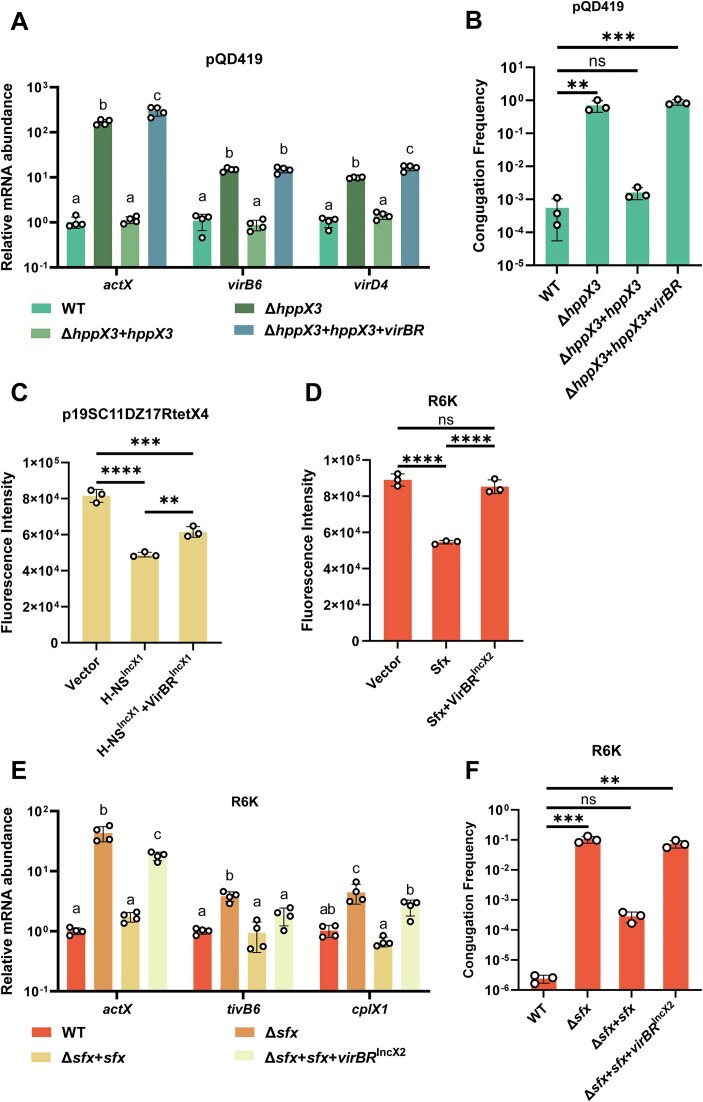
The regulatory interplay between plasmid-borne H-NS family protein and VirBR-like protein is conserved in IncX1, IncX2, and IncX3 plasmids. (A) Relative mRNA abundance of actX, virB6, and virD4 in BW25113/pQD419 (WT) and its derivates. Different letters indicate significant differences between strains, based on one way ANOVA with Tukey’s multiple comparison test. (B) Conjugation frequencies of IncX3 plasmid pQD419 in BW25113 (WT) and its derivates. ** for P< .01, *** for P< .001, ns for not significant, compared with “WT”, based on one way ANOVA with Dunnett’s multiple comparison test. (C) Fluorescence intensity of eGFP under the control of IncX1 T4SS promoter in the presence of H-NSIncX1 or H-NSIncX1 and VirBRIncX1. ** for P< .01, *** for P< .001, **** for P< .0001, based on one way ANOVA with Tukey’s multiple comparison test. (D) Fluorescence intensity of eGFP under the control of IncX2 T4SS promoter in the presence of Sfx or Sfx and VirBRIncX2. **** for P< .0001, ns for not significant, based on one way ANOVA with Tukey’s multiple comparison test. (E) Relative mRNA abundance of actX, tivB6, and cplX1 in BW25113/R6K (WT) and its derivates. Different letters indicate significant differences between strains, based on one way ANOVA with Tukey’s multiple comparison test. (F) Conjugation frequencies of IncX2 plasmid R6K in BW25113 (WT) and its derivates. ** for P< .01, *** for P< .001, ns for not significant, compared with “WT”, based on one way ANOVA with Dunnett’s multiple comparison test.

References

    1. Bonomo RA, Burd EM, Conly J et al. . Carbapenemase-producing organisms: a global scourge. Phil Trans R Soc B. 2018; 66:1135–48.10.1093/cid/cix893. - DOI - PMC - PubMed
    1. Rahman MK, Rodriguez-Mori H, Loneragan G et al. . One health distribution of beta-lactamases in enterobacterales in the United States: a systematic review and meta-analysis. Int J Antimicrob Agents. 2024; 65:107422.10.1016/j.ijantimicag.2024.107422. - DOI - PubMed
    1. Fu B, Xu J, Yin D et al. . Transmission of blaNDM in Enterobacteriaceae among animals, food and human. Emerg Microbes Infect. 2024; 13:2337678.10.1080/22221751.2024.2337678. - DOI - PMC - PubMed
    1. Yong D, Toleman MA, Giske CG et al. . Characterization of a new metallo-beta-lactamase gene, blaNDM-1, and a novel erythromycin esterase gene carried on a unique genetic structure in Klebsiella pneumoniae sequence type 14 from India. Antimicrob Agents Chemother. 2009; 53:5046–54.10.1128/AAC.00774-09. - DOI - PMC - PubMed
    1. Ma J, Song X, Li M et al. . Global spread of carbapenem-resistant Enterobacteriaceae: epidemiological features, resistance mechanisms, detection and therapy. Microbiol Res. 2023; 266:127249.10.1016/j.micres.2022.127249. - DOI - PubMed

MeSH terms

LinkOut - more resources