Preventing Unintended Pregnancies and HIV Through Self-Care Interventions in East and Southern Africa: Findings From a Structured Review
- PMID: 40103694
- PMCID: PMC11913615
- DOI: 10.3389/phrs.2025.1607481
Preventing Unintended Pregnancies and HIV Through Self-Care Interventions in East and Southern Africa: Findings From a Structured Review
Abstract
Objective: To identify promising interventions targeting young people in East and Southern Africa through self-care practices, with a focus on prevention of unintended pregnancies and HIV and develop four evidence-based self-care models.
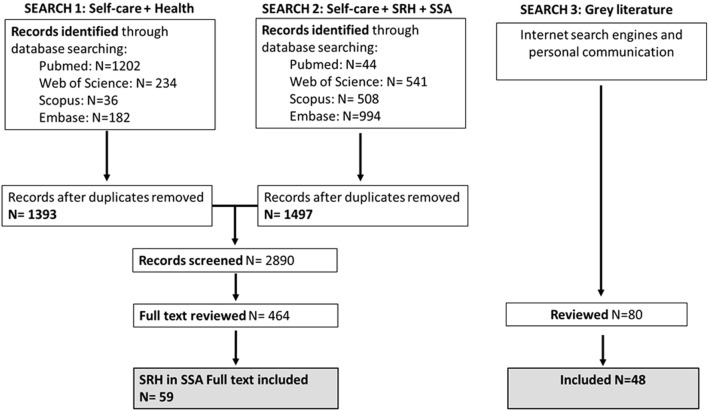
Methods: A structured literature review was conducted followed by a consultation with key stakeholders and youth networks from Malawi, South Africa, Zambia and Zimbabwe. Of the 2,890 published articles identified, 464 were fully reviewed and 59 were included in the final analysis along with 48 pieces of grey literature. A total of 31 youths participated in the consultation sessions.
Results: Self-care interventions with high levels of feasibility, acceptability, and scalability included HIV self-testing, self-management of contraceptives, and self-awareness for improved and safer sex behaviours and sexual health. Key features of these interventions included the use of non-clinical environments, regular follow ups to reinforce practice, use of digital solutions, linkage to in person care, and participatory approaches involving young people from ideation to implementation.
Conclusion: Self-care models that promote distribution, access, support through multiple mechanisms in non-clinical environments are more acceptable and more effective in reaching young people.
Keywords: HIV; adolescents; contraceptives; family planning; self-care.
Copyright © 2025 Castro Lopes, Martin Hilber, Secula, Nyoni, Shankar Tewari, Bakaroudis and Tallarico.
Conflict of interest statement
Authors JS and MB were employed by the organization UNFPA East and Southern Africa Regional Office. Author RT was employed by the organization UNFPA Rwanda Country Office. The remaining authors declare that they do not have any conflicts of interest.
Figures
Similar articles
-
Digital Intervention to Improve Health Services for Young People in Zimbabwe: Process Evaluation of 'Zvatinoda!' (What We Want) Using the RE-AIM (Reach, Effectiveness, Adoption, Implementation, and Maintenance) Framework.JMIR Form Res. 2024 Sep 24;8:e53034. doi: 10.2196/53034. JMIR Form Res. 2024. PMID: 39316784 Free PMC article.
-
Exploring key challenges for healthcare providers and stakeholders in delivering adolescent sexual and reproductive health services and information during the COVID-19 pandemic in Malawi, Zambia and Zimbabwe: a qualitative study.BMC Health Serv Res. 2024 Dec 4;24(1):1541. doi: 10.1186/s12913-024-11873-5. BMC Health Serv Res. 2024. PMID: 39633359 Free PMC article.
-
[Current status of the female condom in Africa].Sante. 1997 Nov-Dec;7(6):405-15. Sante. 1997. PMID: 9503499 Review. French.
-
Correcting mortality estimates among children and youth on antiretroviral therapy in southern Africa: A comparative analysis between a multi-country tracing study and linkage to a health information exchange.Trop Med Int Health. 2024 Aug;29(8):739-751. doi: 10.1111/tmi.14030. Epub 2024 Jul 4. Trop Med Int Health. 2024. PMID: 38961819 Free PMC article.
-
Systematic review of cash plus or bundled interventions targeting adolescents in Africa to reduce HIV risk.BMC Public Health. 2024 Jan 20;24(1):239. doi: 10.1186/s12889-023-17565-9. BMC Public Health. 2024. PMID: 38245689 Free PMC article.
References
-
- World Health Organization. WHO Guideline on Self-Care Interventions for Health and Well-Being. Geneva, Switzerland: World Health Organization; (2021). Available from: https://www.who.int/publications/i/item/9789240052192 (Accessed August 30, 2022).
Publication types
LinkOut - more resources
Full Text Sources