


Global research landscape on nanotechnology in acute lung injury: a bibliometric analysis
- PMID: 40103738
- PMCID: PMC11913875
- DOI: 10.3389/fdgth.2025.1472753
Global research landscape on nanotechnology in acute lung injury: a bibliometric analysis
Abstract
Background: Acute lung injury is a common respiratory emergency that seriously affects the life, health and quality of life of patients, especially after the global COVID-19 pneumonia. The application of nanotechnology in acute lung injury is promising. In response to the knowledge explosion resulting from rapid publication growth, we applied bibliometric analysis to explore the research profile and thematic trends in the field.
Methods: Articles and reviews related to nanotechnology in acute lung injury from 2004 to 2023 were searched. Java-based Citespace, VOSviewer, and R software-based Bibiometrix were used to systematically evaluate publications by spatiotemporal distribution, author distribution, subject categories, topic distribution, references, and keywords.
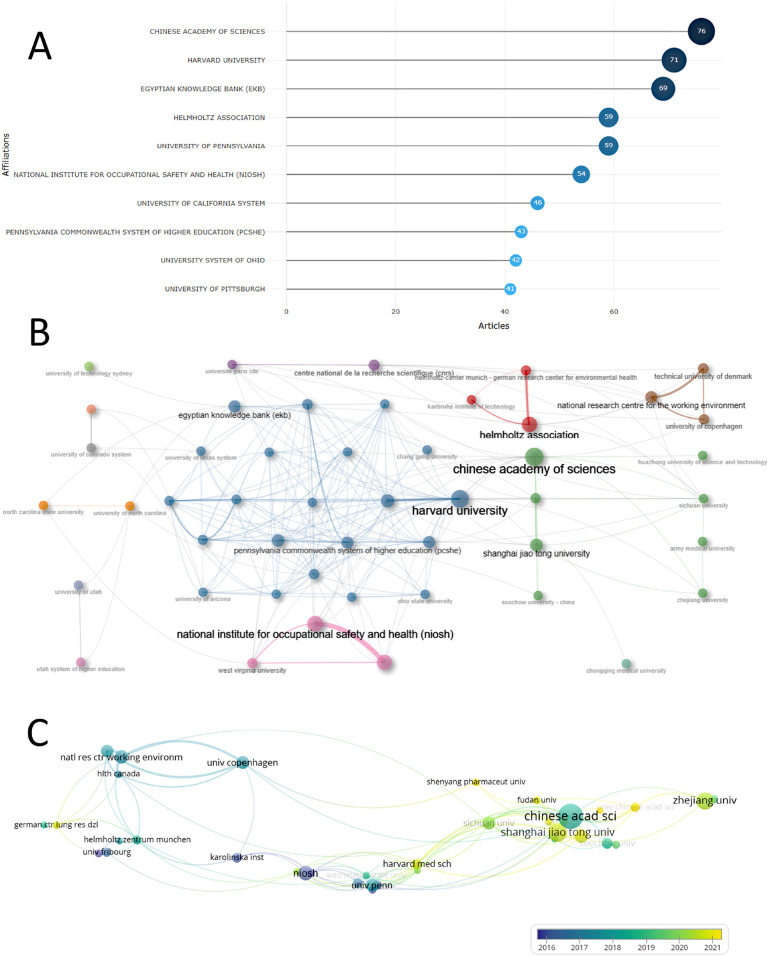
Results: A total of 1,347 publications were included. The number of papers related to nanotechnology in acute lung injury has grown exponentially over the past 20 years. China was the most productive country out of all 53 countries, followed by the United States. The Chinese Academy of Sciences was the most productive institution with 76 papers. PARTICLE AND FIBRE TOXICOLOGY was the most productive journal. The top five high-frequency keywords were inflammation, oxidative stress, toxicity, in vitro, respiratory-distress-syndrome. And the top five emerging keywords were delivery, covid-19, extracellular vesicles, therapy, sars-cov-2. Drug delivery are the focus of current research. Two emerging research areas represented the development trends: novel nanocarriers with higher efficiency and lower biotoxicity, and the other is research related to impact of nanomaterials in the progression of acute lung injury.
Conclusion: The field of nanotechnology in acute lung injury has been in a period of rapid development in the last three years. Delivery,targeted delivery and exosm have been the focus of current research in this field. Two emerging research areas represented the development trends:novel nanocarriers with higher efficiency and lower biotoxicity such as extracellular vesicles, exosomes and solid lipid nanoparticles, and the other is research related to impact of nanomaterials in the progression of acute lung injury.
Keywords: acute lung injury; bibliometric analysis; drug delivery; nanotechnology; research trend.
© 2025 Zhang, Jiang, Jiang and Liu.
Conflict of interest statement
The authors declare that the research was conducted in the absence of any commercial or financial relationships that could be construed as a potential conflict of interest.
Figures




References
-
- Gao Y, Cao F, Tian X, Zhang Q, Xu C, Ji B, et al. Inhibition the ubiquitination of ENaC and na, K-ATPase with erythropoietin promotes alveolar fluid clearance in sepsis-induced acute respiratory distress syndrome. Biomed Pharmacotherapy=Biomed Pharmacotherapie. (2024) 174:116447. 10.1016/j.biopha.2024.116447 - DOI - PubMed
Publication types
LinkOut - more resources
Full Text Sources
Miscellaneous
