Review
. 2025 Mar 18;21(1):230225.
doi: 10.1183/20734735.0225-2023. eCollection 2025 Jan.

From images to clinical insights: an educational review on radiomics in lung diseases

Affiliations
Review

From images to clinical insights: an educational review on radiomics in lung diseases

Cheryl Y Magnin et al. Breathe (Sheff). .

Abstract

Radiological imaging is a cornerstone in the clinical workup of lung diseases. Radiomics represents a significant advancement in clinical lung imaging, offering a powerful tool to complement traditional qualitative image analysis. Radiomic features are quantitative and computationally describe shape, intensity, texture and wavelet characteristics from medical images that can uncover detailed and often subtle information that goes beyond the visual capabilities of radiological examiners. By extracting this quantitative information, radiomics can provide deep insights into the pathophysiology of lung diseases and support clinical decision-making as well as personalised medicine approaches. In this educational review, we provide a step-by-step guide to radiomics-based medical image analysis, discussing the technical challenges and pitfalls, and outline the potential clinical applications of radiomics in diagnosing, prognosticating and evaluating treatment responses in respiratory medicine.


Conflict of interest statement

Conflict of interest: The authors have nothing to disclose.

Figures

FIGURE 1
FIGURE 1
Principle of conventional radiomics and potential clinical applications. The imaging data from routine medical imaging scans in patients with suspected lung disease can be used to extract large amounts of quantitative image characteristics to generate a radiomics-based digital disease fingerprint. This information has the potential to support or complement clinical applications such as diagnosis, prediction/prognosis, disease subtyping and evaluation of treatment response as well as disease monitoring. CT: computed tomography; MRI: magnetic resonance imaging; PET: positron emission tomography.
FIGURE 2
FIGURE 2
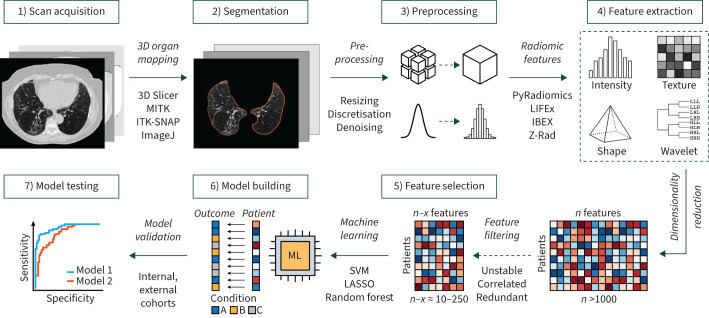
Schematic of the main radiomic workflow steps, including scan acquisition, image segmentation, radiomic feature extraction, radiomic feature selection, model building and testing. ML: machine learning; SVM: support vector machine; LASSO: least absolute shrinkage and selection operator.
FIGURE 3
FIGURE 3
Future perspective of radiomics. Multimodal integration could enhance diagnosis, prognosis and treatment response prediction. Linking radiomic and molecular features could further help to functionally characterise radiomic phenotypes and derive noninvasive radiomic surrogates for molecular profiles, paving the way for digital molecular disease fingerprints (“virtual biopsy”). CT: computed tomography; MRI: magnetic resonance imaging; PET: positron emission tomography.

References

    1. Tárnoki ÁD, Tárnoki DL, Dąbrowska M, et al. . New developments in the imaging of lung cancer. Breathe 2024; 20: 230176. doi:10.1183/20734735.0176-2023 - DOI - PMC - PubMed
    1. Hansell DM, Goldin JG, King TE Jr, et al. . CT staging and monitoring of fibrotic interstitial lung diseases in clinical practice and treatment trials: a position paper from the Fleischner Society. Lancet Respir Med 2015; 3: 483–496. doi:10.1016/S2213-2600(15)00096-X - DOI - PubMed
    1. Walsh SLF, Wells AU, Desai SR, et al. . Multicentre evaluation of multidisciplinary team meeting agreement on diagnosis in diffuse parenchymal lung disease: a case-cohort study. Lancet Respir Med 2016; 4: 557–565. doi:10.1016/S2213-2600(16)30033-9 - DOI - PubMed
    1. Barragán-Montero A, Javaid U, Valdés G, et al. . Artificial intelligence and machine learning for medical imaging: a technology review. Phys Med 2021; 83: 242–256. doi:10.1016/j.ejmp.2021.04.016 - DOI - PMC - PubMed
    1. Lambin P, Rios-Velazquez E, Leijenaar R, et al. . Radiomics: extracting more information from medical images using advanced feature analysis. Eur J Cancer 2012; 48: 441–446. doi:10.1016/j.ejca.2011.11.036 - DOI - PMC - PubMed

LinkOut - more resources