Integrated convolutional neural network for skin cancer classification with hair and noise restoration
- PMID: 40104314
- PMCID: PMC11913500
- DOI: 10.55730/1300-0144.5954
Integrated convolutional neural network for skin cancer classification with hair and noise restoration
Abstract
Background/aim: Skin lesions are commonly diagnosed and classified using dermoscopic images. There are many artifacts visible in dermoscopic images, including hair strands, noise, bubbles, blood vessels, poor illumination, and moles. These artifacts can obscure crucial information about lesions, which limits the ability to diagnose lesions automatically. This study investigated how hair and noise artifacts in lesion images affect classifier performance and how they can be removed to improve diagnostic accuracy.
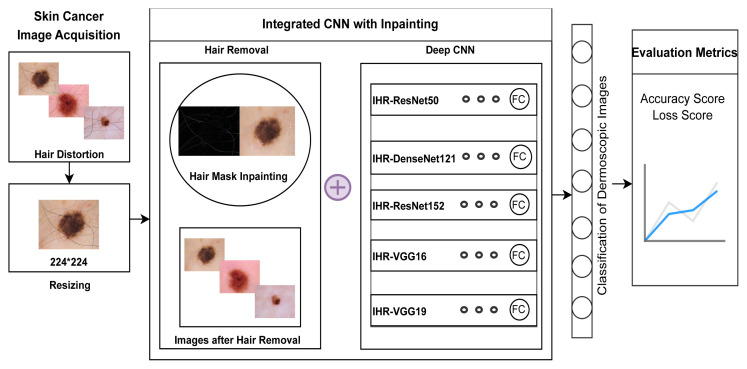
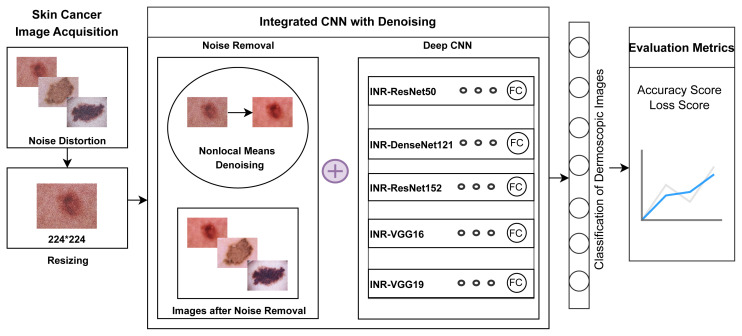
Materials and methods: A synthetic dataset created using hair simulation and noise simulation was used in conjunction with the HAM10000 benchmark dataset. Moreover, integrated convolutional neural networks (CNNs) were proposed for removing hair artifacts using hair inpainting and classification of refined dehaired images, called integrated hair removal (IHR), and for removing noise artifacts using nonlocal mean denoising and classification of refined denoised images, called integrated noise removal (INR).
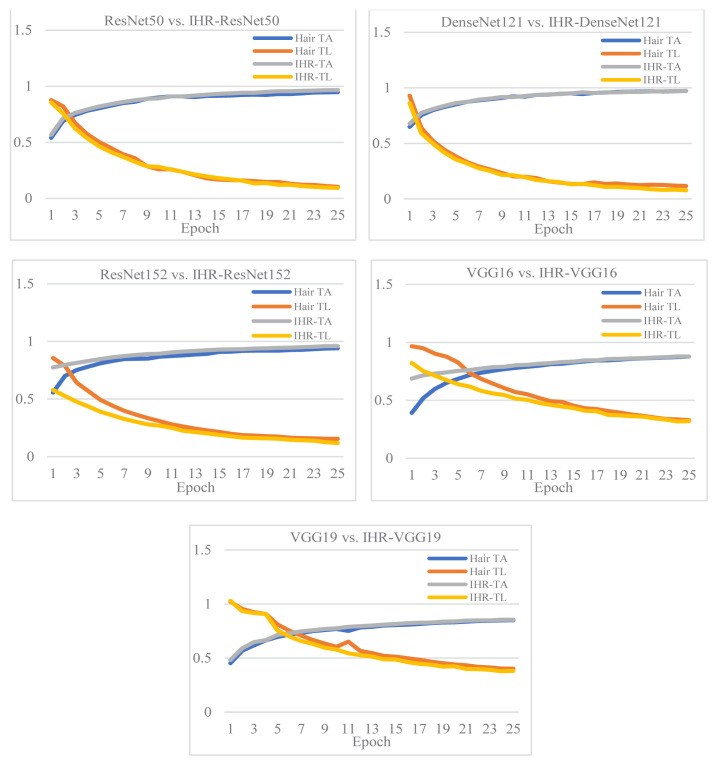
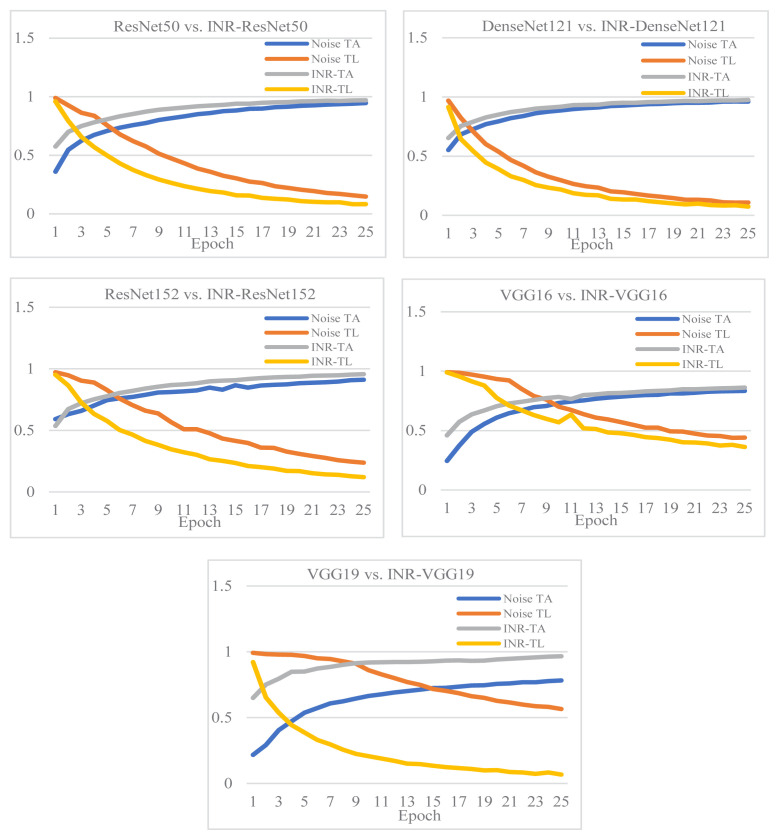
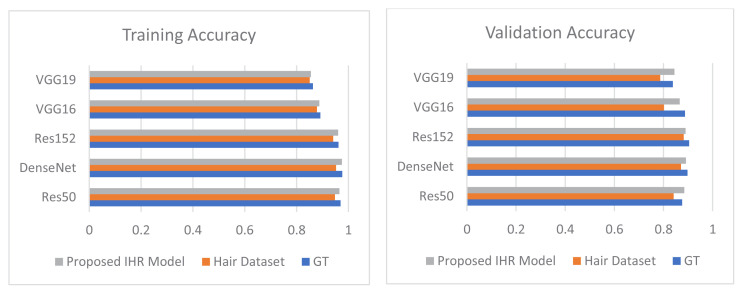
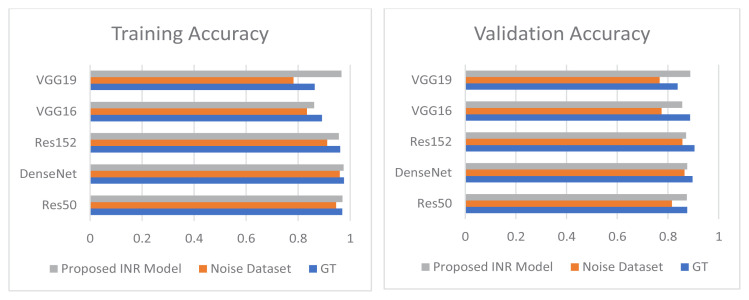
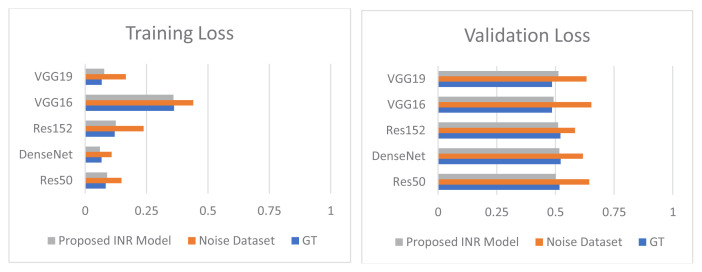
Results: Five deep learning models were used for the classification: ResNet50, DenseNet121, ResNet152, VGG16, and VGG19. The proposed IHR-DenseNet121, IHR-ResNet50, and IHR-ResNet152 achieved 2.3%, 1.78%, and 1.89% higher accuracy than DenseNet121, ResNet50, and ResNet152, respectively, in removing hairs. The proposed INR-DenseNet121, INR-ResNet50, and INR-VGG19 achieved 1.41%, 2.39%, and 18.4% higher accuracy than DenseNet121, ResNet50, and VGG19, respectively, in removing noise.
Conclusion: A significant proportion of pixels within lesion areas are influenced by hair and noise, resulting in reduced classification accuracy. However, the proposed CNNs based on IHR and INR exhibit notably improved performance when restoring pixels affected by hair and noise. The performance outcomes of this proposed approach surpass those of existing methods.
Keywords: Dermoscopic images; classification; convolutional neural network; image hair; image noise; image restoration.
© TÜBİTAK.
Conflict of interest statement
Conflict of interest: The authors declare that there are no known competing financial interests or personal relationships that could have influenced the work reported in this paper.
Figures

References
-
- Mahbod A, Schaefer G, Wang C, Ecker R, Ellinge I.Skin lesion classification using hybrid deep neural networks. ICASSP 2019–2019 IEEE International Conference on Acoustics, Speech and Signal Processing; Brighton, UK. pp. 1229–1233. - DOI
MeSH terms
LinkOut - more resources
Full Text Sources
Medical