


Malignant Cells Beyond the Tumor Core: The Non-Negligible Factor to Overcome the Refractory of Glioblastoma
- PMID: 40104956
- PMCID: PMC11920816
- DOI: 10.1111/cns.70333
Malignant Cells Beyond the Tumor Core: The Non-Negligible Factor to Overcome the Refractory of Glioblastoma
Abstract
Background: Glioblastoma (GBM) is one of the most aggressive primary brain tumors in adults. Over 95% of GBM patients experience recurrence in the peritumoral brain tissue or distant regions, indicating the presence of critical factors in these areas that drive tumor recurrence. Current clinical treatments primarily focus on tumor cells from the tumor core (TC), while the role of neoplastic cells beyond the TC has been largely neglected.
Methods: We conducted a comprehensive review of existing literature and studies on GBM, focusing on the identification and characterization of questionable cells (Q cells). Advanced imaging techniques, such as diffusion tensor imaging (DTI), magnetic resonance spectroscopy (MRS), and positron emission tomography (PET), were utilized to identify Q cells beyond the tumor core. We also analyzed the functional properties, cellular microenvironment, and physical characteristics of Q cells, as well as their implications for surgical resection.
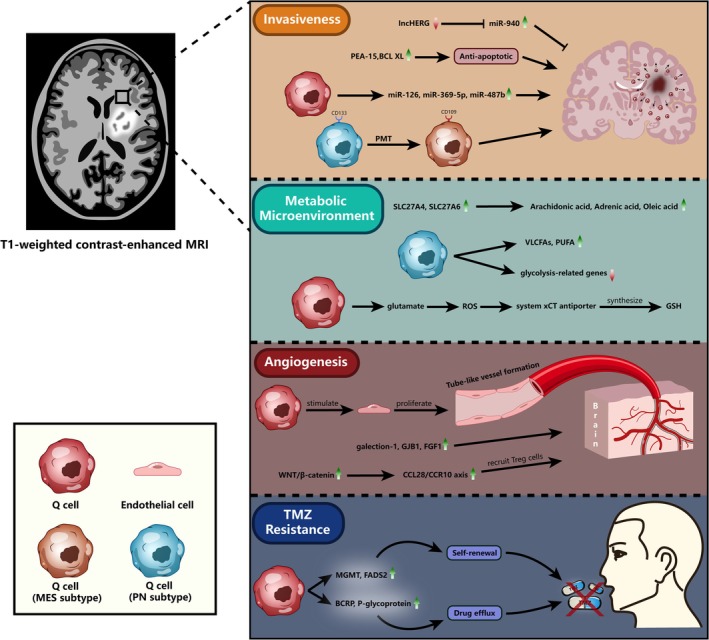
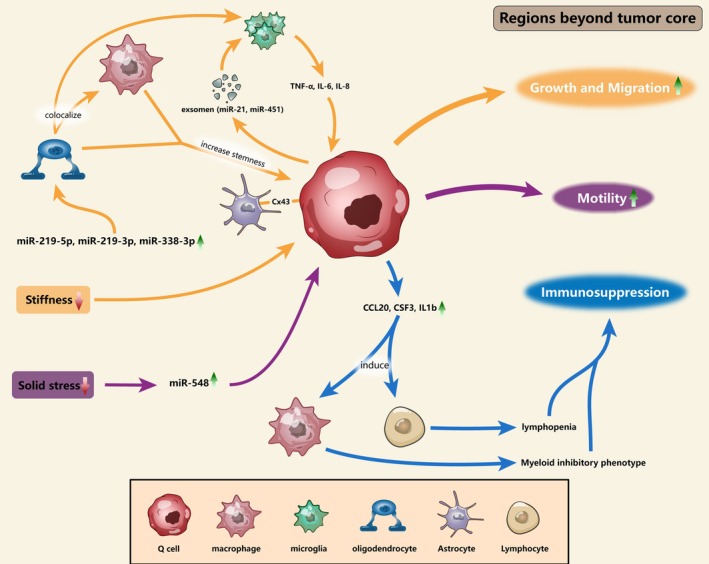
Results: Our review revealed that Q cells exhibit unique functional attributes, including enhanced invasiveness, metabolic adaptations, and resistance mechanisms. These cells reside in a distinct cellular microenvironment and are influenced by physical properties such as solid stress and stiffness. Advanced imaging techniques have improved the identification of Q cells, enabling more precise surgical resection. Targeting Q cells in therapeutic strategies could significantly reduce the risk of GBM recurrence.
Conclusion: The presence of Q cells in the peritumoral brain zone (PBZ) and beyond is a critical factor in GBM recurrence. Current treatments, which primarily target tumor cells in the TC, are insufficient to prevent recurrence due to the neglect of Q cells. Future research should focus on understanding the mechanisms influencing Q cells and developing targeted therapies to improve patient outcomes.
Keywords: GBM; PBZ; SMR; imaging; microenvironment; physics.
© 2025 The Author(s). CNS Neuroscience & Therapeutics published by John Wiley & Sons Ltd.
Conflict of interest statement
The authors declare no conflicts of interest.
Figures
References
Publication types
MeSH terms
LinkOut - more resources
Full Text Sources
Medical
