


Epicardial Fat in Heart Failure and Preserved Ejection Fraction: Novel Insights and Future Perspectives
- PMID: 40106059
- PMCID: PMC11922990
- DOI: 10.1007/s11897-025-00700-5
Epicardial Fat in Heart Failure and Preserved Ejection Fraction: Novel Insights and Future Perspectives
Abstract
Purpose of review: Cardiovascular effects of obesity may be driven, in part, by the distribution of fat. More recently, epicardial adipose tissue (EAT) has gained recognition as an adverse visceral fat impacting cardiac dysfunction in heart failure with preserved ejection fraction (HFpEF).
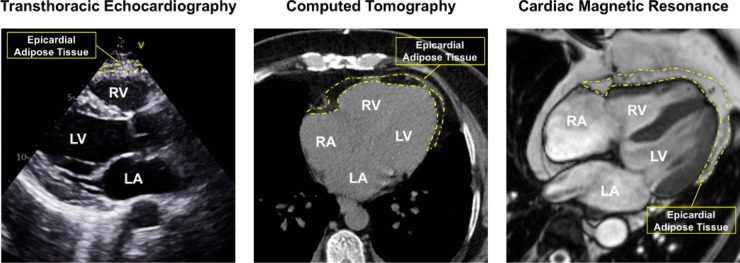
Recent findings: EAT can be identified and measured using several non-invasive imaging techniques, including transthoracic echocardiography, computed tomography, and cardiac magnetic resonance. The presence of EAT is associated with increased risk of HFpEF and worse clinical outcomes among patients with established HFpEF, independent of total adiposity. EAT may serve a pivotal role in the pathogenesis of HFpEF by worsening volume distribution, enhancing pericardial restraint and ventricular interaction, worsening right ventricular dysfunction, and diminishing exercise tolerance. No large trials have tested the effects of reducing fat in specific areas of the body on cardiovascular outcomes, but some studies that followed people in communities and trials over time have suggested that drug and non-drug treatments that lower EAT could improve the risk factors for heart problems in patients with HFpEF. Further understanding the role that pathogenic fat depots play in HFpEF incidence and progression may provide future therapeutic targets in treating the obese-HFpEF phenotype.
Keywords: Epicardial adipose tissue; HFpEF; Heart failure; Obesity; Regional adiposity.
© 2025. This is a U.S. Government work and not under copyright protection in the US; foreign copyright protection may apply.
Conflict of interest statement
Declarations. Competing Interests: Dr. Michos reports consulting for Amgen, Arrowhead, AstraZeneca, Bayer, Boehringer Ingelheim, Edwards Lifescience, Eli Lilly, Esperion, Iois, Medtronic, Merck, New Amsterdam, Novartis, and Novo Nordisk. Dr. Marat Fudim was supported by the NIH, Alleviant, Gradient, Reprieve, Sardocor, and Doris Duke. He is a consultant/has ownership interest in Abbott, Acorai, Ajax, Alio Health, Alleviant, Artha, Audicor, AxonTherapies, Bodyguide, Bodyport, Boston Scientific, Broadview, Cadence, Cardiosense, Cardioflow, CVRx, Daxor, Edwards LifeSciences, Echosens, EKO, Endotronix, Feldschuh Foundation, Fire1, FutureCardia, Galvani, Gradient, Hatteras, HemodynamiQ, Impulse Dynamics, Medtronic, Merck, NovoNordisk, NucleusRx, NXT Biomedical, Omega, Orchestra, Parasym, Pharmacosmos, Presidio, Procyreon, Proton Intelligence, Puzzle, ReCor, SCPharma, Shifamed, Splendo, STAT Health, Summacor, SyMap, Terumo, Vascular Dynamics, Vironix, Viscardia, Zoll. Dr. Robert J. Mentz received research support and honoraria from Abbott, Alleviant Medical, American Regent, Amgen, AstraZeneca, Bayer, Boehringer Ingelheim, Boston Scientific, Cytokinetics, Fast BioMedical, Gilead, Innolife, Eli Lilly, Lexicon, Medtronic, Medable, Merck, Novartis, Novo Nordisk, Pfizer, Pharmacosmos, Relypsa, Reprieve Cardiovascular, Respicardia, Roche, Rocket Pharmaceuticals, Sanofi, Verily, Vifor, Windtree Therapeutics, and Zoll. Dr. Tedford reports no disclosures relative to this manuscript. Dr. Tedford is Editor for the Journal of Heart and Lung Transplantation. He reports general disclosures to include consulting relationships with and receiving honorarium from Abbott, Acorai, Adona, Aria CV Inc., Acceleron/Merck, Alleviant, Boston Scientific, Cytokinetics, Edwards LifeSciences, Gradient, Medtronic, Morphic Therapeutics, Restore Medical, and United Therapeutics. Dr. Tedford serves on steering committee for Abbott, Edwards, Endotronix, and Merck as well as a research advisory board for Abiomed. He also does hemodynamic core lab work for Merck. All other authors report no relevant conflicts of interest. Human and Animal Rights and Informed Consent: This review article does not contain any studies with human or animal subjects performed by any of the authors.
Figures

References
-
- Heidenreich PA, Bozkurt B, Aguilar D, et al. AHA/ACC/HFSA guideline for the management of heart failure: Executive summary: A report of the American college of cardiology/American heart association joint committee on clinical practice guidelines. J Am Coll Cardiol. 2022;79:1757–80. - PubMed
-
- Owan TE, Hodge DO, et al. Trends in prevalence and outcome of heart failure with preserved ejection fraction. New England J Med. 2006;355:251–9. - PubMed
-
- Bursi F, Weston SA, et al. Systolic and diastolic heart failure in the community. Jama. 2006;29:2209–16. - PubMed
Publication types
MeSH terms
LinkOut - more resources
Full Text Sources
Medical
Research Materials
