


A multi-metabolite signature robustly predicts long-term mortality in the PREDIMED trial and several US cohorts
- PMID: 40107652
- PMCID: PMC12245597
- DOI: 10.1016/j.metabol.2025.156195
A multi-metabolite signature robustly predicts long-term mortality in the PREDIMED trial and several US cohorts
Abstract
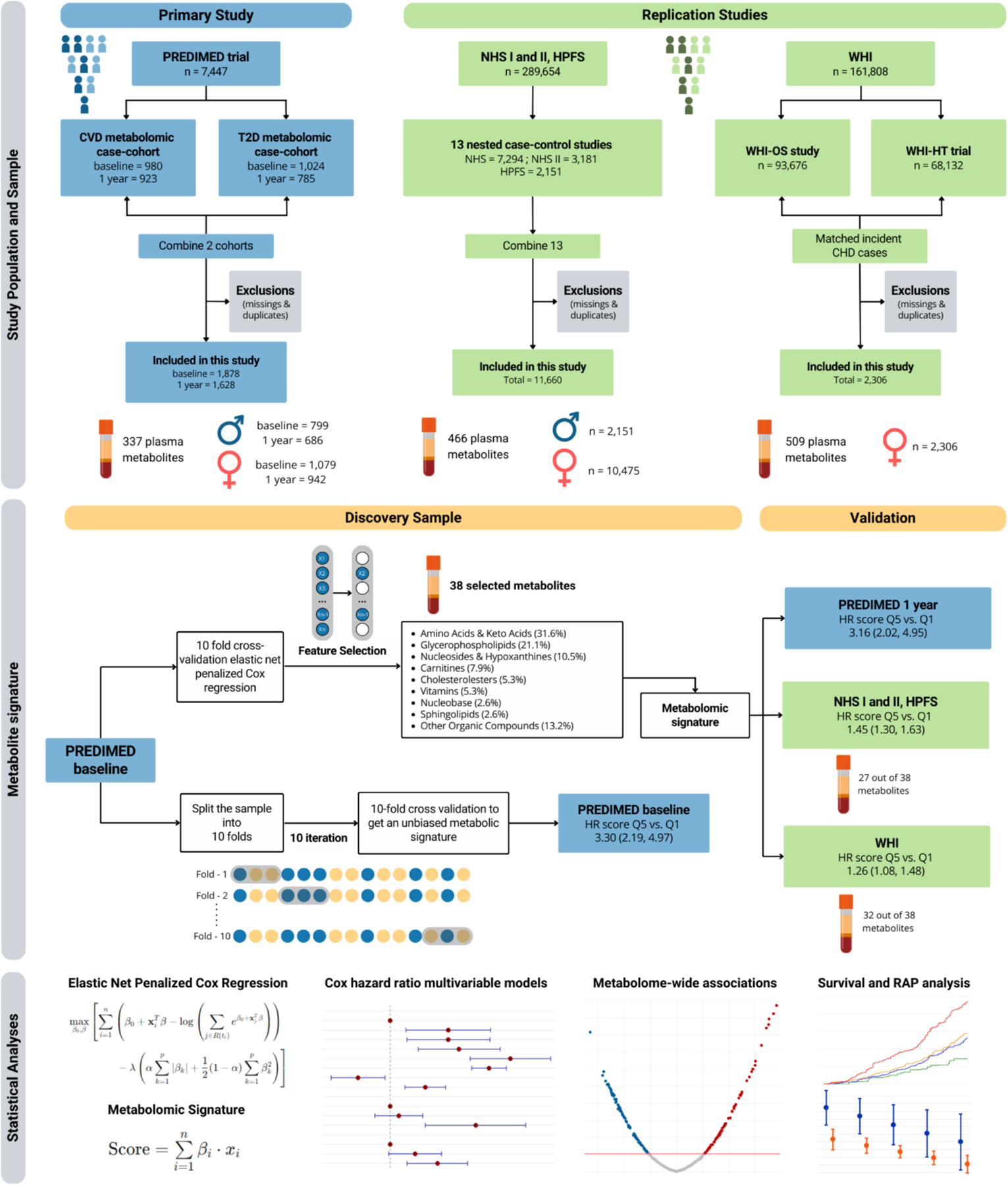
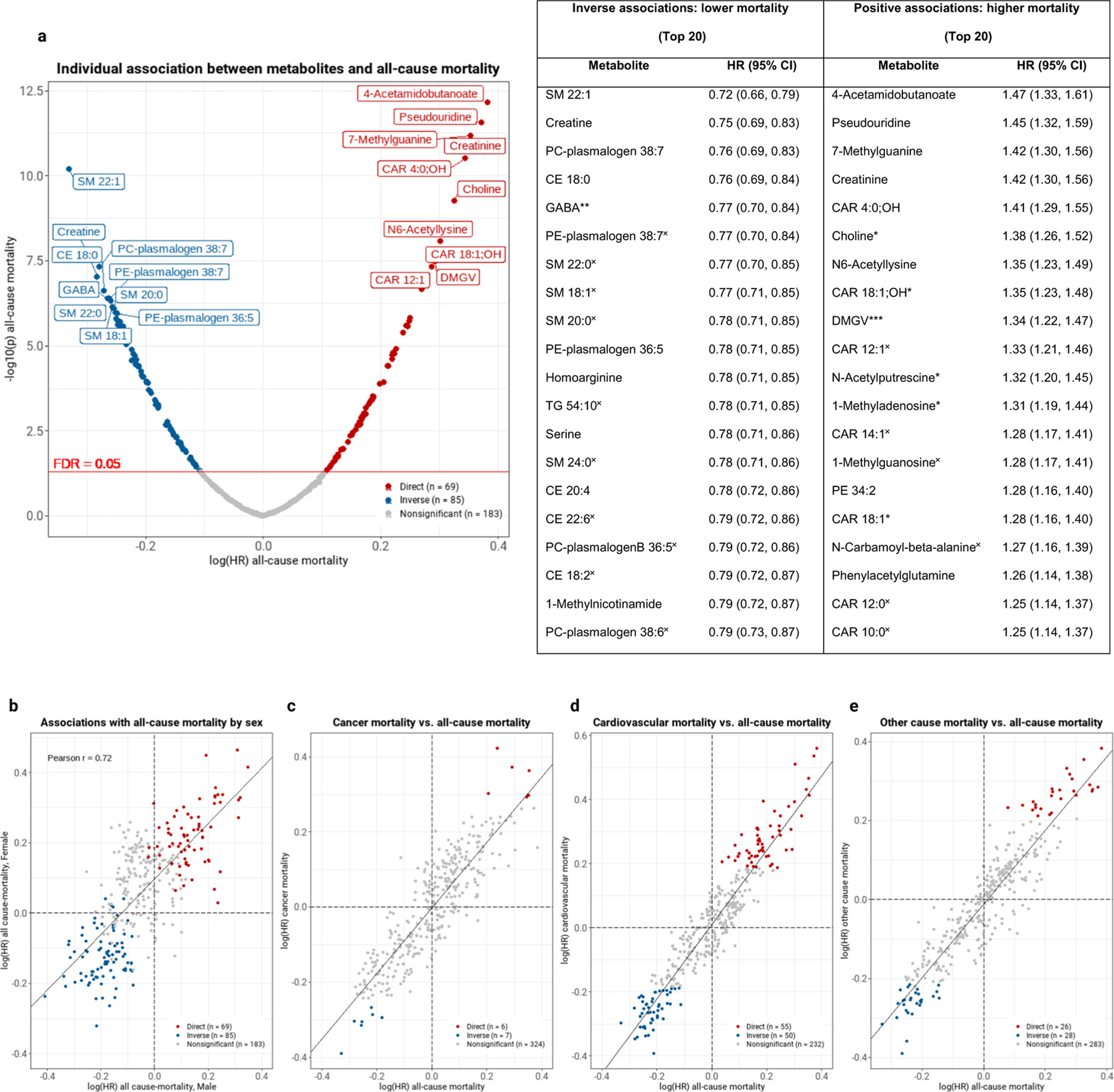
Metabolome-based biomarkers contribute to identify mechanisms of disease and to a better understanding of overall mortality. In a long-term follow-up subsample (n = 1878) of the PREDIMED trial, among 337 candidate baseline plasma metabolites repeatedly assessed at baseline and after 1 year, 38 plasma metabolites were identified as predictors of all-cause mortality. Gamma-amino-butyric acid (GABA), homoarginine, serine, creatine, 1-methylnicotinamide and a set of sphingomyelins, plasmalogens, phosphatidylethanolamines and cholesterol esters were inversely associated with all-cause mortality, whereas plasma dimethylguanidino valeric acid (DMGV), choline, short and long-chain acylcarnitines, 4-acetamidobutanoate, pseudouridine, 7-methylguanine, N6-acetyllysine, phenylacetylglutamine and creatinine were associated with higher mortality. The multi-metabolite signature created as a linear combination of these selected metabolites, also showed a strong association with all-cause mortality using plasma samples collected at 1-year follow-up in PREDIMED. This association was subsequently confirmed in 4 independent American cohorts, validating the signature as a consistent predictor of all-cause mortality across diverse populations.
Keywords: All-cause mortality; Biomarkers; Metabolomic; Metabolomic signature; Plasma metabolites.
Copyright © 2025 Elsevier Inc. All rights reserved.
Conflict of interest statement
Declaration of competing interest The authors declare the following financial interests/personal relationships which may be considered as potential competing interests: Jordi Salas-Salvado reports a relationship with International Nut and Dried Fruit Foundation that includes: funding grants and travel reimbursement. Jordi Salas-Salvado reports a relationship with Mundipharma that includes: speaking and lecture fees. Jordi Salas-Salvado reports a relationship with International Advisory Board of the Project Effect of cashew nut supplementation on glycemic status and lipid profile in type 2 diabetes subjects that includes: board membership. Jordi Salas-Salvado reports a relationship with Institute Danone Spain Advisory Board that includes: board membership. Jordi Salas-Salvado reports a relationship with Scientific Committee of Danone Institute International that includes: board membership. Jordi Salas-Salvado reports a relationship with International Nut and Dried Fruit Foundation World Forum for Nutrition Research and Dissemination that includes: board membership. Jordi Salas-Salvadó is partially supported by ICREA under the ICREA Academia programme. Ramon Estruch reports a relationship with Sociedad Española de Nutrición that includes: non-financial support. Ramon Estruch reports a relationship with Fundación Bosch y Gimpera that includes: non-financial support. Ramon Estruch reports a relationship with Brewers of Europe that includes: speaking and lecture fees. Ramon Estruch reports a relationship with Fundación Cerveza y Salud that includes: speaking and lecture fees. Ramon Estruch reports a relationship with Interprofesional del Aceite de Oliva that includes: speaking and lecture fees. Ramon Estruch reports a relationship with Instituto Cervantes that includes: speaking and lecture fees. Ramon Estruch reports a relationship with Pernaud Ricard that includes: speaking and lecture fees. Ramon Estruch reports a relationship with Fundación Dieta Mediterránea that includes: speaking and lecture fees. Ramon Estruch reports a relationship with Wine and Culinary International Forum that includes: speaking and lecture fees. Ramon Estruch reports a relationship with Fundación Patrimonio Comunal Olivarero that includes: non-financial support. Emilio Ros reports a relationship with California Walnut Commission that includes: speaking and lecture fees. Emilio Ros reports a relationship with Alexion that includes: consulting or advisory. Emilio Ros reports a relationship with International Nut and Dried Fruit Council that includes: travel reimbursement. If there are other authors, they declare that they have no known competing financial interests or personal relationships that could have appeared to influence the work reported in this paper.
Figures



References
Publication types
MeSH terms
Substances
Grants and funding
- R01 CA050385/CA/NCI NIH HHS/United States
- 75N92021D00002/HL/NHLBI NIH HHS/United States
- R01 CA067262/CA/NCI NIH HHS/United States
- R01 HL118264/HL/NHLBI NIH HHS/United States
- U01 CA167552/CA/NCI NIH HHS/United States
- 75N92021D00001/HL/NHLBI NIH HHS/United States
- P30 DK046200/DK/NIDDK NIH HHS/United States
- R01 AR049880/AR/NIAMS NIH HHS/United States
- R01 DK112940/DK/NIDDK NIH HHS/United States
- 75N92021D00004/WH/WHI NIH HHS/United States
- U01 HL145386/HL/NHLBI NIH HHS/United States
- 75N92021D00005/WH/WHI NIH HHS/United States
- R01 DK120870/DK/NIDDK NIH HHS/United States
- P01 CA087969/CA/NCI NIH HHS/United States
- R01 DK119268/DK/NIDDK NIH HHS/United States
- R01 DK127601/DK/NIDDK NIH HHS/United States
- U01 CA176726/CA/NCI NIH HHS/United States
- 75N92021D00003/WH/WHI NIH HHS/United States
- R01 HL034594/HL/NHLBI NIH HHS/United States
- UM1 CA186107/CA/NCI NIH HHS/United States
- R01 HL035464/HL/NHLBI NIH HHS/United States
- R01 HL088521/HL/NHLBI NIH HHS/United States
- R01 CA049449/CA/NCI NIH HHS/United States
- R01 HL060712/HL/NHLBI NIH HHS/United States
LinkOut - more resources
Full Text Sources
