


Relationship between weight-to-waist index and post-stroke depression
- PMID: 40110002
- PMCID: PMC11886329
- DOI: 10.5498/wjp.v15.i3.100909
Relationship between weight-to-waist index and post-stroke depression
Abstract
Background: The weight-to-waist index (WWI) serves as an innovative metric specifically designed to assess central obesity. However, the relationship between WWI and the prevalence of post-stroke depression (PSD) remains inadequately explored in the literature.
Aim: To elucidate the relationship between WWI and PSD.
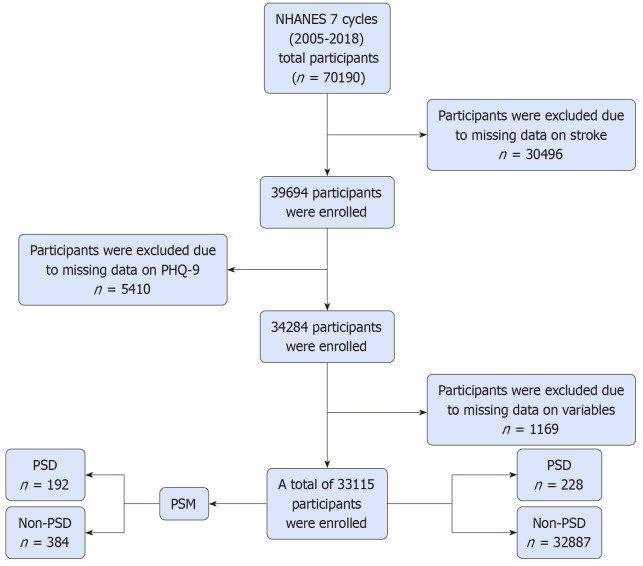
Methods: Data from the National Health and Nutrition Examination Survey 2005 to 2018 were analyzed. Multivariable logistic regression models and propensity score matching were utilized to investigate the association between WWI and PSD, with adjustments for potential confounders. The restricted cubic spline statistical method was applied to explore non-linear associations.
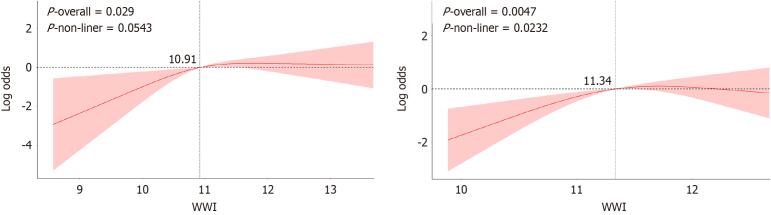
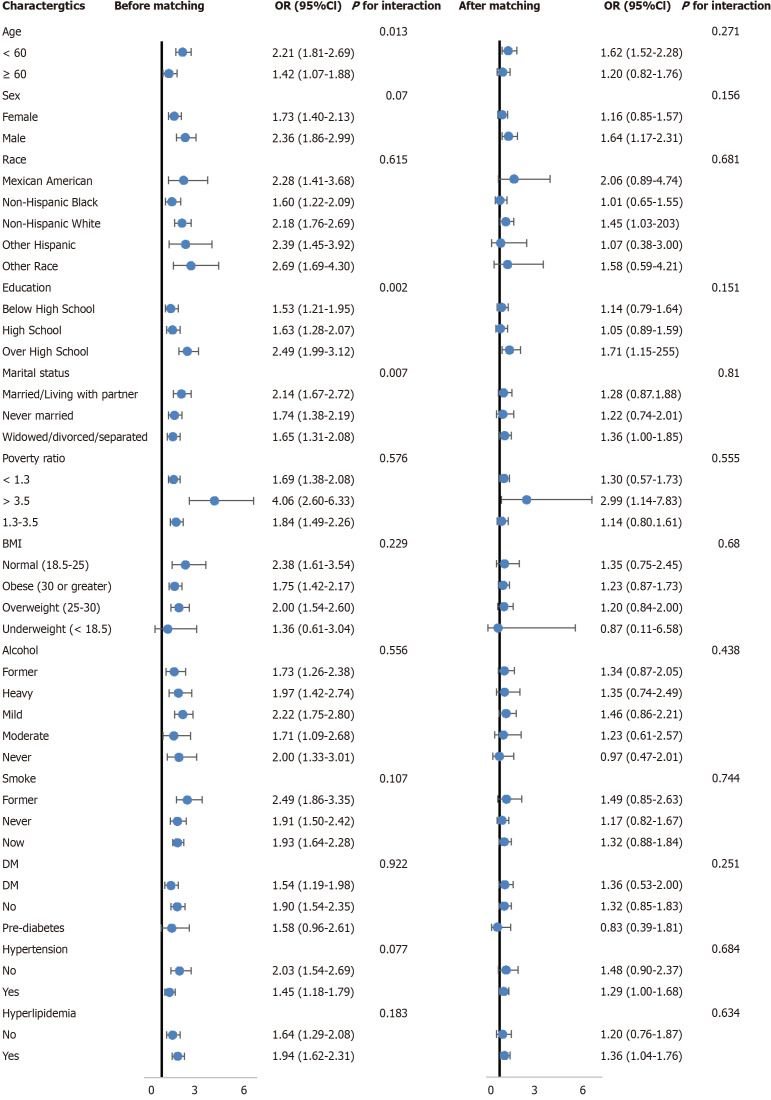
Results: Participants with elevated WWI values had a significantly greater risk of developing PSD. Specifically, individuals in the higher WWI range exhibited more than twice the likelihood of developing PSD compared to those with lower WWI values (odds ratio = 2.21, 95% confidence interval: 1.84-2.66, P < 0.0001). After propensity score matching, the risk of PSD remained significantly elevated (odds ratio = 1.43, 95%confidence interval: 1.09-1.88, P = 0.01). Tertile analysis revealed that participants in the highest WWI tertile faced a significantly higher risk of PSD compared to those in the lowest tertile. Restricted cubic spline analysis further revealed a non-linear association, with the risk of PSD plateauing at higher WWI values.
Conclusion: There is a significant association between elevated WWI and increased risk of PSD. Thus, regular depression screening should be implemented in stroke patients with elevated WWI to enhance patient outcomes.
Keywords: National Health and Nutrition Examination Survey; Obesity; Patient Health Questionnaire-9; Post-stroke depression; Weight-to-waist index.
©The Author(s) 2025. Published by Baishideng Publishing Group Inc. All rights reserved.
Conflict of interest statement
Conflict-of-interest statement: All the authors report no relevant conflicts of interest for this article.
Figures
References
LinkOut - more resources
Full Text Sources
