Clinical Trial
. 2025 Mar 20;15(1):95857.
doi: 10.5662/wjm.v15.i1.95857.

Advances in the treatment of autism spectrum disorder: Wharton jelly mesenchymal stem cell transplantation

Affiliations
Clinical Trial

Advances in the treatment of autism spectrum disorder: Wharton jelly mesenchymal stem cell transplantation

Serdar Kabatas et al. World J Methodol. .

Abstract

Background: Autism spectrum disorder (ASD) is a complex neurodevelopmental disorder with multifaceted origins. In recent studies, neuroinflammation and immune dysregulation have come to the forefront in its pathogenesis. There are studies suggesting that stem cell therapy may be effective in the treatment of ASD.

Aim: To evolve the landscape of ASD treatment, focusing on the potential benefits and safety of stem cell transplantation.

Methods: A detailed case report is presented, displaying the positive outcomes observed in a child who underwent intrathecal and intravenous Wharton's jelly-derived mesenchymal stem cells (WJ-MSCs) transplantation combined with neurorehabilitation.

Results: The study demonstrates a significant improvement in the child's functional outcomes (Childhood Autism Rating Scale, Denver 2 Developmental Screening Test), especially in language and gross motor skills. No serious side effects were encountered during the 2-year follow-up.

Conclusion: The findings support the safety and effectiveness of WJ-MSC transplantation in managing ASD.

Keywords: Autism spectrum disorder; Inflammation; Neurorehabilitation; Stem cell transplantation; Wharton jelly mesenchymal stem cells.


Conflict of interest statement

Conflict-of-interest statement: All authors declare no potential conflicts of interest with respect to the research, authorship, and/or publication of this article.

Figures
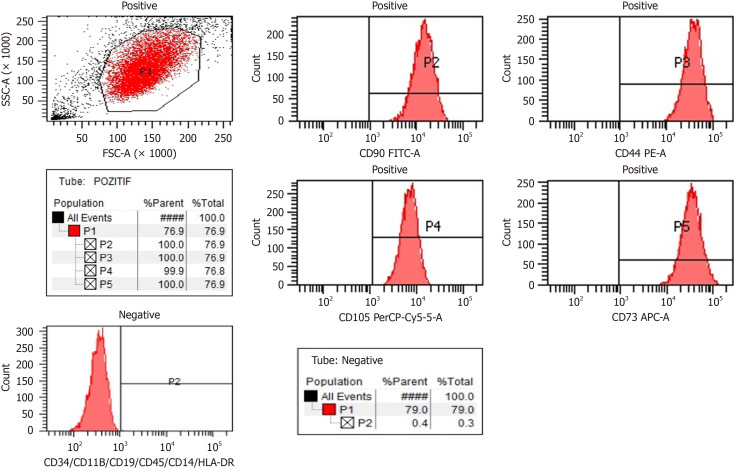
Figure 1
Figure 1
Wharton’s jelly-derived mesenchymal stem cell flow cytometry. Positive marker values (cluster of differentiation [CD]90, CD105, CD73 and CD44) are above 95%. Negative marker values (CD45, CD34, CD19, CD11B, human leukocyte antigen-DR and CD14) are below 2%. HLA: Human leukocyte antigen[8]. Citation: Boyalı O, Kabatas S, Civelek E, Ozdemir O, Bahar-Ozdemir Y, Kaplan N, Savrunlu EC, Karaöz E. Allogeneic mesenchymal stem cells may be a viable treatment modality in cerebral palsy. World J Clin Cases 2024; 12: 1585-1596. Copyright © The Authors 2024. Published by Baishideng Publishing Group Inc.
Figure 2
Figure 2
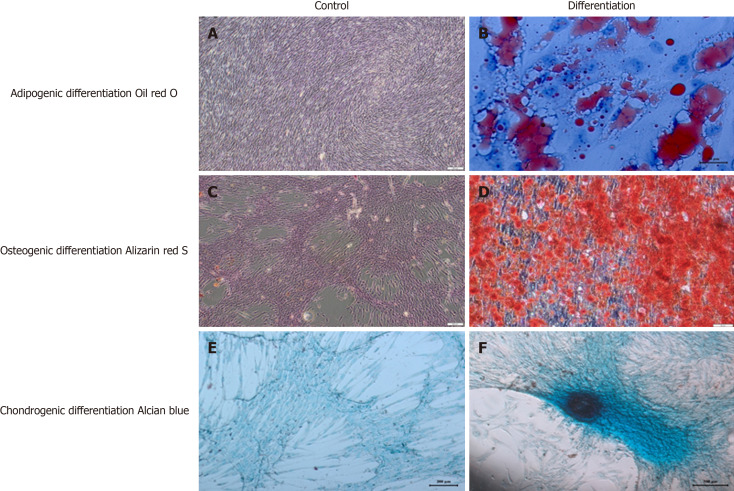
Detection of the differentiation potential of Wharton’s jelly-derived mesenchymal stem cells. A and B: Wharton’s jelly-derived mesenchymal stem cells (WJ-MSCs) were cultured without adipogenic induction and cultured for 3 weeks in adipogenic differentiation medium. Adipogenic differentiation was evidenced by the formation of lipid vacuoles with oil red O staining; C and D: WJ-MSCs were cultured without osteogenic induction and cultured for 3 weeks in osteogenic differentiation medium. Osteogenic differentiation was evidenced by the detection of calcium deposits with Alizarin Red staining; E and F: WJ-MSCs were cultured without chondrogenic induction and cultured for 3 weeks in chondrogenic differentiation medium. Chondrogenic differentiation was evidenced with Alcian Blue staining[8]. Citation: Boyalı O, Kabatas S, Civelek E, Ozdemir O, Bahar-Ozdemir Y, Kaplan N, Savrunlu EC, Karaöz E. Allogeneic mesenchymal stem cells may be a viable treatment modality in cerebral palsy. World J Clin Cases 2024; 12: 1585-1596. Copyright © The Authors 2024. Published by Baishideng Publishing Group Inc.
Figure 3
Figure 3
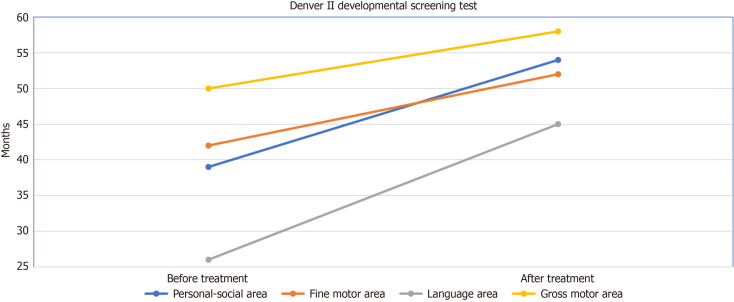
Change of Denver II Developmental Screening test before and after treatment. The rapid improvement in the language area and personal-social area is noteworthy.

References

    1. Patterson PH. Maternal infection and immune involvement in autism. Trends Mol Med. 2011;17:389–394. - PMC - PubMed
    1. Szachta P, Skonieczna-Żydecka K, Adler G, Karakua-Juchnowicz H, Madlani H, Ignyś I. Immune related factors in pathogenesis of autism spectrum disorders. Eur Rev Med Pharmacol Sci. 2016;20:3060–3072. - PubMed
    1. Lv YT, Zhang Y, Liu M, Qiuwaxi JN, Ashwood P, Cho SC, Huan Y, Ge RC, Chen XW, Wang ZJ, Kim BJ, Hu X. Transplantation of human cord blood mononuclear cells and umbilical cord-derived mesenchymal stem cells in autism. J Transl Med. 2013;11:196. - PMC - PubMed
    1. Dimarino AM, Caplan AI, Bonfield TL. Mesenchymal stem cells in tissue repair. Front Immunol. 2013;4:201. - PMC - PubMed
    1. Maric DM, Papic V, Radomir M, Stanojevic I, Sokolovac I, Milosavljevic K, Maric DL, Abazovic D. Autism treatment with stem cells: a case report. Eur Rev Med Pharmacol Sci. 2020;24:8075–8080. - PubMed

Publication types

LinkOut - more resources