


Perioperative, Oncological, and Functional Outcomes of New Multiport Robotic Platforms in Urology: A Systematic Review and Meta-analysis
- PMID: 40115596
- PMCID: PMC11925532
- DOI: 10.1016/j.euros.2025.02.003
Perioperative, Oncological, and Functional Outcomes of New Multiport Robotic Platforms in Urology: A Systematic Review and Meta-analysis
Abstract
Background and objective: Robot-assisted surgery (RAS) has steadily become more prevalent in urology. The Da Vinci multiport surgical robot (DVM-SR) continues to lead the field. In recent years, new multiport surgical robots (NM-SRs) have been introduced to the market; however, their safety and efficacy remain unassessed. This study aims to give a comprehensive evaluation of the perioperative, oncological, and functional outcomes of NM-SRs and a comparison with the DVM-SR.
Methods: A systematic search was performed in PubMed, Scopus, Web of Science, Embase, and clinicaltrial.gov to identify studies that evaluate NM-SRs in major urological surgeries assessing perioperative, functional, and oncological endpoints. A meta-analysis was performed comparing NM-SRs with the DVM-SR for safety, and functional and oncological outcomes.
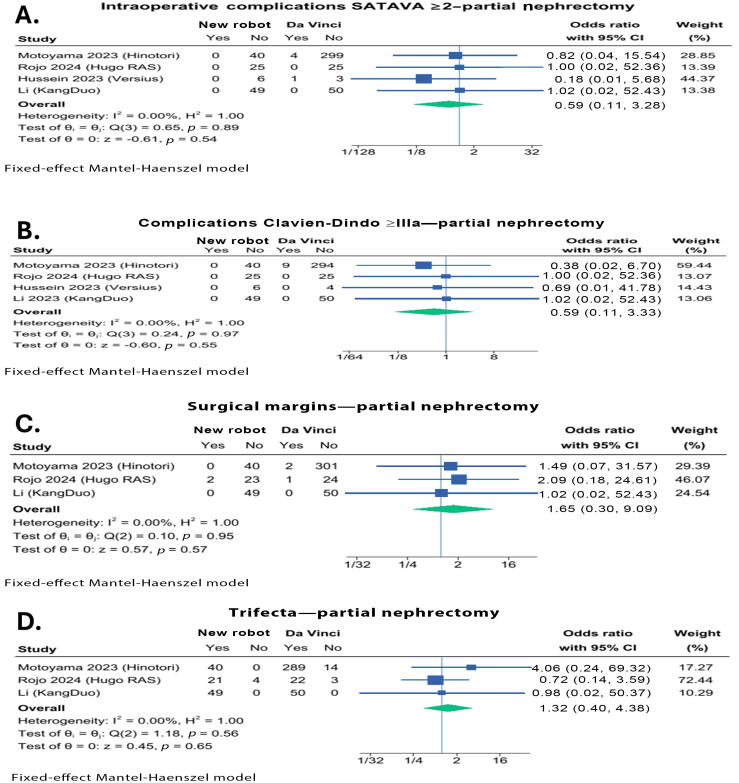
Key findings and limitations: Seventy-four studies involving 5487 patients were included in the review. Nine platforms were studied: Hinotori, Hugo RAS, Revo-I, Versius, Avatera, Senhance, KangDuo Surgical Robot-01, Dexter, and Toumai. NM-SRs were used to perform robot-assisted radical prostatectomy (RARP; 41 studies), partial nephrectomy (RAPN; 14 studies), radical nephrectomy (RARN; four studies), adrenalectomy (four studies), nephroureterectomy (two studies), RARN and thrombectomy (one study), colpopexy (four studies), pyeloplasty (seven studies), simple nephrectomy (four studies), simple prostatectomy (three studies), and ureteral surgery (four studies). Cystectomies with NM-SRs were described only in case reports and were excluded. The comparative analysis between NM-SRs and the DVM-SR showed similar outcomes in terms of intraoperative SATAVA grade ≥2 complications (odds ratio [OR] 0.89, 95% confidence interval [CI] 0.25, 3.1, p = 0.9 for RARP and OR 0.59, 95% CI 0.11, 3.3, p = 0.5 for RAPN), postoperative high-grade complications (Clavien-Dindo ≥IIIa, OR 0.85, 95% CI 0.4, 2, p = 0.7 for RARP and OR 0.59, 95% CI 0.1, 3.3, p = 0.6 for RAPN), and positive surgical margins (OR 0.90, 95% CI 0.72, 1.1, p = 0.3 for RARP and OR 1.65, 95% CI 0.3, 9.1, p = 0.6 for RAPN). For patients undergoing RARP, biochemical recurrence and urinary continence rates at 3 mo were comparable (OR 0.99 [95% CI 0.5, 1.8, p = 1] and OR 0.99 [95% CI 0.77, 1.3, p = 0.9], respectively). The achievement of the trifecta for RAPN appeared to be similar between the included studies on NM-SRs and the DVM-SR (OR 1.3, 95% CI 0.4, 4.4, p = 0.7). The small sample size of the included studies and the preliminary nature of the results represent the major limitations.
Conclusions and clinical implications: When compared with the DVM-SR, NM-SRs may offer similar safety, and oncological and functional outcomes across most surgeries for both benign and malignant diseases. Further research is needed to explore the potential of NM-SRs, given the promising initial findings.
Patient summary: New multiport surgical robots (NM-SRs) appear to be safe and effective compared with the Da Vinci surgical robotic system. However, further research is required to thoroughly assess their long-term outcomes and cost effectiveness. NM-SRs represent an opportunity to spread the use of robot-assisted surgery globally.
Keywords: Hinotori; Hugo robot-assisted surgery; KangDuo; Partial nephrectomy; Prostatectomy; Robotic surgery; Senhance; Toumai; Urology; Versius.
© 2025 The Author(s).
Figures


References
Publication types
LinkOut - more resources
Full Text Sources
Research Materials
