


Chronic subdural hematoma with mild to moderate symptoms: The effect of initial treatment approach on clinical outcome
- PMID: 40115869
- PMCID: PMC11925197
- DOI: 10.1016/j.bas.2025.104219
Chronic subdural hematoma with mild to moderate symptoms: The effect of initial treatment approach on clinical outcome
Abstract
Background: The effect of a conservative (wait-and-watch) approach in chronic subdural hematoma (cSDH) patients with mild to moderate symptoms, is poorly studied. Surgical evacuation is effective, but inherently carries the risk of surgical or anesthetic complications.
Research question: To assess the effect of conservative or operative (burrhole craniostomy) treatment on clinical outcome, in cSDH patients with mild to moderate symptoms.
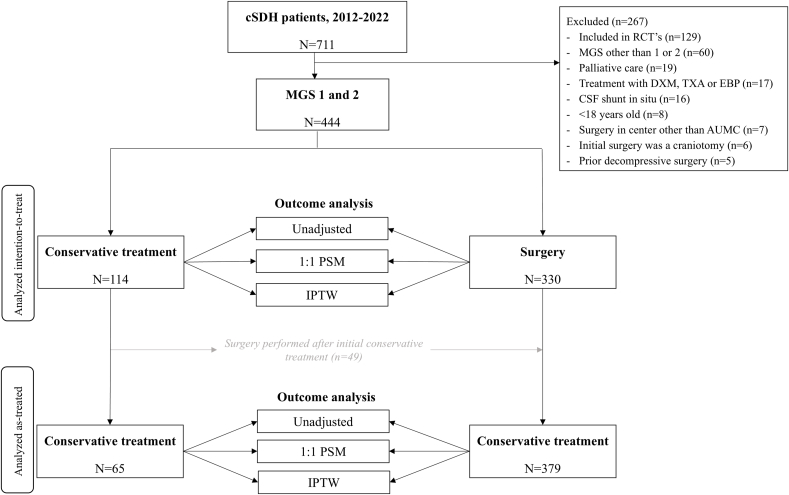
Methods: This single center, retrospective cohort study included 444 cSDH patients with a Markwalder Grading Scale score 1 or 2, treated between 2012 and 2022. The primary outcomes were complication rate, length of hospital stay and 30-days' mortality. The results were analyzed using both intention-to-treat and as-treated approaches. Propensity score techniques were applied to adjust for clinical and radiological baseline differences.
Results: Of the 114 conservatively treated patients, 49 (43%) crossed-over to surgery. The 330 remaining patients were treated surgically. In the intention-to-treat and as-treated analysis, initial surgery was associated with a higher complication rate (OR 2.02, 95% CI 1.04-3.94; OR 2.87, 95% CI 1.04-7.91) and longer hospital stay (β 2.34, 95% CI 0.15-4.52; β 6.62, 95% CI 3.60-9.64). Conservative treatment was associated with higher 30-day mortality (as-treated OR 0.19, 95% CI 0.06-0.66, favoring surgery), but this was unrelated to cSDH.
Conclusion: In this selected cohort of cSDH patients with mild to moderate symptoms, a conservative approach was associated with less complications and hospital stay. For these patients, a 'conservative treatment first' regimen may therefore be considered. Corroboration in a prospective cohort with neurological and functional outcomes is warranted.
Keywords: Chronic; Conservative treatment; Drainage; Hematoma; Humans; Propensity score; Retrospective studies; Subdural.
© 2025 The Authors.
Conflict of interest statement
The authors declare that they have no known competing financial interests or personal relationships that could have appeared to influence the work reported in this paper.
Figures
References
-
- Berghauser Pont L.M., Dippel D.W., Verweij B.H., Dirven C.M., Dammers R. Ambivalence among neurologists and neurosurgeons on the treatment of chronic subdural hematoma: a national survey. Acta Neurol. Belg. 2013;113(1):55–59. - PubMed
-
- Cenic A., Bhandari M., Reddy K. Management of chronic subdural hematoma: a national survey and literature review. Can. J. Neurol. Sci. 2005;32(4):501–506. - PubMed
-
- Creditor M.C. Hazards of hospitalization of the elderly. Ann. Intern. Med. 1993;118(3):219–223. - PubMed
LinkOut - more resources
Full Text Sources
