


Associations of body roundness index and sugar-sweetened beverage consumption with psychological symptoms in adolescents: a multicenter cross-sectional survey based on Chinese adolescents aged 12-18 years old
- PMID: 40129672
- PMCID: PMC11930830
- DOI: 10.3389/fnut.2025.1505491
Associations of body roundness index and sugar-sweetened beverage consumption with psychological symptoms in adolescents: a multicenter cross-sectional survey based on Chinese adolescents aged 12-18 years old
Abstract
Background: Adolescent psychosocial symptoms continue to rise, negatively affecting academic performance and future achievement, and have become an important public health issue of common concern worldwide. However, few studies have been conducted on the association between body roundness index (BRI) and sugar-sweetened beverage (SSB) consumption and psychological symptoms in Chinese adolescents. The present study may provide implications for the intervention and prevention of psychological symptoms in Chinese adolescents.
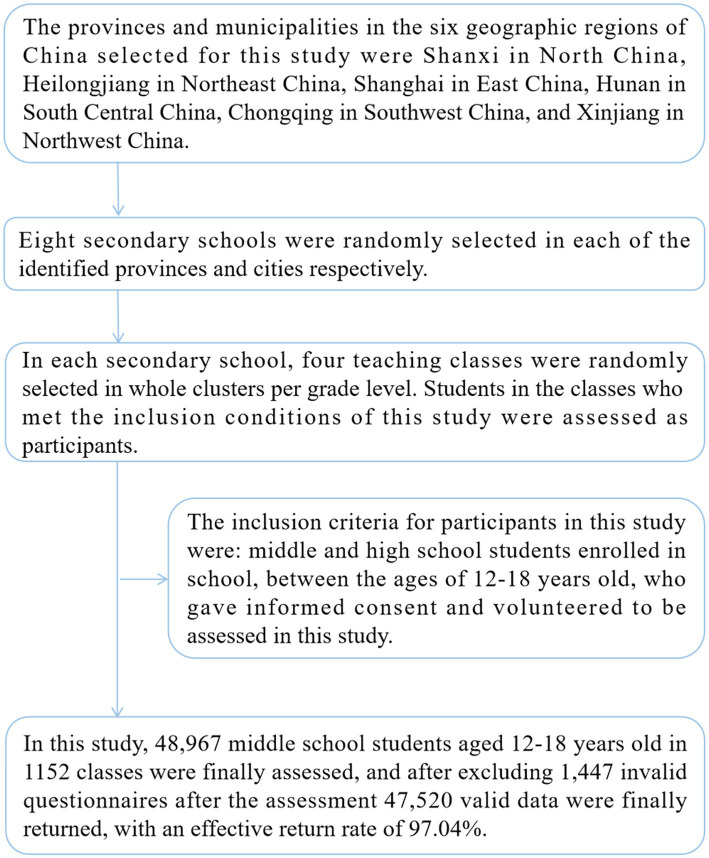
Methods: In this study, 47,520 adolescents aged 12-18 years from six geographic regions of China were assessed cross-sectionally for BRI, SSB consumption, and psychological symptoms in 2023. Independent samples t-tests, chi-square tests, logistic regression analyses, and ordered logistic regression analyses were used to compare and analyze the associations that existed between BRI and SSB consumption and psychological symptoms among Chinese adolescents.
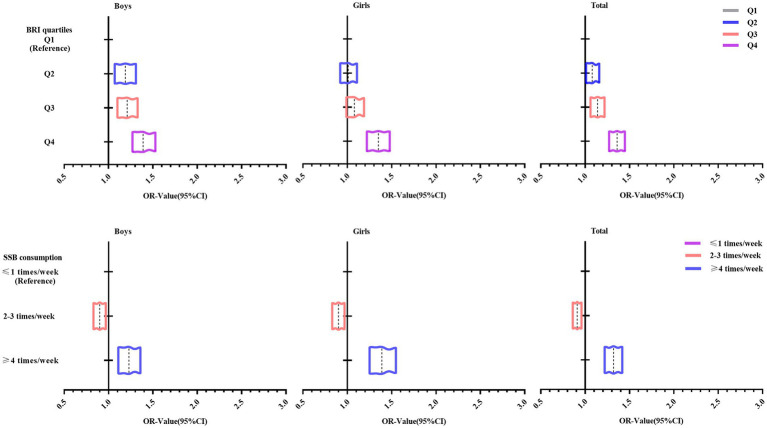
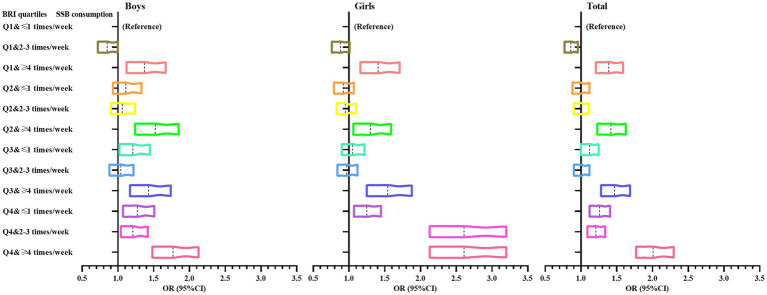
Results: The BRI of Chinese adolescents aged 12-18 years was (2.03 ± 0.94). The proportions of adolescents with SSB consumption ≤1 times/week, 2-3 times/week, and ≥ 4 times/week were 33.2, 52.0, and 14.7%, respectively, and the differences were statistically significant in comparison (X 2 value of 597.860, p < 0.001). The prevalence of psychological symptoms among Chinese adolescents was 19.2%. The prevalence rates of emotional problems, behavioral problems, and social adjustment difficulties were 26.1, 25.2, and 16.1%, respectively. After adjusting for relevant covariates, ordered logistic regression analysis showed that with BRI quartiles Q1 and SSB consumption ≤1 times/week as the reference group, the adolescents in the group with BRI quartiles of Q4 and SSB consumption ≥4 times/week (OR = 2.01, 95% CI: 1.77-2.30) had the highest risk of developing psychological symptoms (p < 0.001).
Conclusion: There is an association between BRI and SSB consumption with psychological symptoms in Chinese adolescents. Chinese adolescents with higher BRI and SSB consumption were at higher risk of developing psychological symptoms. In the future, the increase in BRI and SSB consumption should be effectively controlled to prevent or reduce the occurrence of psychological symptoms.
Keywords: adolescents; body roundness index; cross-sectional assessment; psychological symptoms; sugar-sweetened beverage consumption.
Copyright © 2025 Chen, Zheng, Wei, Ling and Kong.
Conflict of interest statement
The authors declare that the research was conducted in the absence of any commercial or financial relationships that could be construed as a potential conflict of interest.
Figures
Similar articles
-
Associations between sugar-sweetened beverage consumption, weight-adjusted-waist index, with psychological symptoms: a cross-sectional survey of adolescents in mainland China.Front Psychiatry. 2025 Mar 28;16:1558919. doi: 10.3389/fpsyt.2025.1558919. eCollection 2025. Front Psychiatry. 2025. PMID: 40225846 Free PMC article.
-
Associations of moderate-to-vigorous physical activity and body roundness index with psychological symptoms in adolescents in mainland China: a national multicenter cross-sectional survey.BMC Psychiatry. 2025 Mar 18;25(1):252. doi: 10.1186/s12888-025-06684-9. BMC Psychiatry. 2025. PMID: 40102793 Free PMC article.
-
Associations between sugar-sweetened beverage consumption, moderate-to-vigorous physical activity duration and psychological symptoms in adolescents: A nationwide study in China.J Affect Disord. 2025 Jul 1;380:26-36. doi: 10.1016/j.jad.2025.03.069. Epub 2025 Mar 19. J Affect Disord. 2025. PMID: 40118280
-
Sugar-sweetened beverages, relative grip strength, and psychological symptoms among rural adolescents in western China: a cross-sectional study.Front Nutr. 2025 Jan 15;12:1511256. doi: 10.3389/fnut.2025.1511256. eCollection 2025. Front Nutr. 2025. PMID: 39886545 Free PMC article.
-
Environmental interventions to reduce the consumption of sugar-sweetened beverages and their effects on health.Cochrane Database Syst Rev. 2019 Jun 12;6(6):CD012292. doi: 10.1002/14651858.CD012292.pub2. Cochrane Database Syst Rev. 2019. PMID: 31194900 Free PMC article.
References
LinkOut - more resources
Full Text Sources
