Review
. 2025 Mar 20;14(6):466.
doi: 10.3390/cells14060466.

Sirtuins and Gut Microbiota: Dynamics in Health and a Journey from Metabolic Dysfunction to Hepatocellular Carcinoma

Affiliations
Review

Sirtuins and Gut Microbiota: Dynamics in Health and a Journey from Metabolic Dysfunction to Hepatocellular Carcinoma

Mahmoud Zhra et al. Cells. .

Abstract

Metabolic dysfunction leading to non-alcoholic fatty liver disease (NAFLD) exhibits distinct molecular and immune signatures that are influenced by factors like gut microbiota. The gut microbiome interacts with the liver via a bidirectional relationship with the gut-liver axis. Microbial metabolites, sirtuins, and immune responses are pivotal in different metabolic diseases. This extensive review explores the complex and multifaceted interrelationship between sirtuins and gut microbiota, highlighting their importance in health and disease, particularly metabolic dysfunction and hepatocellular carcinoma (HCC). Sirtuins (SIRTs), classified as a group of NAD+-dependent deacetylases, serve as crucial modulators of a wide spectrum of cellular functions, including metabolic pathways, the inflammatory response, and the process of senescence. Their subcellular localization and diverse functions link them to various health conditions, including NAFLD and cancer. Concurrently, the gut microbiota, comprising diverse microorganisms, significantly influences host metabolism and immune responses. Recent findings indicate that sirtuins modulate gut microbiota composition and function, while the microbiota can affect sirtuin activity. This bidirectional relationship is particularly relevant in metabolic disorders, where dysbiosis contributes to disease progression. The review highlights recent findings on the roles of specific sirtuins in maintaining gut health and their implications in metabolic dysfunction and HCC development. Understanding these interactions offers potential therapeutic avenues for managing diseases linked to metabolic dysregulation and liver pathology.

Keywords: gut microbiota; hepatocellular carcinoma (HCC); metabolic dysfunction; non-alcoholic fatty liver disease (NAFLD); sirtuins (SIRTs).


Conflict of interest statement

The authors declare no conflicts of interest.

Figures
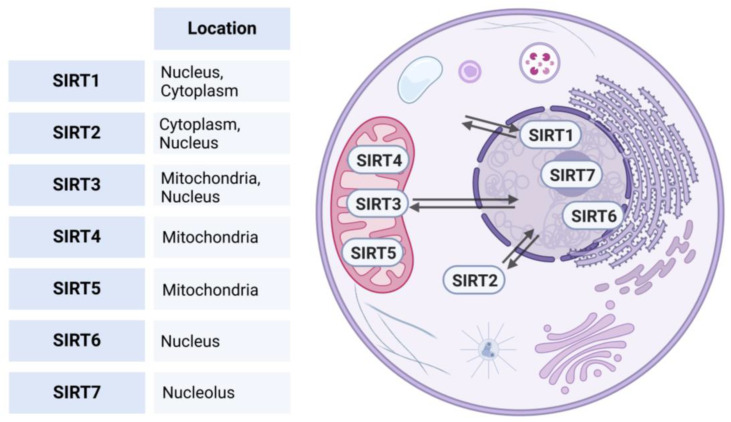
Figure 1
Figure 1
Subcellular localizations of human sirtuins. This figure illustrates the subcellular localization of human sirtuins (SIRT1-7). SIRT1, 6, and 7 predominantly reside in the nucleus; SIRT1 can translocate to the cytoplasm under physiological or pathological stimuli. SIRT2 is primarily located in the cytoplasm but can translocate to the nucleus. SIRT3 is located in the mitochondria and is able to relocate between the mitochondria and nucleus, while SIRT4 and SIRT5 are typically found in the mitochondrial compartment. Created in BioRender. https://BioRender.com/r59u349 (accessed on 12 March 2025).
Figure 2
Figure 2
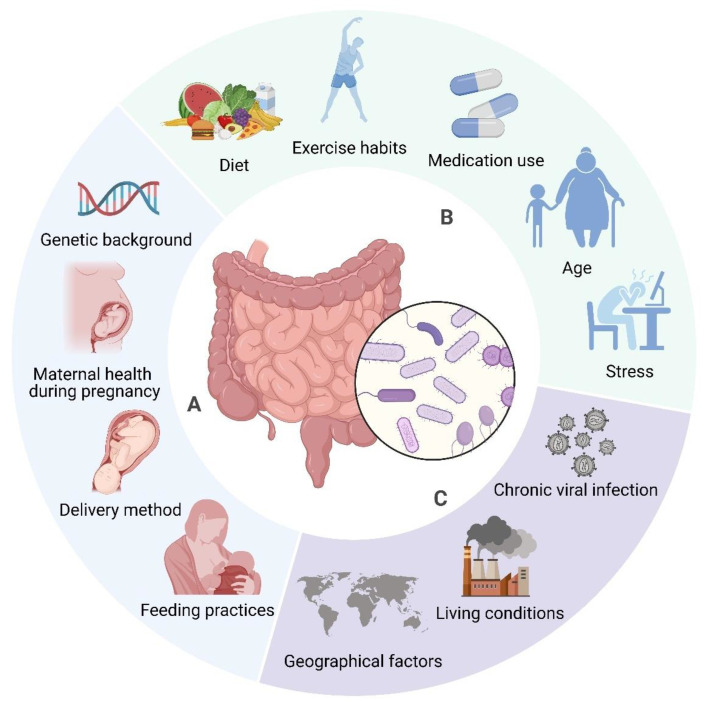
Determinants of Gut Microbiome Composition. The composition of gut microbiota is affected by a wide range of factors. Some elements, such as genetic background (e.g., specific gene variants), delivery method (vaginal vs. caesarean), early infant feeding practises (breastfeeding vs. formula feeding), and maternal health during pregnancy (e.g., gestational diabetes, infections) are established early in life and tend to remain stable (A). In contrast, factors like diet (e.g., high fibre vs. high fat), medication use (antibiotics), exercise habits, age, and stress levels are more variable and can be modified throughout life (B). Furthermore, environmental influences, including chronic viral infections (e.g., Epstein–Barr virus), living conditions (urban vs. rural), and geographical factors (climate, culture), also contribute to microbiome composition, although these may be more challenging to alter (C). Created in BioRender. https://BioRender.com/r59u349 (accessed on 12 March 2025).
Figure 3
Figure 3
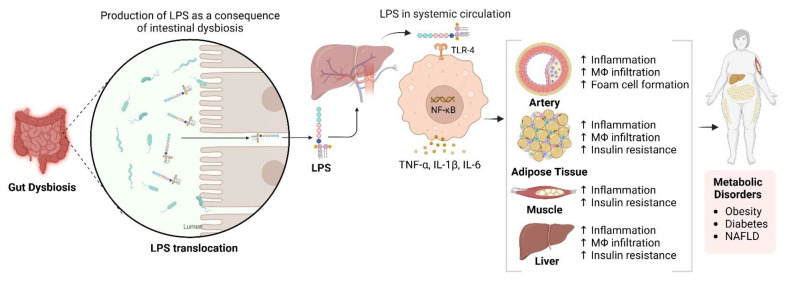
Impact of Gut Dysbiosis on Inflammation and Metabolic Dysfunction. This figure illustrates the process following gut dysbiosis, which leads to the release of lipopolysaccharides (LPS). These LPS molecules enter the systemic circulation via the portal vein, activating macrophages through Toll-like receptor 4 (TLR4). This activation results in the release of pro-inflammatory cytokines, including TNF-α, IL-1β, and IL-6, contributing to increased inflammation and hepatic insulin resistance. Additionally, activated macrophages infiltrate adipose tissue, exacerbating inflammation and insulin resistance, thereby contributing to metabolic disorders such as obesity, diabetes, and non-alcoholic fatty liver disease (NAFLD). The diagram also indicates the systemic effects of inflammation on various tissues, including the arteries, adipose tissue, muscle, and liver. Created in BioRender. https://BioRender.com/r59u349 (accessed on 12 March 2025).
Figure 4
Figure 4
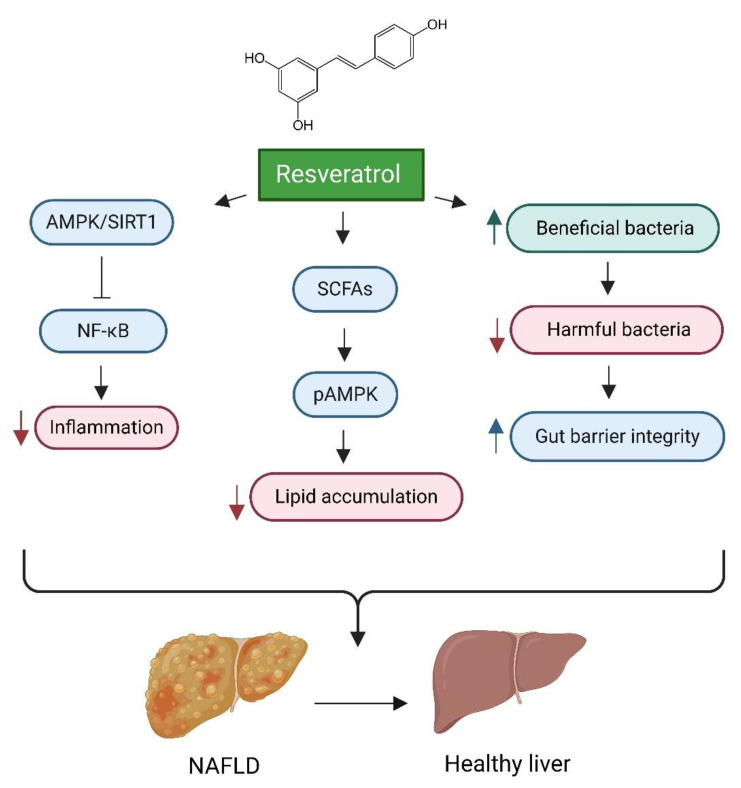
Impact of Resveratrol on Gut Health and Liver Disease. This figure illustrates the multifaceted mechanisms through which resveratrol mitigates the progression of non-alcoholic fatty liver disease (NAFLD) and improves liver health. Key processes include the enhancement of gut microbiota by promoting beneficial bacterial proliferation, which strengthens gut barrier integrity and overall gut health. Additionally, resveratrol activates the AMPKα/SIRT1 signalling pathway, suppressing the NF-κB inflammatory pathway and leading to decreased inflammation and hepatic steatosis. Furthermore, resveratrol influences hepatic lipid metabolism and reduces lipid accumulation by increasing the production of short-chain fatty acids (SCFAs), which enhances AMPK activation and contributes to decreased lipid accumulation. Created in BioRender. https://BioRender.com/r59u349 (accessed on 12 March 2025).
Figure 5
Figure 5
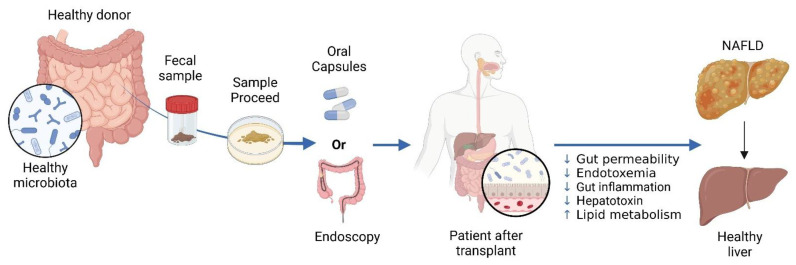
The Use of Fecal Microbiota Transplantation (FMT) in Treating NAFLD. In FMT, a healthy donor’s stool is processed and administered to a patient with NAFLD. Delivery can be achieved through oral or endoscopic methods. NAFLD is linked to gut dysbiosis and heightened intestinal permeability, which facilitates the transfer of gut-derived factors to the liver, exacerbating the condition. FMT aims to rectify dysbiosis and enhance the gut barrier, with the goal of improving liver health in individuals with NAFLD. Created in BioRender. https://BioRender.com/r59u349 (accessed on 12 March 2025).

References

    1. Wu Q., Zhang T.-N., Chen H.-h., Yu X.-F., Lv J., Liu Y.-Y., Liu Y., Zheng G., Zhao J., Wei Y.-F., et al. The sirtuin family in health and disease. Signal Transduct. Target. Ther. 2022;7:402. - PMC - PubMed
    1. Bhatt V., Tiwari A.K. Sirtuins, a key regulator of ageing and age-related neurodegenerative diseases. Int. J. Neurosci. 2022;133:1167–1192. doi: 10.1080/00207454.2022.2057849. - DOI - PubMed
    1. Ceballos M.P., Quiroga A.D., Palma N.F. Role of sirtuins in hepatocellular carcinoma progression and multidrug resistance: Mechanistical and pharmacological perspectives. Biochem. Pharmacol. 2023;212:115573. doi: 10.1016/j.bcp.2023.115573. - DOI - PubMed
    1. Afzaal M., Saeed F., Shah Y.A., Hussain M., Rabail R., Socol C.T., Hassoun A., Pateiro M., Lorenzo J.M., Rusu A.V., et al. Human gut microbiota in health and disease: Unveiling the relationship. Front. Microbiol. 2022;13:999001. doi: 10.3389/fmicb.2022.999001. - DOI - PMC - PubMed
    1. Kim S., Seo S.-U., Kweon M.-N. Gut microbiota-derived metabolites tune host homeostasis fate. Semin. Immunopathol. 2024;46:1–15. doi: 10.1007/s00281-024-01012-x. - DOI - PMC - PubMed

MeSH terms

LinkOut - more resources