


Varanid Teeth Asymmetry and Correlation to Body Size
- PMID: 40137015
- PMCID: PMC11942679
- DOI: 10.3390/jdb13010009
Varanid Teeth Asymmetry and Correlation to Body Size
Abstract
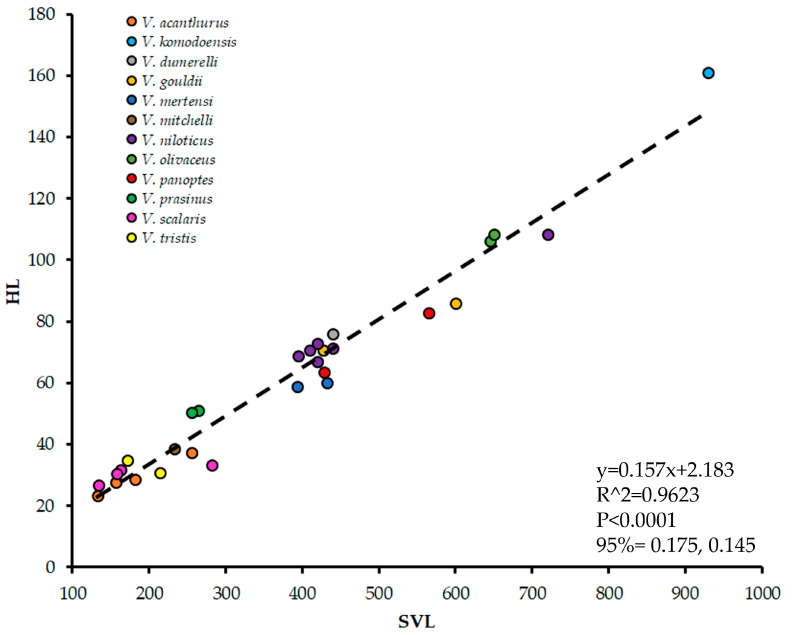
Stressors such as injuries, embryonic instability during development, and higher levels of stress hormones such as testosterone can result in increases in fluctuating asymmetry in reptiles and other vertebrates. Digit asymmetry, digit ratio variability, and skull trait asymmetry such as eye and jaw size have been correlated with stress level in both snakes and lizards. Teeth asymmetry has also been used as a biomarker for stress and brain laterality. Body size is correlated with many potential stressors, yet there has been little research on how body size in reptiles relates to asymmetry. We investigate teeth asymmetry within the lizard family Varanidae, a clade with a diverse range of sizes consisting of the largest living lizard, Varanus komodoensis. Using a landmark/semi-landmark analysis, we derived Centroid Size for 671 pairs of teeth from 13 varanid species, and asymmetry was derived for each pair. Right-biased asymmetry was significantly greater in the upper tooth row, but breaking up tooth positions into further sections did not yield a significant difference. We found a significant positive linear correlation between body size and right-biased teeth directional asymmetry within Varanus, but only when excluding V. komodoensis. This significant correlation may result from fewer potential predators and more potential food items, thus resulting in less overall stress. When analyzed separately, V. komodoensis individuals with <180 mm head length demonstrated a positive, yet non-significant, trend along a similar trajectory to their congenerics with a high goodness of fit. On the other hand, individuals > 180 mm showed a high degree of scatter, with several specimens having pronounced left-biased asymmetry. We suspect that this dramatic change was due to a combination of ontogenetic niche shift, bigger home ranges, a greater susceptibility to negative anthropogenic influences, and/or a male bias in the bigger specimens sampled, but a larger sample size is required to determine if there is statistical significance in these intra-specific trends. Body asymmetry can reflect brain laterality, which may be a potential driver for the teeth asymmetry seen here.
Keywords: Komodo dragon; Varanidae; Varanus; dentition; directional asymmetry; lizard.
Conflict of interest statement
The authors declare no conflicts of interest. The funders had no role in the design of the study; in the collection, analyses, or interpretation of data; in the writing of the manuscript; or in the decision to publish the results.
Figures



References
-
- Seligmann H. Evidence that minor directional asymmetry is functional in lizard hindlimbs. J. Zool. 1998;245:205–208. doi: 10.1111/j.1469-7998.1998.tb00088.x. - DOI
-
- Seligmann H., Moravec J., Werner Y.L. Morphological, functional and evolutionary aspects of tail autotomy and regeneration in the ‘living fossil’ Sphenodon (Reptilia: Rhynchocephalia) Biol. J. Linn. Soc. 2008;93:721–743. doi: 10.1111/j.1095-8312.2008.00975.x. - DOI
-
- Sion G., Tal R., Meiri S. Asymmetric behavior in Ptyodactylus guttatus: Can a digit ratio reflect brain laterality? Symmetry. 2020;12:1490. doi: 10.3390/sym12091490. - DOI
-
- Razzetti E., Faiman R., Werner Y.L. Directional asymmetry and correlation of tail injury with left-side dominance occur in Serpentes (Sauropsida) Zoomorphology. 2007;126:31–43. doi: 10.1007/s00435-007-0028-2. - DOI
LinkOut - more resources
Full Text Sources
