


Prediction of Chemotherapy Response in Locally Advanced Breast Cancer Patients at Pre-Treatment Using CT Textural Features and Machine Learning: Comparison of Feature Selection Methods
- PMID: 40137573
- PMCID: PMC11946754
- DOI: 10.3390/tomography11030033
Prediction of Chemotherapy Response in Locally Advanced Breast Cancer Patients at Pre-Treatment Using CT Textural Features and Machine Learning: Comparison of Feature Selection Methods
Abstract
Rationale: Neoadjuvant chemotherapy (NAC) is a key element of treatment for locally advanced breast cancer (LABC). Predicting the response of NAC for patients with LABC before initiating treatment would be valuable to customize therapies and ensure the delivery of effective care.
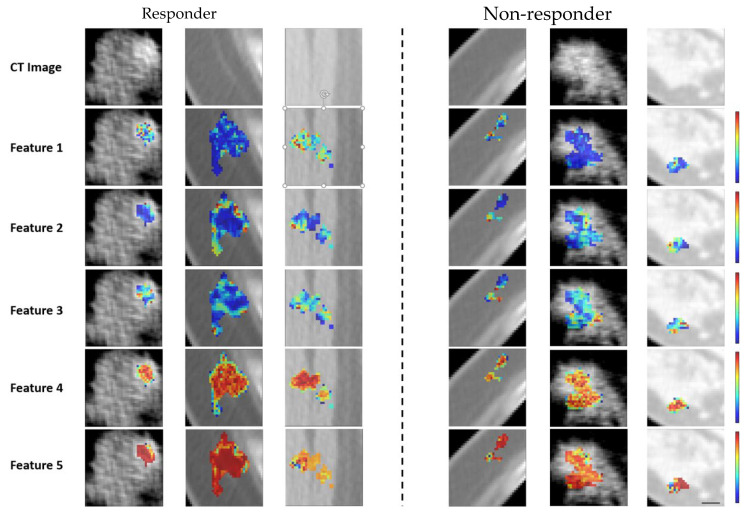
Objective: Our objective was to develop predictive measures of tumor response to NAC prior to starting for LABC using machine learning and textural computed tomography (CT) features in different level of frequencies.
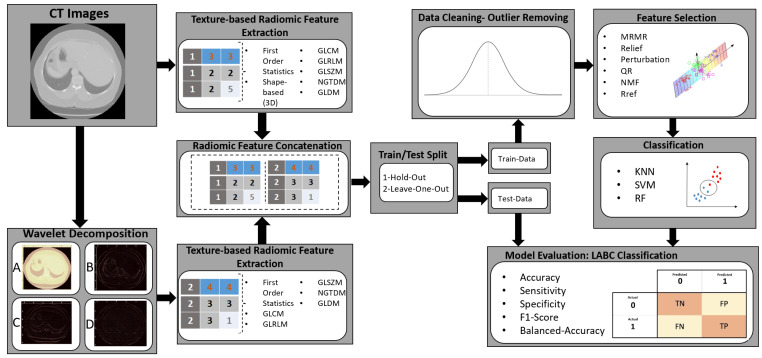
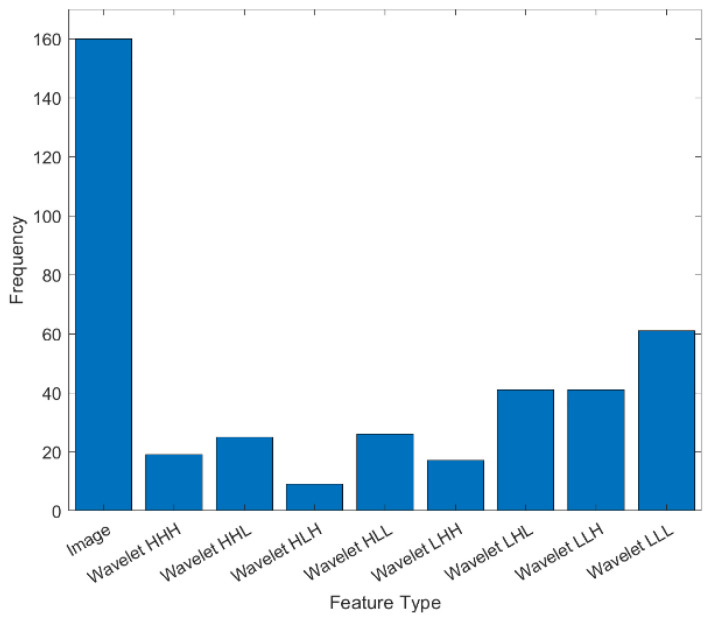
Materials and methods: A total of 851 textural biomarkers were determined from CT images and their wavelet coefficients for 117 patients with LABC to evaluate the response to NAC. A machine learning pipeline was designed to classify response to NAC treatment for patients with LABC. For training predictive models, three models including all features (wavelet and original image features), only wavelet and only original-image features were considered. We determined features from CT images in different level of frequencies using wavelet transform. Additionally, we conducted a comparison of feature selection methods including mRMR, Relief, Rref QR decomposition, nonnegative matrix factorization and perturbation theory feature selection techniques.
Results: Of the 117 patients with LABC evaluated, 82 (70%) had clinical-pathological response to chemotherapy and 35 (30%) had no response to chemotherapy. The best performance for hold-out data splitting was obtained using the KNN classifier using the Top-5 features, which were obtained by mRMR, for all features (accuracy = 77%, specificity = 80%, sensitivity = 56%, and balanced-accuracy = 68%). Likewise, the best performance for leave-one-out data splitting could be obtained by the KNN classifier using the Top-5 features, which was obtained by mRMR, for all features (accuracy = 75%, specificity = 76%, sensitivity = 62%, and balanced-accuracy = 72%).
Conclusions: The combination of original textural features and wavelet features results in a greater predictive accuracy of NAC response for LABC patients. This predictive model can be utilized to predict treatment outcomes prior to starting, and clinicians can use it as a recommender system to modify treatment.
Keywords: CT imaging; LABC; NAC; machine learning; textural features.
Conflict of interest statement
The authors declare that there are no conflicts of interest.
Figures
References
-
- Senkus E., Kyriakides S., Ohno S., Penault-Llorca F., Poortmans P., Rutgers E., Zackrisson S., Cardoso F. Primary breast cancer: ESMO Clinical Practice Guidelines for diagnosis, treatment and follow-up. Ann. Oncol. 2015;26:8–30. doi: 10.1093/annonc/mdv298. - DOI
-
- Rajan R., Poniecka A., Smith T.L., Yang Y., Frye D., Pusztai L., Fiterman D.J., Gal-Gombos E., Whitman G., Rouzier R., et al. Change in tumour cellularity of breast carcinoma after neoadjuvant chemotherapy as a variable in the pathologic assessment of response. Cancer Interdiscip. Int. J. Am. Cancer Soc. 2004;100:1365–1373. - PubMed
Publication types
MeSH terms
Grants and funding
LinkOut - more resources
Full Text Sources
Medical
