


IR-GPT: AI Foundation Models to Optimize Interventional Radiology
- PMID: 40140092
- PMCID: PMC12052823
- DOI: 10.1007/s00270-024-03945-0
IR-GPT: AI Foundation Models to Optimize Interventional Radiology
Abstract
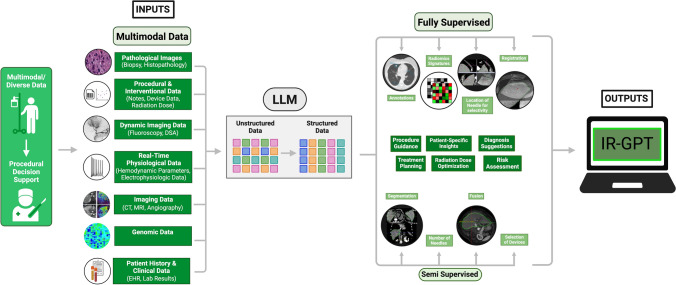
Foundation artificial intelligence (AI) models are capable of complex tasks that involve text, medical images, and many other types of data, but have not yet been customized for procedural medicine. This report reviews prior work in deep learning related to interventional radiology (IR), identifying barriers to generalization and deployment at scale. Moreover, this report outlines the potential design of an "IR-GPT" foundation model to provide a unified platform for AI in IR, including data collection, annotation, and training methods-while also contextualizing challenges and highlighting potential downstream applications.
Keywords: Artificial Intelligence; Foundation models; Mulitmodal data; Procedural optimization.
© 2025. The Author(s).
Conflict of interest statement
Declarations. Conflicts of interest: The authors declare no competing non-financial interests but the following competing financial interests. NIH may own intellectual property in the field. NIH and BJW receive royalties for licensed patents from Philips, unrelated to this work. BW is Principal Investigator on the following CRADA’s = Cooperative Research & Development Agreements, between NIH and industry: Philips, Philips Research, Celsion Corp, BTG Biocompatibles / Boston Scientific, Siemens Healthineers / Varian Interventional Systems, NVIDIA, Canon, XACT Robotics. Mediview, Deep Sight, Uro-1, Promaxo. The following industry partners also support research in CIO lab via equipment, personnel, devices and/ or drugs: 3 T Technologies (devices), Exact Imaging (data), AngioDynamics (equipment), AstraZeneca (pharmaceuticals, NCI CRADA), ArciTrax (devices and equipment), Imactis/ GE (Equipment), Johnson & Johnson (equipment), Medtronic (equipment), Theromics (Supplies), Profound Medical (equipment and supplies), QT Imaging (equipment and supplies), Combat Medical (equipment). DX is an employee of NVIDIA. The content of this manuscript does not necessarily reflect the views, policies, or opinions of the National Institutes of Health (NIH) or the U.S. Department of Health and Human Services. The mention of commercial products, their source, or their use in connection with material reported herein is not to be construed as an actual or implied endorsement of such products by the U.S. government.
Figures
References
-
- Dubey, Abhimanyu, et al. "The llama 3 herd of models." arXiv preprint arXiv:2407.21783 (2024).
-
- Achiam, Josh, et al. "Gpt-4 technical report." arXiv preprint arXiv:2303.08774 (2023).
-
- Kirillov, Alexander, et al. "Segment anything."Proceedings of the IEEE/CVF international conference on computer vision. 2023.
-
- Li C, et al. Llava-med: Training a large language-and-vision assistant for biomedicine in one day. Adv Neural Inf Process Syst. 2024;13:36.
Publication types
MeSH terms
Grants and funding
LinkOut - more resources
Full Text Sources
