Review
. 2025 Mar 14;26(6):2650.
doi: 10.3390/ijms26062650.

Seborrheic Dermatitis: Exploring the Complex Interplay with Malassezia

Affiliations
Review

Seborrheic Dermatitis: Exploring the Complex Interplay with Malassezia

Francesca Piacentini et al. Int J Mol Sci. .

Abstract

Seborrheic dermatitis (SD) is a chronic inflammatory skin condition often involving the sebaceous-rich areas, characterized by erythematous scaly lesions. It is frequently observed in individuals with immune dysregulation, suggesting the interplay between the immune system and disease development. An altered immune environment leads to an exaggerated inflammatory response with the activation of innate immunity, involving the participation of mast cells, γδ T cells, and the NOD-LRR-pyrin-domain-containing protein 3 (NLRP3) inflammasome. This review aims to assess the complex relationship between Malassezia and the immune system in the pathogenesis of SD. We will explore how an impaired immune response predisposes the skin to Malassezia overgrowth and infection. We will examine the role of adaptive immunity, particularly T helper cells, in driving chronic inflammation in SD. All actors involved, whether part of innate or adaptive immunity, are responsible for the release of pro-inflammatory cytokines, which contribute to the progression of the disease. Therapeutic strategies aimed at the modulation of the immune response in SD have been tested in clinical trials evaluating the efficacy of immunomodulatory treatments in the management of SD. This review synthesizes insights from immunological studies and clinical trials to present an in-depth analysis of the immune mechanisms underpinning SD, thereby proposing targeted therapeutic strategies for its management.

Keywords: Malassezia; cytokine; inflammation; seborrheic dermatitis.


Conflict of interest statement

The authors declare no conflicts of interest.

Figures
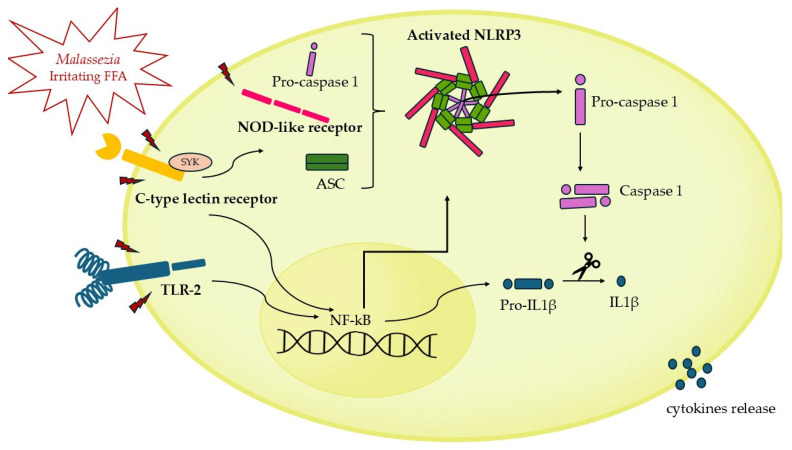
Figure 1
Figure 1
The assembly and activation of the NLRP3 inflammasome in response to NOD-like receptor (NLR) stimulated by Malassezia spp. and irritating FFAs. The inflammasome is assembled by three essential components: the sensor (NLR), the adaptor (ASC, apoptosis-associated speck-like protein containing a caspase recruitment domain), and the effector (caspase-1). Upon activation, caspase-1 interacts with clustered ASC leading to the formation of nucleated filaments. The activated caspase-1 cleaves pro-IL-1β to generate active IL-1β. TLR2 heterocomplex triggers NF-κB activation, which upregulates the expression of proinflammatory cytokines, including pro-IL-1β. Syk-coupled C-type lectin receptors activate both NF-κB and NLRP3 inflammasome. Upon NF-κB activation NLRP3 is upregulated, emphasizing the interplay between immune signaling pathways in the regulation of inflammation.
Figure 2
Figure 2
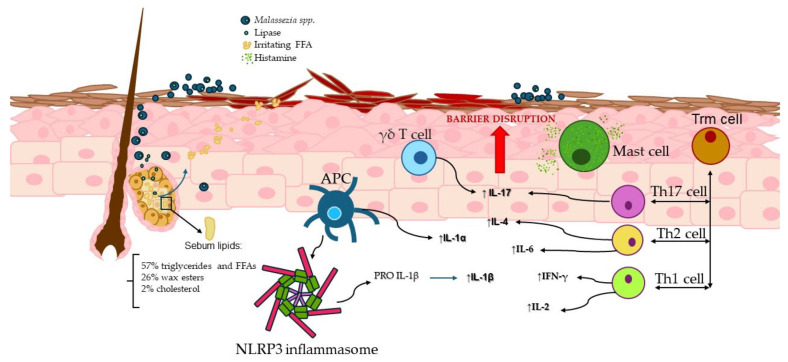
A hypothetical pathogenic pathway involving the colonization of Malassezia spp. under immunocompromised conditions. The lipase produced by the fungus acts on sebaceous lipids, resulting in the release of irritating FFAs. Dendritic cells, γδT cells, MCs, and Trm cells thus initiate an innate immune response. Activated dendritic cells trigger the NLRP3 inflammasome, which contributes to the production of IL-1β. MCs release histamine, inducing pruritus. Trm cells also involved in memory recall, activate Th1, Th2, and Th17 subsets, which produce IL-4, IL-6, IFN-γ, IL-2, and IL-17.

References

    1. Dall’Oglio F., Nasca M.R., Gerbino C., Micali G. An Overview of the Diagnosis and Management of Seborrheic Dermatitis. Clin. Cosmet. Investig. Dermatol. 2022;15:1537–1548. doi: 10.2147/CCID.S284671. - DOI - PMC - PubMed
    1. Gupta A.K., Bluhm R. Seborrheic dermatitis. J. Eur. Acad. Dermatol. Venereol. 2004;18:13–20. doi: 10.1111/j.1468-3083.2004.00693.x. - DOI - PubMed
    1. De Avelar Breunig J., de Almeida H.L., Jr., Duquia R.P., Souza P.R.M., Staub H.L. Scalp seborrheic dermatitis: Prevalence and associated factors in male adolescents. Int. J. Dermatol. 2012;51:46–49. doi: 10.1111/j.1365-4632.2011.04964.x. - DOI - PubMed
    1. Dessinioti C., Katsambas A. Seborrheic dermatitis: Etiology, risk factors, and treatments: Facts and controversies. Clin. Dermatol. 2013;31:343. doi: 10.1016/j.clindermatol.2013.01.001. - DOI - PubMed
    1. Laurence M., Benito-León J., Calon F. Malassezia and Parkinson’s Disease. Front. Neurol. 2019;10:758. doi: 10.3389/fneur.2019.00758. - DOI - PMC - PubMed