


Clonal Hematopoiesis of Indeterminate Potential and Atrial Fibrillation: Insights into Pathophysiology and Clinical Implications
- PMID: 40141381
- PMCID: PMC11942860
- DOI: 10.3390/ijms26062739
Clonal Hematopoiesis of Indeterminate Potential and Atrial Fibrillation: Insights into Pathophysiology and Clinical Implications
Abstract
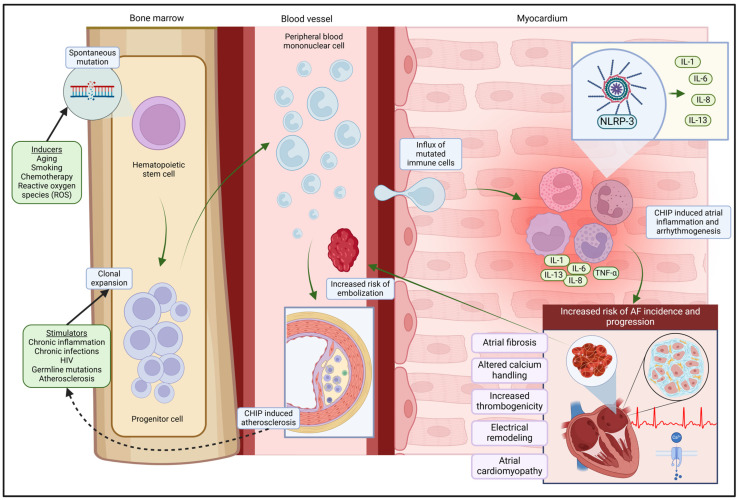
Clonal hematopoiesis of indeterminate potential (CHIP) has emerged as a novel risk factor for cardiovascular diseases. CHIP is characterized by the expansion of hematopoietic stem cell clones harboring somatic mutations in genes such as TET2, DNMT3A, and ASXL1, which are implicated in inflammation, atrial remodeling, and hypercoagulability. These mutations foster a pro-inflammatory and pro-thrombotic environment conducive to arrhythmogenesis, thereby linking CHIP to the development and progression of atrial fibrillation (AF). Mechanistic insights indicate that CHIP contributes to atrial fibrosis, disrupts calcium signaling, and exacerbates oxidative stress, all of which heighten susceptibility to AF. Clinical studies, including epidemiological and Mendelian randomization analyses, further support the association between CHIP and an increased risk of both incident and progressive AF, with specific mutations such as TET2 and ASXL1 identified as significant contributors. Additionally, CHIP has been linked to adverse outcomes in AF, including elevated rates of heart failure, thromboembolism, and mortality. Understanding CHIP's role in AF pathophysiology offers opportunities for the development of precision medicine approaches, providing novel avenues for early intervention and targeted AF treatment. This review synthesizes current mechanistic and clinical evidence on the role of CHIP in AF, emphasizes its potential as a biomarker for risk stratification, and explores emerging therapeutic strategies targeting CHIP-associated pathways.
Keywords: ASXL1; DNMT3A; TET2; atrial fibrillation; atrial fibrosis; clonal hematopoiesis of indeterminate potential; inflammation.
Conflict of interest statement
The authors declare no conflicts of interest.
Figures
References
-
- Chugh S.S., Havmoeller R., Narayanan K., Singh D., Rienstra M., Benjamin E.J., Gillum R.F., Kim Y.-H., McAnulty J.H.J., Zheng Z.-J., et al. Worldwide Epidemiology of Atrial Fibrillation: A Global Burden of Disease 2010 Study. Circulation. 2014;129:837–847. doi: 10.1161/CIRCULATIONAHA.113.005119. - DOI - PMC - PubMed
-
- Benjamin E.J., Muntner P., Alonso A., Bittencourt M.S., Callaway C.W., Carson A.P., Chamberlain A.M., Chang A.R., Cheng S., Das S.R., et al. Heart Disease and Stroke Statistics—2019 Update: A Report from the American Heart Association. Circulation. 2019;139:10. doi: 10.1161/CIR.0000000000000659. - DOI - PubMed
-
- Karakasis P., Pamporis K., Siontis K.C., Theofilis P., Samaras A., Patoulias D., Stachteas P., Karagiannidis E., Stavropoulos G., Tzikas A., et al. Major Clinical Outcomes in Symptomatic vs. Asymptomatic Atrial Fibrillation: A Meta-Analysis. Eur. Heart J. 2024:ehae694. doi: 10.1093/eurheartj/ehae694. - DOI - PubMed
Publication types
MeSH terms
Substances
LinkOut - more resources
Full Text Sources
Medical
