


A Review on Recent Trends in Bacteriophages for Post-Harvest Food Decontamination
- PMID: 40142412
- PMCID: PMC11946132
- DOI: 10.3390/microorganisms13030515
A Review on Recent Trends in Bacteriophages for Post-Harvest Food Decontamination
Abstract
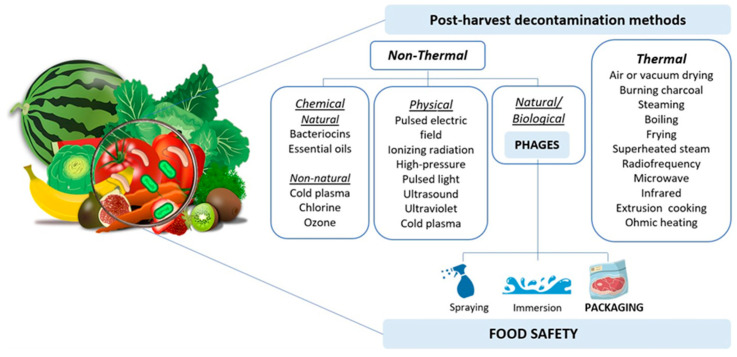
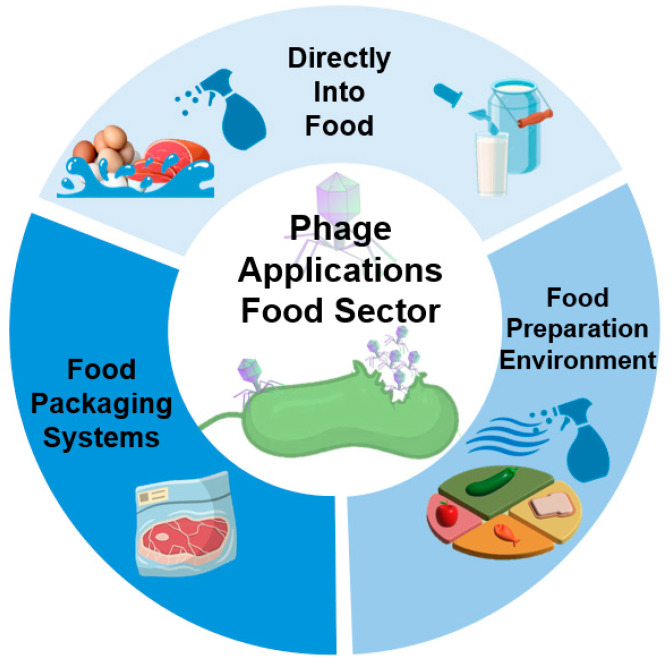
Infectious diseases resulting from unsafe food consumption are a global concern. Despite recent advances and control measures in the food industry aimed at fulfilling the growing consumer demand for high-quality and safe food products, infection outbreaks continue to occur. This review stands out by providing an overview of post-harvest food decontamination methods against some of the most important bacterial foodborne pathogens, with particular focus on the advantages and challenges of using phages, including their most recent post-harvest applications directly to food and integration into active food packaging systems, highlighting their potential in providing safer and healthier food products. The already approved commercial phage products and the numerous available studies demonstrate their antibacterial efficacy against some of the most problematic foodborne pathogens in different food products, reinforcing their possible use in the future as a current practice in the food industry for food decontamination. Moreover, the incorporation of phages into packaging materials holds particular promise, providing protection against harsh conditions and enabling their controlled and continuous release into the food matrix. The effectiveness of phage-added packaging materials in reducing the growth of pathogens in food systems has been well-demonstrated. However, there are still some challenges associated with the development of phage-based packaging systems that need to be addressed with future research.
Keywords: active food packaging; food safety; foodborne pathogens; phage biocontrol; post-harvest stage.
Conflict of interest statement
The authors declare no conflicts of interest.
Figures
References
-
- World Health Organization (WHO) Food Safety Fact Sheet. [(accessed on 16 January 2025)]. Available online: https://www.who.int/news-room/fact-sheets/detail/food-safety.
-
- Chacha J.S., Zhang L., Ofoedu C.E., Suleiman R.A., Dotto J.M., Roobab U., Agunbiade A.O., Duguma H.T., Mkojera B.T., Hossaini S.M., et al. Revisiting non-thermal food processing and preservation methods—Action mechanisms, pros and cons: A technological update (2016–2021) Foods. 2021;10:1430. doi: 10.3390/foods10061430. - DOI - PMC - PubMed
-
- Mendoza I.C., Luna E.O., Pozo M.D., Vásquez M.V., Montoya D.C., Moran G.C., Romero L.G., Yépez X., Salazar R., Romero-Peña M., et al. Conventional and non-conventional disinfection methods to prevent microbial contamination in minimally processed fruits and vegetables. LWT—Food Sci. Technol. 2022;165:113714. doi: 10.1016/j.lwt.2022.113714. - DOI - PMC - PubMed
Publication types
Grants and funding
- UIDP/50017/2020 + UIDB/50017/2020 + LA/P/0094/2020/Fundação para a Ciência e Tecnologia
- UIDB/50011/2020 (DOI 10.54499/UIDB/50011/2020), UIDP/50011/2020 (DOI 10.54499/UIDP/50011/2020) & LA/P/0006/2020 (DOI 10.54499/LA/P/0006/2020/Fundação para a Ciência e Tecnologia
- DOI 10.54499/2020.06571.BD/Fundação para a Ciência e Tecnologia
- DOI 10.54499/CEECIND/03974/2017/CP1459/CT0022/Fundação para a Ciência e Tecnologia
- CEECIND/00464/2017/Fundação para a Ciência e Tecnologia
LinkOut - more resources
Full Text Sources
Molecular Biology Databases
