Review
. 2025 Mar 11;14(6):1894.
doi: 10.3390/jcm14061894.

Hair Longevity-Evidence for a Multifactorial Holistic Approach to Managing Hair Aging Changes

Affiliations
Review

Hair Longevity-Evidence for a Multifactorial Holistic Approach to Managing Hair Aging Changes

Gillian E Westgate et al. J Clin Med. .

Abstract

Loss of hair density-hair thinning and balding- is typically referred to as male and female pattern alopecia. Causes include genetic predisposition and links to the impact of dihydrotestosterone on the follicle dermal papilla, which are typically characterized by an increase in the number of vellus follicles. Links to chronological aging are unclear. Proven treatments remain few in number and are still targeting and tested on those experiencing classical pattern hair loss. The way hair changes with aging, especially in women, can be considered as having a much broader scope. Trends in managing changes to hair density, length, and fiber quality with aging now mostly include cocktail approaches-whether topical, injected, or oral-recognizing that solutions are more likely to require a multifactorial strategy. This review examines the evidence for the more holistic approach to addressing unwanted hair loss, which includes nutrition, lifestyle, stress management, and scalp and hair care, as well as co-morbidities with other health concerns. We discuss the strengths and limitations of clinical study design to investigate efficacy using multifactorial holistic approaches. We propose that this strategy will contribute to the emerging concept of hair longevity in which follicle, scalp, and fiber are targeted and that maintaining anagen is the most appropriate route to achieving healthy hair with aging. Finally, we discuss the problem facing patients and consumers regarding the quantity of misinformation and how it influences choosing from a fast-growing market of solutions that bypass a pharmaceutical approach to hair thinning.

Keywords: aging; alopecia; hair and scalp; hair loss; metabolism; senescence.


Conflict of interest statement

DG and MS are employees of Olistic. GW is a paid consultant for Olistic.

Figures
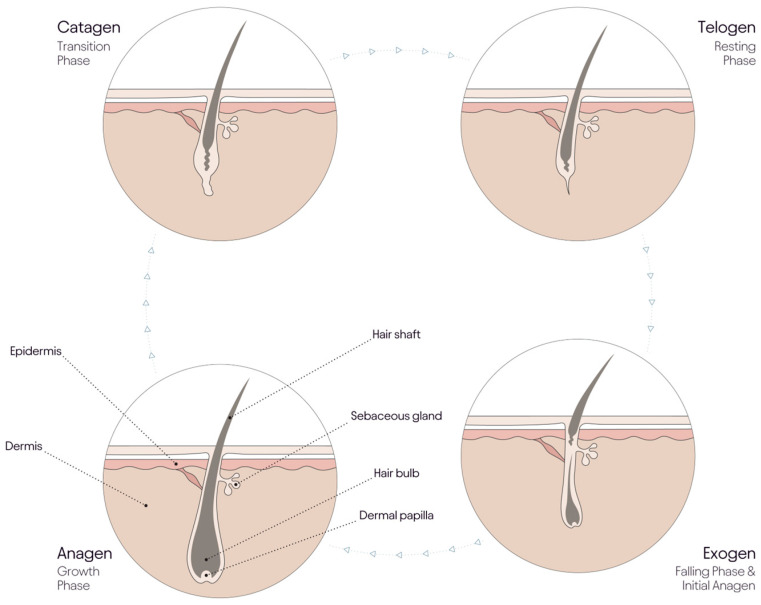
Figure 1
Figure 1
Hair growth cycle. The hair growth cycle consists of the anagen, catagen, telogen, and exogen phases, each contributing to its dynamic progression.
Figure 2
Figure 2
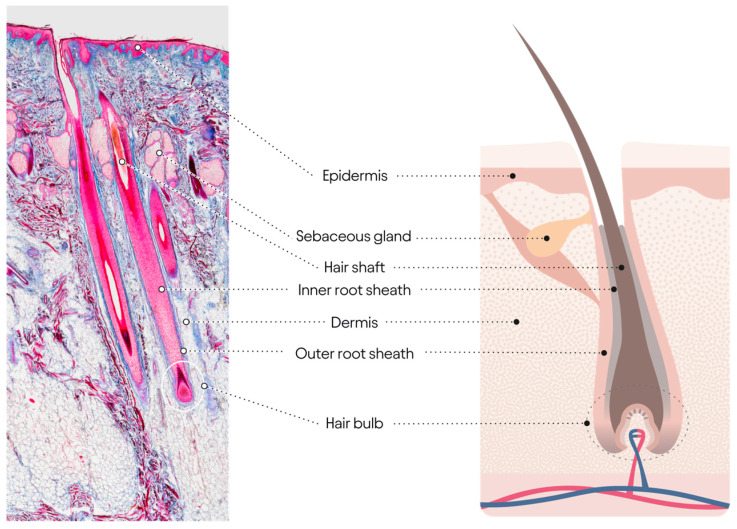
Hair follicle anatomy: a histological representation of the hair follicle is shown on the (left), while a diagram representation is displayed on the (right).
Figure 3
Figure 3
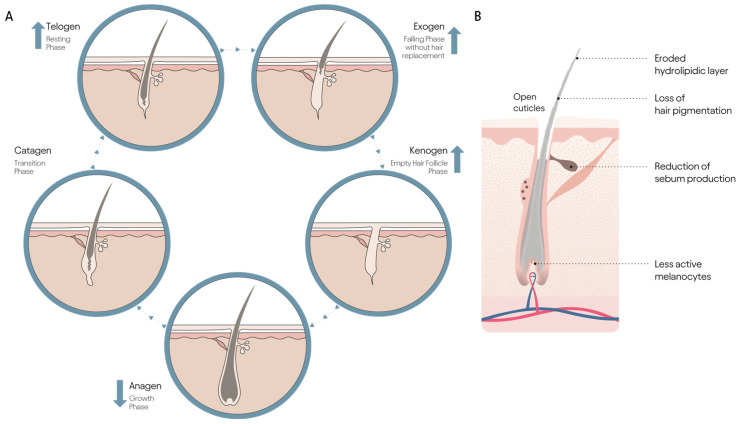
Aged hair growth cycle: displaying the dynamic process of the hair growth cycle, including the anagen, catagen, telogen, exogen, and kenogen phases. (A) Emphasis is placed on the changes associated with hair aging, such as a shorter anagen phase (↓), a longer telogen phase (↑), and the increased prominence of the exogen (↑) and kenogen phases (↑). (B) Diagram of an aged hair follicle, highlighting the primary alterations caused by the aging process: open cuticles, eroded hydrolipidic layer, loss of hair pigmentation due to less active melanocytes, and reduction of sebum production.
Figure 4
Figure 4
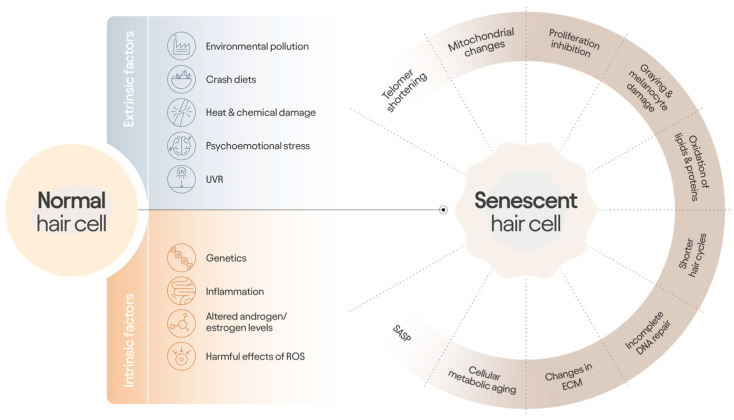
The multifactorial process of hair aging. Intrinsic and extrinsic factors initiate the complex process of hair cell senescence, leading to a great variety of changes.

References

    1. Owecka B., Tomaszewska A., Dobrzeniecki K., Owecki M. The Hormonal Background of Hair Loss in Non-Scarring Alopecias. Biomedicines. 2024;12:513. doi: 10.3390/biomedicines12030513. - DOI - PMC - PubMed
    1. Starace M., Orlando G., Alessandrini A., Piraccini B.M. Female Androgenetic Alopecia: An Update on Diagnosis and Management. Am. J. Clin. Dermatol. 2020;21:69–84. doi: 10.1007/s40257-019-00479-x. - DOI - PubMed
    1. Messenger A.G., Sinclair R. Follicular miniaturization in female pattern hair loss: Clinicopathological correlations. Br. J. Dermatol. 2006;155:926–930. doi: 10.1111/j.1365-2133.2006.07409.x. - DOI - PubMed
    1. Gupta A.K., Mays R.R., Dotzert M.S., Versteeg S.G., Shear N.H., Piguet V. Efficacy of non-surgical treatments for androgenetic alopecia: A systematic review and network meta-analysis. J. Eur. Acad. Dermatol. Venereol. 2018;32:2112–2125. doi: 10.1111/jdv.15081. - DOI - PubMed
    1. Rebora A., Guarrera M., Drago F. Postpartum telogen effluvium. J. Eur. Acad. Dermatol. Venereol. 2016;30:518. doi: 10.1111/jdv.12914. - DOI - PubMed

LinkOut - more resources