


Detection and In Vivo Validation of Dichorhavirus e-Probes in Meta-Transcriptomic Data via Microbe Finder (MiFi®) Discovers a Novel Host and a Possible New Strain of Orchid Fleck Virus
- PMID: 40143368
- PMCID: PMC11946451
- DOI: 10.3390/v17030441
Detection and In Vivo Validation of Dichorhavirus e-Probes in Meta-Transcriptomic Data via Microbe Finder (MiFi®) Discovers a Novel Host and a Possible New Strain of Orchid Fleck Virus
Abstract
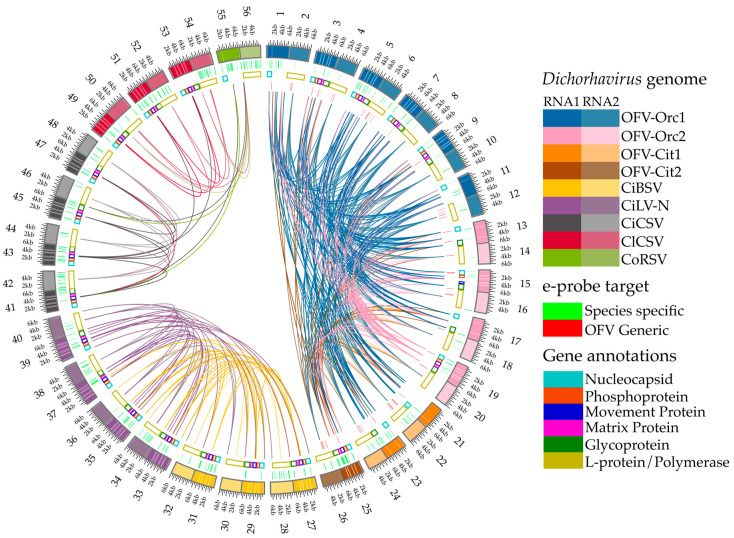
Dichorhavirus is a recently accepted plant virus genus within the family Rhabdoviridae. Species assigned to the genus consist of bi-segmented, negative sense, single-stranded RNA viruses and are transmitted by Brevipalpus spp. Currently, there are five recognized species and two unclassified members in the genus Dichorhavirus. Four out of seven-orchid fleck virus (OFV), citrus leprosis virus N, citrus chlorotic spot virus, and citrus bright spot virus-can infect citrus and produce leprosis disease-like symptoms. The E-probe Diagnostic for Nucleic Acid Analysis (EDNA) was developed to reduce computational effort and then integrated within Microbe-Finder (MiFi®) online platform to design and evaluate e-probes in raw High Throughput Sequencing (HTS) data. During this study, Dichorhavirus genomes were downloaded from public databases and e-probes were designed using the MiProbe incorporated into the MiFi® platform. Three different sizes of e-probes, 40, 60, and 80 nucleotides, were developed and selected based on whole genome comparisons with near-neighbor genomes. For curation, each e-probe was searched in the NCBI nucleotide sequence database using BLASTn. All the e-probes that had hits with non-target species with ≥90% identities were removed. The sensitivity and specificity of Dichorhavirus genus, species, strain, and variant-specific e-probes were validated in vivo using HTS meta-transcriptomic libraries generated from Dichorhavirus-suspected citrus, orchid, and ornamentals. Through downstream analysis of HTS data, EDNA not only detected the known hosts of OFV but also discovered an unknown host leopard plant (Farfugium japonicum), and the possible existence of a new ornamental strain of OFV in nature.
Keywords: Brevipalpus transmitted virus (BTV); EDNA; MiFi; e-probe; high-throughput sequencing; orchid fleck virus; virus detection; virus discovery.
Conflict of interest statement
The authors declare no conflicts of interest, as the research was conducted in the absence of any commercial or financial relationships that could be construed as a potential conflict of interest.
Figures


References
-
- Dietzgen R.G., Freitas-Astúa J., Chabi-Jesus C., Ramos-González P.L., Goodin M.M., Kondo H., Tassi A.D., Kitajima E.W. Advances in Virus Research. Volume 102. Academic Press Inc.; Cambridge, MA, USA: 2018. Dichorhaviruses in Their Host Plants and Mite Vectors; pp. 119–148. - PubMed
-
- Nemchinov L.G., Irish B.M., Grinstead S. First report of Medicago trirhavirus 1 infecting alfalfa in Washington State, USA. Plant Dis. 2024 doi: 10.1094/PDIS-05-24-1132-PDN. Epub ahead of print . - DOI
-
- Dietzgen R.G., Kuhn J.H., Clawson A.N., Freitas-Astúa J., Goodin M.M., Kitajima E.W., Kondo H., Wetzel T., Whitfield A.E. Dichorhavirus: A Proposed New Genus for Brevipalpus Mite-Transmitted, Nuclear, Bacilliform, Bipartite, Negative-Strand RNA Plant Viruses. Arch. Virol. 2014;159:607–619. doi: 10.1007/s00705-013-1834-0. - DOI - PubMed
Publication types
MeSH terms
Substances
Associated data
Grants and funding
LinkOut - more resources
Full Text Sources
Miscellaneous
