


Psychiatrist-led hepatitis C (HCV) treatment at an opioid agonist treatment clinic in Stockholm- a model to enhance the HCV continuum of care
- PMID: 40148897
- PMCID: PMC11948708
- DOI: 10.1186/s12888-025-06733-3
Psychiatrist-led hepatitis C (HCV) treatment at an opioid agonist treatment clinic in Stockholm- a model to enhance the HCV continuum of care
Erratum in
-
Correction: Psychiatrist-led hepatitis C (HCV) treatment at an opioid agonist treatment clinic in Stockholm- a model to enhance the HCV continuum of care.BMC Psychiatry. 2025 Jul 31;25(1):746. doi: 10.1186/s12888-025-07203-6. BMC Psychiatry. 2025. PMID: 40745597 Free PMC article. No abstract available.
Abstract
Background: People with opioid agonist therapy (OAT) represent a population with an increased hepatitis C (HCV) prevalence. Recent studies provide strong evidence regarding effective HCV treatment outcomes and low levels of reinfection in this population. Increased access to HCV care for people with OAT is essential to reach the WHO goal of eliminating HCV as a major public health threat by 2030.
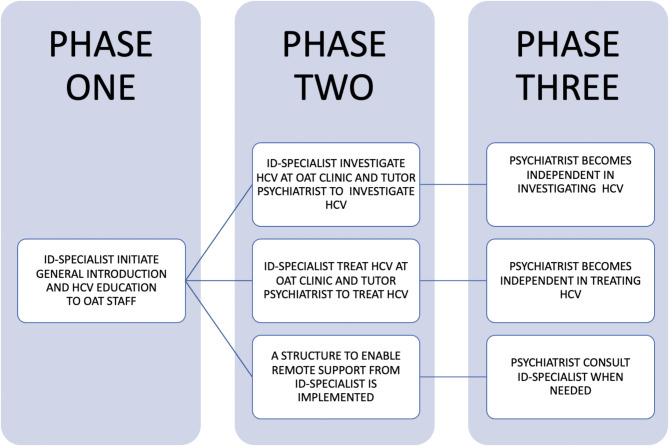
Methods: The Maria OAT clinic, located in central Stockholm, provides OAT for approximately 500 patients. The majority have a history of injection drug use. In October 2017, psychiatrist-led HCV treatment was initiated, with remote consultation support from the local infectious diseases clinic. All OAT staff participated in HCV-specific education to increase HCV awareness. To evaluate HCV treatment outcomes for this model of care, we examined sustained virological response (SVR) and reinfection rates between January 2018 and December 2022.
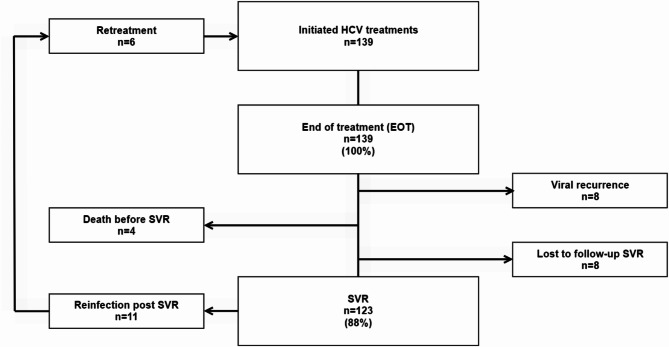
Results: Between October 2017 and June 2022, 133 participants received HCV treatment through weekly administrations or directly observed treatment. 72% were men, and the overall mean age was 44.7 years. Six participants were retreated, giving a total of 139 treatment initiations. All were HCV RNA negative at end of treatment, and 88% reached SVR. A total of 11 reinfections post SVR were noted, with a reinfection rate of 7.3/100 person-years (95% CI 4.1-12.9).
Conclusion: Overall, successful HCV treatment results and levels of reinfections consistent with the literature were achieved. Bringing HCV diagnostics and treatment to an OAT clinic constitutes a good example of enhancing the HCV continuum of care. Furthermore, HCV treatment education for psychiatrists, addiction specialists and staff at OAT clinics makes HCV care more sustainable, as specifically noted during the COVID-19 pandemic. This successful model of care, introducing HCV treatment by psychiatrists on-site at OAT clinics, has now been further implemented at other OAT clinics in Stockholm.
Keywords: Continuum of care; HCV treatment; OAT; Task shifting.
© 2025. The Author(s).
Conflict of interest statement
Declarations. Ethics approval and consent to participate: The study was performed in accordance with the Helsinki Declaration and was approved by the Regional Ethical Review Board in Stockholm (Dnr: 2019 − 002016). All HCV treated participants at the Maria OAT clinic were informed about the study and provided written informed consent. Consent for publication: Not applicable. Competing interests: PEK has received honoraria for lectures from Gilead and Indivior; SA has received payment or honoraria for lectures and educational events from Gilead, AbbVie, Merck Sharp & Dohme, Biogen, not related to this work; MK has received honoraria for lectures/consultancy from AbbVie, Gilead, MSD, Mundipharma, DnE Pharma, Nordic Drugs and has received research grants from Gilead and Nordic Drugs. No conflicts of interest exist for the remaining author.
Figures
References
-
- WHO, Hepatitis C. 2024 2024/11/22]; Available from: https://www.who.int/news-room/fact-sheets/detail/hepatitis-c
-
- Hajarizadeh B, et al. Direct-acting antiviral treatment for hepatitis C among people who use or inject drugs: a systematic review and meta-analysis. Lancet Gastroenterol Hepatol. 2018;3(11):754–67. - PubMed
-
- Graf C, et al. Efficacy of Direct-acting antivirals for chronic hepatitis C virus infection in people who inject drugs or receive opioid substitution therapy: A systematic review and Meta-analysis. Clin Infect Dis. 2020;70(11):2355–65. - PubMed
MeSH terms
Substances
LinkOut - more resources
Full Text Sources
Medical
