


Tri-orchidism: A rare case report
- PMID: 40151276
- PMCID: PMC11937628
- DOI: 10.1016/j.radcr.2025.02.069
Tri-orchidism: A rare case report
Abstract
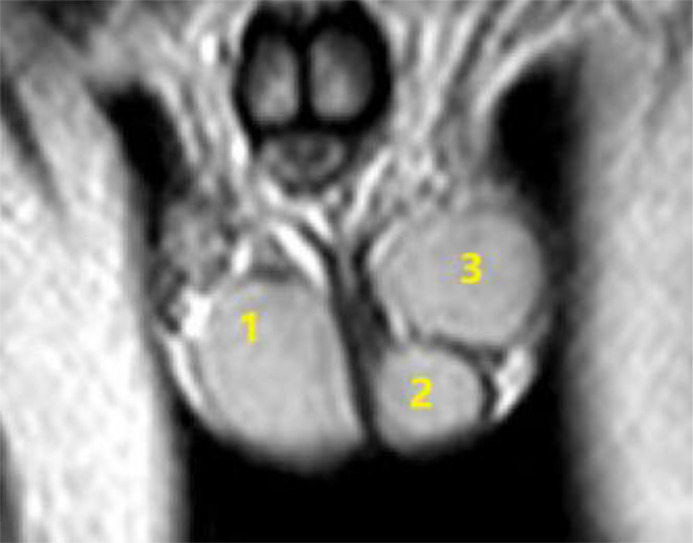
Tri-orchidism which means 3 testes in the scrotal cavity, is the most common type of the polyorchidism. It is the rarest anomaly of the urogenital tract, and occurs more commonly on the left side. Superanumerary testes shows scrotal and extra-scrotal presentation and is associated with several clinical features and complications. We report a case of triorchidism in a 29-year-old man who presented with left hemiscrotal pain, later on diagnosed on clinical and sonographic examinations. The management depends on different factors and include conservative treatment with follow up, orchidopexy and orchidectomy. Orchidectomy is advised in suspected case of malignancy.
Keywords: MRI; Polyorchidism; Tri-orchidism; Ultrasound.
© 2025 The Authors.
Figures


References
-
- Spranger R., Gunst M., Kuhn M. Polyorchidism: a strange anomaly with unsuspected properties. J Urol. 2002;168:198. - PubMed
Publication types
LinkOut - more resources
Full Text Sources
