. 2025 Mar 28;11(13):eadu3344.
doi: 10.1126/sciadv.adu3344. Epub 2025 Mar 28.

Neuraminidase-specific antibodies drive differential cross-protection between contemporary FLUBV lineages

Affiliations

Neuraminidase-specific antibodies drive differential cross-protection between contemporary FLUBV lineages

Caroline K Page et al. Sci Adv. .

Abstract

The two influenza B virus (FLUBV) lineages have continuously diverged from each other since the 1980s, with recent (post-2015) viruses exhibiting accelerated evolutionary rates. Emerging data from human studies and epidemiological models suggest that increased divergence in contemporary viruses may drive differential cross-protection, where infection with Yamagata lineage viruses provides limited immunity against Victoria lineage viruses. Here, we developed animal models to investigate the mechanisms behind asymmetric cross-protection between contemporary FLUBV lineages. Our results show that contemporary Victoria immunity provides robust cross-protection against the Yamagata lineage, whereas Yamagata immunity offers limited protection against the Victoria lineage. This differential cross-protection is driven by Victoria-elicited neuraminidase (NA)-specific antibodies, which show cross-lineage reactivity, unlike those from Yamagata infections. These findings identify a phenomenon in contemporary FLUBV that may help explain the recent disappearance of the Yamagata lineage from circulation, highlighting the crucial role of targeting NA in vaccination strategies to enhance cross-lineage FLUBV protection.


Figures

Fig. 1.
Fig. 1.. Influenza preimmunity contributes to the duration of cross-protection elicited between Victoria and Yamagata lineage viruses.
(A and B) Experimental design, timeline, and immune status for establishing a ferret FLUBV cross-protection model. Naïve or A/California/07/2009 (H1N1) preimmune ferrets were intranasally inoculated with 106 PFU of either B/Washington/02/2019 (B/Vic) or B/Oklahoma/10/2018 (B/Yam). Following the initial FLUBV infection, animals were rested for either 2 or 6 months and then infected with the opposing lineage influenza B virus. (C and D) Viral titers in nasal wash samples collected days 1, 3, 5, and 7 postsecondary FLUBV infection in ferrets with B/Vic preimmunity, challenged with B/Yam. (E and F) Viral titers from nasal wash samples in ferrets with B/Yam preimmunity, challenged with B/Vic after a 2- or- 6-month rest period. Viral titers from naïve ferrets in (C) and (D) and (E) and (F) are repeated for graphical clarity. Statistical significance was determined by a two-way ANOVA with Geisser-Greenhouse correction, with P values indicated as follows: *P < 0.05, **P < 0.01, and ****P < 0.0001. Data points represent individual animals, and bars represent means ± SD.
Fig. 2.
Fig. 2.. Serum antibodies mediate differential protection against influenza B with contemporary viruses.
(A) Experimental design, timeline, and viruses used for establishing the FLUBV cross-protection model. Mice were intranasally infected with 103 PFU of either B/WA, B/OK, B/Bris, or B/MA, rested for 35 days, and then reinfected with 104 PFU of an opposing lineage virus. Lung samples were collected on days 1, 3, 5, and 7 postsecondary infection to assess viral replication. (B) Viral replication in the lungs of mice initially infected with noncontemporary B/Bris or B/MA and then reinfected 35 days later with cross-lineage noncontemporary B/MA or B/Bris, respectively. (C) Viral replication in the lungs of mice initially infected with noncontemporary B/Bris or B/MA and then reinfected 35 days later with cross-lineage contemporary B/OK or B/WA, respectively. (D) Viral replication in the lungs of mice initially infected with contemporary B/WA or B/OK and then reinfected 35 days later with cross-lineage contemporary B/OK or B/WA, respectively. The day 3 data represent two independent experiments. (E) Experimental design for the passive transfer experiment. Mice were intranasally inoculated with 103 PFU of B/WA or B/OK. Serum was collected 35 days postinfection and transferred to naïve recipient mice, which were then challenged with 103 PFU of the cross-lineage virus, B/OK or B/WA, respectively. Lungs were collected from challenged mice on day 3 postinfection. (F) Viral replication in the lungs of mice passively transferred anti-Vic or anti-Yam antibodies and challenged with B/WA (Vic). (G) Viral replication in the lungs of mice passively transferred anti-Vic or anti-Yam antibodies and challenged with B/OK (Yam). Statistical significance was determined using a two-way [(B) to (D)] or one-way [(F) to (G)] ANOVA, with **P < 0.01, ***P < 0.001, and ****P < 0.0001.
Fig. 3.
Fig. 3.. HA-specific antibodies provide homologous protection against an FLUBV challenge.
(A) Spider plots displaying average normalized IgG (top) and IgA (bottom) serum responses in Victoria- and Yamagata-infected mice for various influenza A and B antigens: Yamagata (pink), Victoria (purple), H1N1 (yellow), and H3N2 (light blue). Each vertex represents the normalized binding of IgG/IgA to a single influenza antigen. Anti-WA (Victoria) infection serum and anti-OK (Yamagata) infection serum groups are denoted by blue and green lines, respectively. The outer circle numbers indicate which antigen the response is directed at (table S1), whereas the pink and purple dots inside the circle denote HA antigens of the infection strains Victoria (B/WA) and B/Yamagata (B/OK), respectively. (B) Timeline for rHA vaccination in mice with either B/WA HA (Victoria) or B/OK HA (Yamagata). (C and D) ELISA of serum collected after prime or prime-boost vaccination, tested against rHA from homologous or cross-lineage antigens. OD, optical density. (E and F) Lung viral titers on day 3 postinfection with contemporary FLUBV (B/WA, Victoria or B/OK, Yamagata) in rHA-vaccinated mice. Statistical significance was determined using a one-way ANOVA, with *P < 0.05 and ****P < 0.0001.
Fig. 4.
Fig. 4.. Functional NA-specific antibody responses drive differential cross-protection against contemporary FLUBVs.
(A) ELISA following FLUBV infection with either B/Washington/02/2019 (B/WA), B/Oklahoma/10/2018 (B/OK), B/Brisbane/60/2008 (B/Bris), or B/Massachusetts/02/2012 (B/MA) in mice or ferrets, tested against rNA from Victoria (B/WA) or Yamagata (B/OK) lineages. (B) ELLA following FLUBV infection with B/WA, B/OK, B/Bris, or B/MA in mice and ferrets. Dashed line indicated the 50% inhibition cutoff. (C and D) ELLA results using serum from mice postboost with rNA vaccination. (E and F) Lung viral titers on day 3 postinfection with contemporary FLUBV (B/WA, Victoria or B/OK, Yamagata) in rNA-vaccinated mice. Statistical significance was determined using a one-way ANOVA, with *P < 0.05, **P < 0.01, and ****P < 0.0001.
Fig. 5.
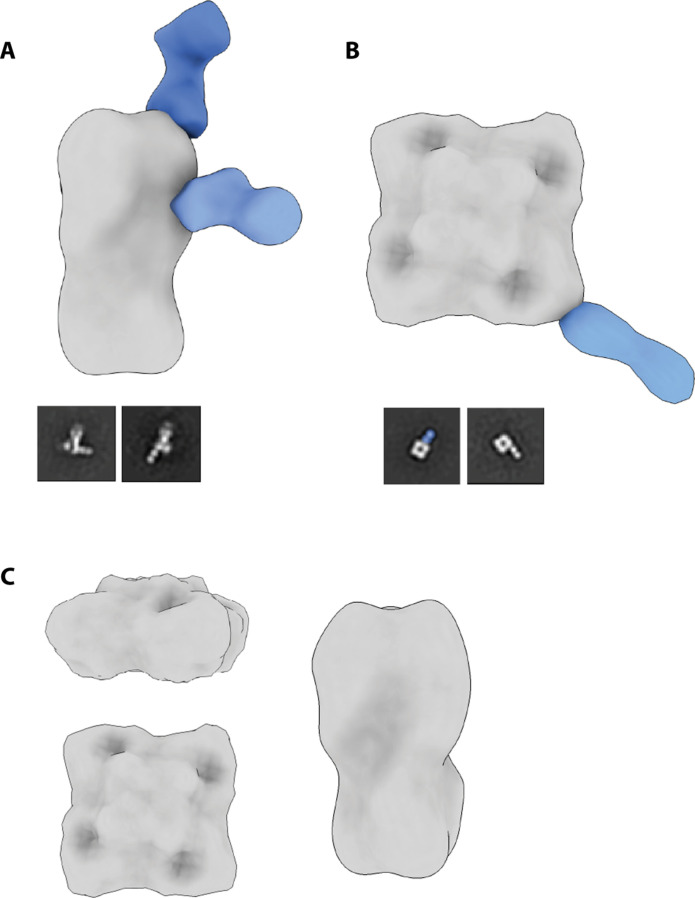
Fig. 5.. Negative-stain electron microscopy reconstructions of Victoria ferret pAbs with representative 2D classes.
pAb complex assemblies were generated by segmenting and resampling densities corresponding to each Fab and then mapped onto an HA trimer or NA tetramer. Complete 3D classes are shown in the Supplementary Materials. (A) Recombinant B/Washington/02/2019 (B/WA; Victoria) HA with B/WA ferret serum at day 28 postinfection. (B) Recombinant B/WA NA with B/WA ferret serum at day 28 postinfection. A putative NA interface pAb is highlighted in 2D as insufficient particles were available for a 3D reconstruction. (C) Recombinant B/WA HA and NA complexed with B/Oklahoma/10/2018 (B/OK; Yamagata) ferret serum at day 28 postinfection. No pAb responses observed.

References

    1. Francis T. Jr., A new type of virus from epidemic influenza. Science 92, 405–408 (1940). - PubMed
    1. McCullers J. A., Hayden F. G., Fatal influenza B infections: Time to reexamine influenza research priorities. J. Infect. Dis. 205, 870–872 (2012). - PubMed
    1. Rosu M. E., Lexmond P., Bestebroer T. M., Hauser B. M., Smith D. J., Herfst S., Fouchier R. A. M., Substitutions near the HA receptor binding site explain the origin and major antigenic change of the B/Victoria and B/Yamagata lineages. Proc. Natl. Acad. Sci. U.S.A. 119, e2211616119 (2022). - PMC - PubMed
    1. Rota P. A., Wallis T. R., Harmon M. W., Rota J. S., Kendal A. P., Nerome K., Cocirculation of two distinct evolutionary lineages of influenza type B virus since 1983. Virology 175, 59–68 (1990). - PubMed
    1. Sandt C. E., Bodewes R., Rimmelzwaan G. F., Vries R. D., Influenza B viruses: Not to be discounted. Future Microbiol. 10, 1447–1465 (2015). - PubMed

MeSH terms

LinkOut - more resources