


Joint association of estimated glucose disposal rate and systemic inflammation response index with mortality in cardiovascular-kidney-metabolic syndrome stage 0-3: a nationwide prospective cohort study
- PMID: 40158167
- PMCID: PMC11955130
- DOI: 10.1186/s12933-025-02692-x
Joint association of estimated glucose disposal rate and systemic inflammation response index with mortality in cardiovascular-kidney-metabolic syndrome stage 0-3: a nationwide prospective cohort study
Abstract
Background: The Cardiovascular-Kidney-Metabolic (CKM) syndrome underscores the complex interactions among metabolic disorders, kidney disease, and cardiovascular conditions. Insulin resistance (IR) and inflammation are crucial in CKM syndrome development, but their combined effect in stages 0-3 remains unclear.
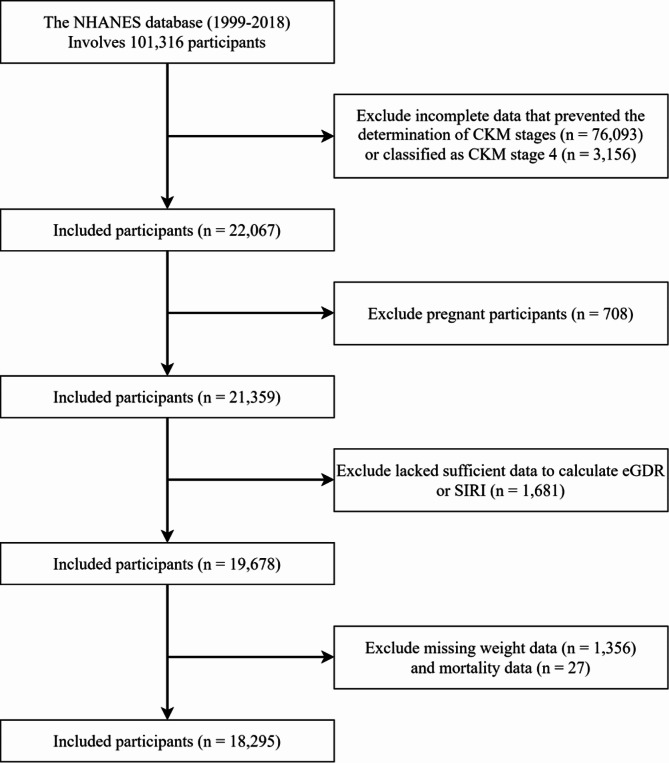
Methods: Using data from the National Health and Nutrition Examination Survey (NHANES), we included 18,295 participants with CKM syndrome stages 0-3 from 10 cycles between 1999 and 2018. IR was assessed using the estimated glucose disposal rate (eGDR), and systemic inflammation was evaluated using the Systemic Inflammation Response Index (SIRI). The primary endpoint was all-cause mortality, and the secondary endpoint was cardiovascular disease (CVD) mortality.
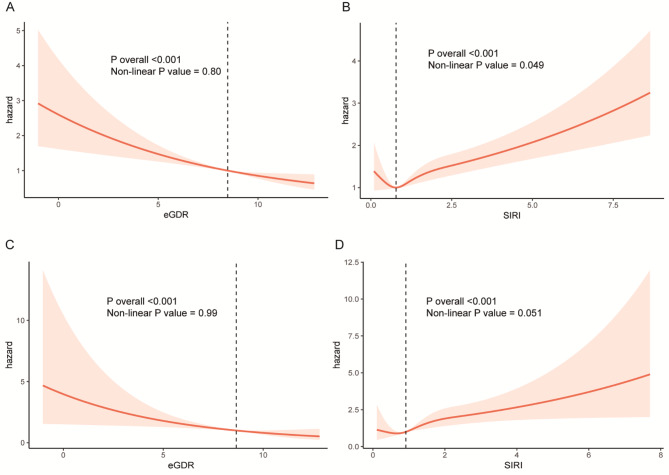
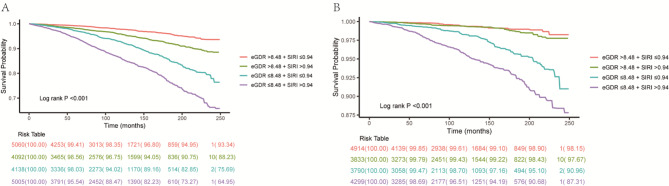
Results: Over an average follow-up period of 121 months, we recorded 1,998 all-cause deaths and 539 CVD deaths. Both eGDR and SIRI were independent risk factors for mortality. The hazard ratios (HR) for eGDR were 0.90 (0.86, 0.94) for all-cause mortality and 0.85 (0.78, 0.93) for CVD mortality, per unit increase in eGDR. For SIRI, the HRs were 1.16 (1.11, 1.21) for all-cause mortality and 1.33 (1.19, 1.46) for CVD mortality, per unit increase in SIRI. Compared to individuals with high eGDR and low SIRI levels, those with low eGDR and high SIRI levels exhibited significantly higher mortality risks, with HRs of 1.97 (1.58, 2.44) for all-cause mortality and 2.35 (1.48, 3.73) for CVD mortality. Subgroup analysis revealed that the combined impact of eGDR and SIRI was particularly significant in patients under 60 years old.
Conclusion: In CKM syndrome stages 0-3, eGDR and SIRI have joint effect on mortality. Combining these markers can help identify high-risk individuals early, enabling timely monitoring and intervention to improve outcomes.
Keywords: Cardiovascular-kidney-metabolic syndrome; Estimated glucose disposal rate; Mortality; National health and nutrition examination survey; Systemic inflammation response index.
© 2025. The Author(s).
Conflict of interest statement
Declarations. Conflict of interest: The authors declare no competing interests. Ethical approval and consent to participate: The research protocol for NHANES received formal approval from the Institutional Review Board of the National Center for Health Statistics (NCHS), with written informed consent obtained from all participating individuals. As the current investigation constitutes a secondary analysis of deidentified, publicly available NHANES data, it was classified as exempt from further institutional review board evaluation according to established ethical guidelines for secondary data analysis. Consent for publication: Not applicable.
Figures
References
-
- Ndumele CE, Rangaswami J, Chow SL, Neeland IJ, Tuttle KR, Khan SS, et al. Cardiovascular-Kidney-Metabolic health: A presidential advisory from the American heart association. Circulation. 2023;148:1606–35. - PubMed
-
- Ndumele CE, Neeland IJ, Tuttle KR, Chow SL, Mathew RO, Khan SS, et al. A synopsis of the evidence for the science and clinical management of Cardiovascular-Kidney-Metabolic (CKM) syndrome: A scientific statement from the American heart association. Circulation. 2023;148:1636–64. - PubMed
MeSH terms
Substances
Grants and funding
LinkOut - more resources
Full Text Sources
Medical
Miscellaneous
