. 2025 Apr:114:105672.
doi: 10.1016/j.ebiom.2025.105672. Epub 2025 Mar 29.

Impact of rosuvastatin on the memory potential and functionality of CD8+ T cells from people with HIV

Affiliations

Impact of rosuvastatin on the memory potential and functionality of CD8+ T cells from people with HIV

Federico Perdomo-Celis et al. EBioMedicine. 2025 Apr.

Abstract

Background: Virus-specific CD8+ T cells play a major role in the natural control of HIV infection, linked to memory-like features such as high survival capacity and polyfunctionality. However, virus-specific CD8+ T cells from HIV non-controllers exhibit an effector-like and exhausted profile, with limited antiviral potential. Metabolic reprogramming of cells from non-controllers could reinvigorate their functional capacities. Considering the implication of the cholesterol pathway in the induction of T cell exhaustion, here we evaluated the impact of rosuvastatin, an inhibitor of cholesterol synthesis, on the functionality and memory profile of HIV-specific CD8+ T cells from people on antiretroviral treatment.

Methods: We analysed samples from 10 individuals with HIV-1 on ART who participated in the IMEA 043-CESAR trial and received rosuvastatin for 12 weeks. We explored whether rosuvastatin treatment was accompanied by changes in the memory potential of CD8+ T cells. We evaluated the phenotype and functionality of total and HIV-specific CD8+ T cells before, during, and after treatment with rosuvastatin. A mixed effects model was used for repeated measures and corrected for multiple comparisons.

Findings: Total and HIV-specific CD8+ T cell survival and functionality were enhanced in individuals who received a 12-week course of rosuvastatin, with a consistent increase in polyfunctional IFN-γ+ TNF-α+ cells. The superior CD8+ T cell functionality after rosuvastatin treatment was associated with intrinsic metabolic changes, including the decrease of fatty acid uptake, as well as a reduction in effector/exhaustion markers. Changes in the characteristics of CD8+ T cells coincided with the duration of rosuvastatin administration, and most effects waned after the cessation of the treatment.

Interpretation: CD8+ T cell metabolic reprogramming by targeting the cholesterol pathway, combined with other available immunotherapies, might represent a promising strategy in the search for the cure of HIV or other chronic viral infections.

Funding: The CESAR trial was sponsored by IMEA. This work was supported by the NIH (grants UM1AI164562 and R01DK131476).

Keywords: CD8(+) T cells; HIV control; HIV remission; HIV-1; Statins; T cell reprogramming.


Conflict of interest statement

Declaration of interests None to declare.

Figures

Fig. 1
Fig. 1
Rosuvastatin promotes polyfunctional CD8+ T cells. a. Study design and changes in total, HDL and LDL cholesterol, and triglycerides (TG) in the participants included in this study. b–d. Frequency of live CD3+ cells (b), as well as CFSElo (c), and CD107a+ (d) CD8+ T cells upon 6 days stimulation with anti-CD3/CD28 antibodies. e. Representative expression of IFN-γ and TNF-α in polyclonally-stimulated CD8+ T cells from the same donor at the three time points evaluated, and summary of the frequency of IFN-γ+ and TNF-α+ CD8+ T cells. f. Frequency of IFN-γ+ TNF-α+ CD8+ T cells. Samples from 10 participants were analysed (b–f, n = 8 at S12). Data obtained from 3 independent experiments are shown. NS: Not statistically significant (p > 0.05). Mixed effects model for repeated measures and Šidák's multiple-comparison test was used.
Fig. 2
Fig. 2
Metabolic changes in CD8+ T cells upon rosuvastatin treatment. a–c. PBMCs were stimulated for 6 days with anti-CD3/CD28 antibodies. Representative expression of pS6 and pAKT in total CD8+ responder cells (IFN-γ+ and/or CD107a+) from the same donor at the three time points evaluated (a), and summary of the frequency of pS6+ pAKT+ (b) and pS6 pAKT (c) cells among total responder cells. Samples from 10 participants were analysed (n = 8 at S12). d. CD8+ T cells were stimulated for 48 h with anti-CD3/CD28 antibodies, and memory subpopulations were analysed. Representative expression of BODIPY on central memory CD8+ T cells and summary of the frequency of BODIPY+ among memory CD8+ T cells (n = 6 participants). Data obtained from two independent experiments are shown. NS: Not statistically significant (p > 0.05). Mixed effects model for repeated measures and Šidák's multiple-comparison test was used.
Fig. 3
Fig. 3
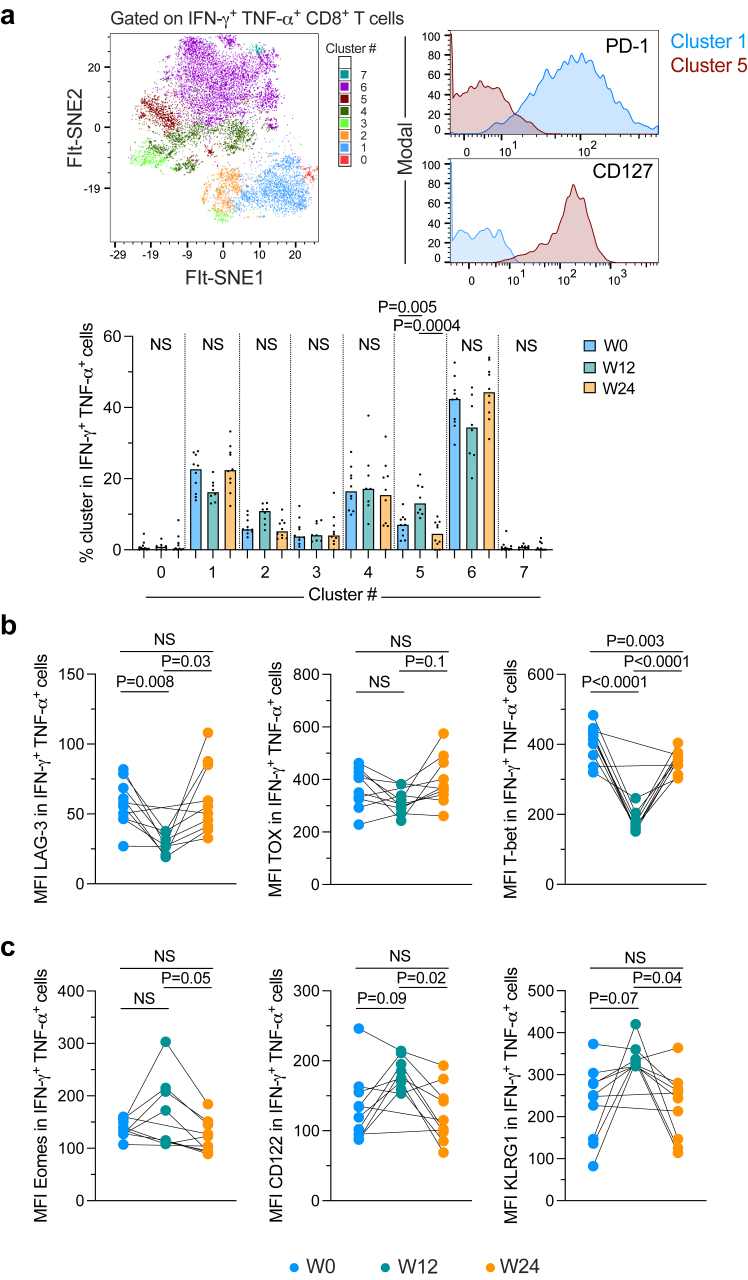
A less effector/exhausted-like profile of polyfunctional CD8+ T cells upon rosuvastatin treatment. a. FlowSOM clusters derived from IFN-γ+ TNF-α+ polyclonal CD8+ T cells were projected on a FIt-SNE plot. The expression of PD-1 and CD127 in clusters 1 and 5 are shown in the right panels. The frequency of each cluster among IFN-γ+ TNF-α+ cells in the samples analysed is shown in the bottom panel. b. Expression of LAG-3, TOX, and T-bet in IFN-γ+ TNF-α+ CD8+ T cells at the three time points evaluated. c. Expression of Eomes, CD122, and KLRG1 in IFN-γ+ TNF-α+ CD8+ T cells. Samples from 10 participants were analysed (b and c, n = 8 at S12). Data obtained from 3 independent experiments are shown. NS: Not statistically significant (p > 0.05). Mixed effects model for repeated measures and Šidák's multiple-comparison test was used.
Fig. 4
Fig. 4
Rosuvastatin promotes polyfunctional HIV-specific CD8+ T cells. PBMCs were stimulated for 6 days with a pool of Gag peptides for the evaluation of HIV-specific CD8+ T cells. Frequency of CFSElo, CD107a+, IFN-γ+ (a), and TNF-α+ (b) HIV-specific CD8+ T cells. c. Representative expression of IFN-γ and TNF-α in Gag-stimulated CD8+ T cells from the same donor at the three time points evaluated. d. Summary of the frequency of IFN-γ+ TNF-α+ HIV-specific CD8+ T cells. Data obtained from 3 independent experiments are shown. e. Left: Representative expression of PD-1 in CD8+ Gag responder cells (IFN-γ+ and/or CD107a+); Right: Summary of the expression of PD-1 in Gag responder CD8+ T cells. f. Summary of the expression of T-bet in Gag responder CD8+ T cells. g. Frequencies of pS6+ pAKT+ in Gag responder CD8+ T cells. h. Expression of pS6 and pAKT on a per-cell basis in Gag responder CD8+ T cells. Samples from 10 participants were analysed (n = 8 at S12). Data obtained from 3 independent experiments are shown. NS: Not statistically significant (p > 0.05). Mixed effects model for repeated measures and Šidák's multiple-comparison test was used.

References

    1. Collins D.R., Gaiha G.D., Walker B.D. CD8+ T cells in HIV control, cure and prevention. Nat Rev Immunol. 2020;20(8):471–482. - PMC - PubMed
    1. Sáez-Cirión A., Pancino G. HIV controllers: a genetically determined or inducible phenotype? Immunol Rev. 2013;254:281–294. - PubMed
    1. Sáez-Cirión A., Sereti I. Immunometabolism and HIV-1 pathogenesis: food for thought. Nat Rev Immunol. 2021;21:5–19. - PubMed
    1. Betts M.R., Nason M.C., West S.M., et al. HIV nonprogressors preferentially maintain highly functional HIV-specific CD8+ T cells. Blood. 2006;107:4781–4789. - PMC - PubMed
    1. Rutishauser R.L., Deguit C.D.T., Hiatt J., et al. TCF-1 regulates HIV-specific CD8+ T cell expansion capacity. JCI Insight. 2021;6:1–16. - PMC - PubMed

Substances