[Preprint]. 2025 Mar 10:2025.03.09.641258.
doi: 10.1101/2025.03.09.641258.

Environmental NaCl affects C. elegans development and aging

Affiliations

Environmental NaCl affects C. elegans development and aging

Franziska Pohl et al. bioRxiv. .

Update in

Abstract

Sodium is an essential nutrient, but is toxic in excess. In humans, excessive dietary sodium can cause high blood pressure, which contributes to age-related diseases including stroke and heart disease. We used C. elegans to elucidate how sodium levels influence animal aging. Most experiments on this animal are conducted in standard culture conditions: Nematode Growth Medium (NGM) agar with a lawn of E. coli. Here, we report that the supplemental NaCl in standard NGM, 50 mM, accelerates aging and decreases lifespan. For comparison, we prepared NGM with reduced NaCl or excess NaCl. Considering reduced NaCl as a baseline, wild-type worms on standard NGM displayed normal development and fertility but reduced lifespan and health span, indicating toxicity in old animals. The long-lived mutants daf-2, age-1, and nuo-6, cultured on standard NGM, also displayed reduced lifespan. Thus, NaCl in standard NGM accelerates aging in multiple genetic backgrounds. Wild-type worms on excess NaCl displayed delayed development and reduced fertility, and reduced lifespan and health span, indicating toxicity in both young and old animals. These results suggest that young animals are relatively resistant to NaCl toxicity, but that aging causes progressive sensitivity, such that old animals display toxicity to both standard and excess NaCl. We investigated pathways that respond to NaCl. Young animals cultured with excess NaCl activated gpdh-1, a specific response to NaCl stress. Old animals cultured with excess NaCl activated gpdh-1 and hsp-6, a reporter for the mitochondrial unfolded protein response. Thus, excess NaCl activates multiple stress response pathways in older animals.

Keywords: C. elegans; aging; daf-2; development; lifespan; salt; sodium chloride (NaCl).


Figures

Figure 1.
Figure 1.. Environmental NaCl affects wild-type C. elegans lifespan, health span, development rate, and progeny production.
A) Hermaphrodite embryos were cultured on NGM dishes with the indicated concentration of supplemental NaCl. The resulting adults were transferred to fresh dishes periodically to separate them from progeny and monitored daily for survival beginning on adult day 0. Eight independent experiments were performed with a combined 625, 584, 223 death events, and 122, 154, 159 censored subjects for 0, 50, 200 mM supplemental NaCl, respectively. Kaplan-Meier Analysis with log-rank test for trend. p-values were corrected using Bonferroni correction. ***p<0.001. B,C) Pharyngeal pumping and body bends were observed with a dissecting microscope. Three independent experiments with ≥15 animals per experiment. Values are mean±SEM analyzed using ordinary two-way ANOVA with Tukey’s multiple comparison test, with a single pooled variance. *p<0.05, **p<0.01,***p<0.001. D) Movement classes on day 8 were categorized with a dissecting microscope; bars with shaded colors display percent of the population in class A on bottom, B in the middle, and C on top. Two independent experiments with a combined n=76, 62, and 27 animals cultured on 0, 50, and 200 mM supplemental NaCl, respectively. Class A: vigorous, coordinated, spontaneous movement; Class B: uncoordinated movement - part of body (head, tail, etc.) is paralyzed or uncoordinated; Class C: majority of animal is paralyzed, no forward or backward movement, only moves head or tail slightly. E,F) Animals were synchronized at the egg stage and monitored hourly for deposition of their first egg, resulting in one value per animal. Three independent experiments with ≥7 animals per experiment. Bars in E are mean±SEM; bars in F are average time to first egg, mean±SD. Ordinary one-way ANOVA with Dunnett’s multiple comparison test with single pooled variance. ***p<0.001. G,H) Day 0 adult hermaphrodites were transferred to new dishes daily, and their daily progeny production was measured by counting their progeny 2–5 days later. Three independent experiments with ≥5 hermaphrodites. G) Daily progeny production shown as mean±SEM, analyzed using mixed-effects model with Geisser-Greenhouse correction and Tukey’s multiple comparison test, with individual variances computed for each comparison. F) Total number of self-progeny for day 0–5 of individual animals, shown as mean±SD, analyzed using ordinary one-way ANOVA and Dunnett’s multiple comparison test with a single pooled variance. *p<0.05, **p<0.01, ***p<0.001.
Figure 2.
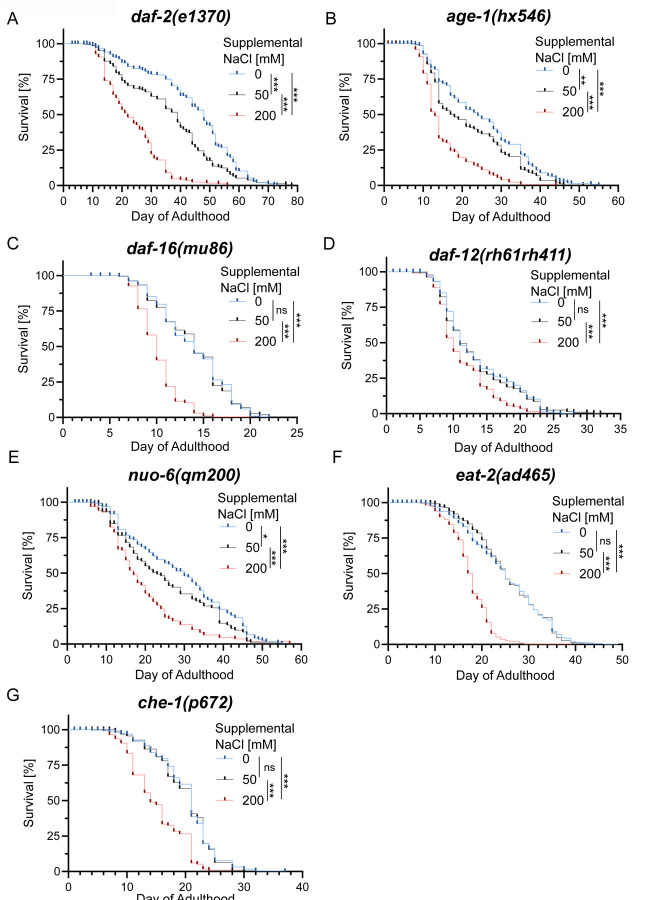
Figure 2.. Environmental NaCl influences the lifespan of mutant C. elegans.
Hermaphrodite embryos were cultured on NGM dishes with the indicated concentration of supplemental NaCl, and the resulting adults were monitored daily for survival beginning on adult day 0. Survival curves were analyzed by Kaplan-Meier Analysis with log-rank test for trend; p-values were corrected using Bonferroni correction. *p<0.05 **p<0.01, ***p<0.001. A) daf-2(e1370): Four independent experiments with 195, 162, 172 death events and 55, 60, 87 censored subjects for 0, 50, 200 mM supplemental NaCl, respectively. B) age-1(hx546): Three independent experiments with 235, 182, 146 death events and 56, 103, 150 censored subjects for 0, 50, 200 mM supplemental NaCl, respectively. C) nuo-6(qm200): Three independent experiments with 123, 93, 130 death events and 103, 132, 93 censored subjects for 0, 50, 200 mM supplemental NaCl, respectively. D) eat-2(ad465): Four independent experiments with 367, 322, 236 death events and 134, 173, 154 censored subjects for 0, 50, 200 mM supplemental NaCl, respectively. E) daf-16(mu86): Three independent experiments with 237, 219, 215 death events and 27, 41, 44 censored subjects for 0, 50, 200 mM supplemental NaCl, respectively. F) daf-12(rh61rh411): Four independent experiments with 296, 286, 186 death events and 56, 54, 141 censored subjects for 0, 50, 200 mM supplemental NaCl, respectively. G) che-1(p672): three independent experiments with 187, 146, 135 death events and 66, 97, 107 censored subjects for 0, 50, 200 mM supplemental NaCl, respectively.
Figure 3.
Figure 3.. Environmental NaCl influences gpdh-1p expression.
A-D) Transgenic animals containing reporter constructs were cultured on 0, 50, and 200 mM supplemental NaCl, and GFP fluorescence was quantified on adult days 0, 2, 4, 6, 8, 10, 12, 14, and 16. A,C) Representative fluorescence images of ~10 animals on adult day 0, 6, and 14 cultured on medium with 0, 50, or 200 mM supplemental NaCl. Genotypes are gpdh-1p::GFP – A (OG119; drIs4 [gpdh-1p::GFP + col-12p::DsRed] IV) in panels A-B, or gpdh-1p::GFP – B (VP198; kbIs5 [gpdh-1p::GFP + rol-6(su1006)]) in panels C-D. Inlay is bright field image. Scale bar on bottom right = 200 µm. B,D) Data points represent fluorescence intensity in arbitrary units (AU); bars are mean±SEM. Analyzed by two-way ANOVA with Dunnett’s multiple comparison analysis, with a single pooled variance. *p<0.05, ***p<0.001. For panel B, three independent experiments with n= 3–14 animals per condition each day; for panel D, three independent experiments for days 0–14, and two independent experiments for day 16, with n= 3–15 animals per condition each day.
Figure 4.
Figure 4.. Environmental NaCl influences stress response pathways.
A-D) Transgenic animals containing reporter constructs were cultured on 0, 50, and 200 mM supplemental NaCl, and GFP fluorescence was quantified on days 0, 5, and 11 of adulthood; each data point represents fluorescence intensity of one animal in arbitrary units (AU); bars are mean±SD. Two-way ANOVA with Tukey’s multiple comparisons test was performed using the compact letter display for comparison: for any two groups that share a letter, p>0.05, indicating no significant difference; for groups with different letters, p<0.05, indicating a statistically significant difference. A) Strain SJ4100 (zcIs13 [hsp-6p::GFP + lin-15(+)]) uses expression of GFP by the hsp-6 promoter to report on the mitochondrial unfolded protein response (mitoUPR). B) Strain SJ4005 (zcIs4 [hsp-4::GFP] V) uses expression of hsp-4 to report on the endoplasmic reticulum (ER) unfolded protein response. C) Strain CF1553 (muIs84 [(pAD76) sod-3p::GFP + rol-6(su1006)]) uses expression of manganese superoxide dismutate 3 (sod-3) to report on the oxidative stress response. D) Strain CL2166 (dvIs19 [(pAF15)gst-4p::GFP::NLS] uses expression of glutathione S-transferase 4 (gst-4) to report on the oxidative stress response (conjugation of reduced glutathione to exogenous and endogenous hydrophobic electrophiles). E) Representative fluorescence images of gst-4p::GFP expression on day 0 from ~10 animals cultured on NGM with 0, 50, and 200 mM supplemental NaCl. Inlay is bright field image. Scale bar on bottom right = 200 µm.

References

    1. Adachi H, Fujiwara Y, Ishii N. 1998. Effects of Oxygen on Protein Carbonyl and Aging in Caenorhabditis elegans Mutants With Long (age-1) and Short (mev-1) Life Spans. The Journals of Gerontology: Series A. 53A(4):B240–B244. doi: 10.1093/GERONA/53A.4.B240. [accessed 2024 Sep 19]. https://dx.doi.org/10.1093/gerona/53A.4.B240. - DOI - PubMed
    1. Al-Amin M, Kawasaki I, Gong J, Shim YH. 2016. Caffeine Induces the Stress Response and Up-Regulates Heat Shock Proteins in Caenorhabditis elegans. Mol Cells. 39(2):163–168. doi: 10.14348/MOLCELLS.2016.2298. - DOI - PMC - PubMed
    1. Anderson EN, Corkins ME, Li JC, Singh K, Parsons S, Tucey TM, Sorkaç A, Huang H, Dimitriadi M, Sinclair DA, et al. 2016. C. elegans lifespan extension by osmotic stress requires FUdR, base excision repair, FOXO, and sirtuins. Mech Ageing Dev. 154:30–42. doi: 10.1016/J.MAD.2016.01.004. - DOI - PMC - PubMed
    1. Bar-Ziv R, Bolas T, Dillin A. 2020. Systemic effects of mitochondrial stress. EMBO Rep. 21(6). doi: 10.15252/embr.202050094. [accessed 2020 Aug 30]. https://www.embopress.org/doi/10.15252/embr.202050094. - DOI - PMC - PubMed
    1. Bar-Ziv R, Frakes AE, Higuchi-Sanabria R, Bolas T, Frankino PA, Gildea HK, Metcalf MG, Dillin A. 2020. Measurements of physiological stress responses in C. Elegans . Journal of Visualized Experiments. 2020(159):1–21. doi: 10.3791/61001. [accessed 2021 Mar 4]. www.jove.com URL:https://www.jove.com/video/61001. - DOI - PMC - PubMed

Publication types

LinkOut - more resources