[Preprint]. 2025 Mar 29:2025.03.06.641951.
doi: 10.1101/2025.03.06.641951.

Sequencing-free whole genome spatial transcriptomics at molecular resolution in intact tissue

Affiliations

Sequencing-free whole genome spatial transcriptomics at molecular resolution in intact tissue

Yubao Cheng et al. bioRxiv. .

Update in

Abstract

Recent breakthroughs in spatial transcriptomics technologies have enhanced our understanding of diverse cellular identities, compositions, interactions, spatial organizations, and functions. Yet existing spatial transcriptomics tools are still limited in either transcriptomic coverage or spatial resolution. Leading spatial-capture or spatial-tagging transcriptomics techniques that rely on in-vitro sequencing offer whole-transcriptome coverage, in principle, but at the cost of lower spatial resolution compared to image-based techniques. In contrast, high-performance image-based spatial transcriptomics techniques, which rely on in situ hybridization or in situ sequencing, achieve single-molecule spatial resolution and retain sub-cellular morphologies, but are limited by probe libraries that target only a subset of the transcriptome, typically covering several hundred to a few thousand transcript species. Together, these limitations hinder unbiased, hypothesis-free transcriptomic analyses at high spatial resolution. Here we develop a new image-based spatial transcriptomics technology termed Reverse-padlock Amplicon Encoding FISH (RAEFISH) with whole-genome level coverage while retaining single-molecule spatial resolution in intact tissues. We demonstrate image-based spatial transcriptomics targeting 23,000 human transcript species or 22,000 mouse transcript species, including nearly the entire protein-coding transcriptome and several thousand long-noncoding RNAs, in single cells in cultures and in tissue sections. Our analyses reveal differential subcellular localizations of diverse transcripts, cell-type-specific and cell-type-invariant tissue zonation dependent transcriptome, and gene expression programs underlying preferential cell-cell interactions. Finally, we further develop our technology for direct spatial readout of gRNAs in an image-based high-content CRISPR screen. Overall, these developments provide the research community with a broadly applicable technology that enables high-coverage, high-resolution spatial profiling of both long and short, native and engineered RNA species in many biomedical contexts.


Conflict of interest statement

Declaration of Interests S.W. and Y.Cheng are inventors on a patent application filed by Yale University related to RAEFISH and Perturb-RAEFISH reported in this manuscript. S.W. is one of the inventors on a patent applied for by Harvard University related to MERFISH.

Figures

Fig. 1.
Fig. 1.. RAEFISH enables genome-wide spatial transcriptomic profiling at single-molecule resolution.
A, Schematic illustration of the RAEFISH design. B, Schematic of oligo pool amplification. C, Demonstration of why other RCA-based ISS and multiplexed FISH methods are incompatible with the procedure in B. D, Example decoded image of A549 cells and raw single amplicon images from example molecules (yellow boxed in the zoom-in decoded image). Scale bars: 20 μm in decoded image, 2 μm in zoom-in decoded image, 500 nm in amplicon image. White lines in the decoded image indicate cell segmentation. The foci in the decoded images are pseudo-colored. The magenta and cyan colors in the raw single amplicon images correspond to Atto 647 and Alexa Fluor 750 fluorescent dyes respectively. E-F, Distribution of the numbers of RNA molecules (E) and different genes (F) detected in each cell. G, Correlation between RAEFISH and RNA-seq results.
Fig. 2.
Fig. 2.. RAEFISH reveals cell-cycle associated genes and subcellular distributions of RNAs.
A, Log2 enrichment of cell-cycle associated gene expression in G1, S, and G2M cells with hierarchical clustering. B, Unsupervised clustering with cell-cycle associated genes displayed with t-distributed stochastic neighbor embedding (TSNE). C. Enriched GO terms of all the cell-cycle associated genes. D. Nuclear ratios of protein coding (PC) RNAs and lncRNAs. E, Nuclear ratios of example lncRNAs. In all box plots throughout the manuscript, the boxes cover the 25th to 75th percentiles, the whiskers cover the 10th to 90th percentiles, and the line in the middle of the box represents the median value. P value in D was calculated by two-sided Wilcoxon rank sum test.
Fig. 3.
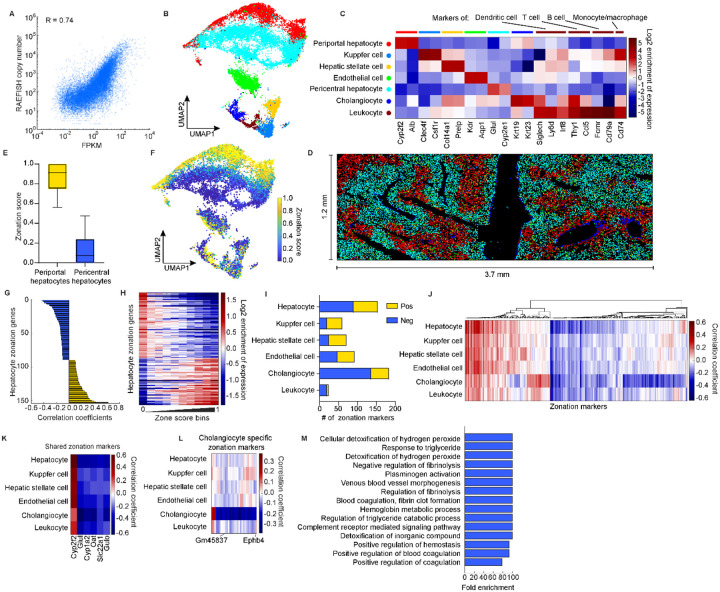
Fig. 3.. RAEFISH uncovers spatial transcriptomic architectures and spatially dependent gene expression in liver tissue.
A, Correlation between RAEFISH and RNA-seq results. B, Single cell clusters displayed with Uniform Manifold Approximation and Projection (UMAP). C, Log2 enrichment of marker genes in each identified cell types. D, The in-situ map of the identified cell types. E, Zonation scores of periportal and pericentral hepatocytes. F, Zonation scores of all cells displayed on UMAP. G, Correlation coefficients between gene expression of hepatocyte zonation markers and zonation score. H, Log2 enrichment of expression of hepatocyte zonation markers in cells with binned zonation values. I, Number of zonation markers identified in each cell type. J, Expression-zone score correlation coefficients of zonation markers identified from all cell types with hierarchically clustering. K, Expression-zone score correlation coefficients of zonation markers shared by all cell types. L, Expression-zone score correlation coefficients of cholangiocyte specific zonation markers. M, Top GO terms of cholangiocyte-specific negative zonation markers.
Fig. 4.
Fig. 4.. RAEFISH uncovers cell-cell communication in liver tissue.
A, Log2 enrichment of cell-cell interactions. B, Differentially expressed genes (DEGs) of cholangiocytes neighboring leukocytes versus cholangiocytes not neighboring leukocytes. C, Zonation scores of cholangiocytes interacting with leukocytes versus cholangiocytes not neighboring leukocytes. D, Zonation scores of leukocytes interacting with cholangiocytes versus leukocytes not interacting with cholangiocytes. E, DEGs of leukocytes neighboring cholangiocytes versus leukocytes not neighboring cholangiocytes. F, Top GO terms of top upregulated genes in leukocytes neighboring cholangiocytes versus leukocytes not neighboring cholangiocytes. G, Log2 fold change of expression of leukocyte subtype marker genes in leukocytes interacting with cholangiocytes versus leukocytes not interacting with cholangiocytes. P value in A was calculated by Fisher’s exact test. P values in C, D were calculated by two-sided Wilcoxon rank sum test.
Fig. 5.
Fig. 5.. RAEFISH uncovers characteristics of spatial transcriptomic architectures and cell-cell interaction in mouse placenta.
A, Single cell gene expression clusters displayed on UMAP. B, Log2 enrichment of marker genes in identified cell types. C, The in-situ map of the identified cell types. D, Log2 enrichment of cell-cell interactions. E, DEGs of macrophages neighboring decidual stromal cells versus macrophages not neighboring decidual stromal cells. F, DEGs of decidual stromal cells neighboring vascular stromal cells versus decidual stromal cells not neighboring vascular stromal cells. P value in D was calculated by Fisher’s exact test.
Fig. 6.
Fig. 6.. RAEFISH uncovers spatial transcriptomic architectures in mouse lymph node.
A, Single cell gene expression clusters displayed on UMAP. B, Log2 enrichment of marker genes in each identified cell type. C, The in-situ map of the identified cell types. D, Zonation scores of the cells in the lymph node. Cells in gray colors were not involved in zonation analysis. E, Expression-zone score correlation coefficients of all zonation markers with hierarchically clustering. F, Top GO terms of positive and negative zonation markers.
Fig. 7.
Fig. 7.. RAEFISH enables direct readout of gRNAs in an image-based CRISPR screen.
A, Schematic illustration of direct RAEFISH targeting of gRNA spacer region. B, Representative decoded gRNA molecules in single cells. Different pseudo colors represent different gRNA identities. White lines show cell segmentation. Each gRNA is encoded with a 14-bit binary code with 4 “1” bits. C. Pie chart representing the percentages of cells with different numbers of dominant gRNA identities. D, Distribution of the copy numbers of gRNAs detected in each cell. E, Log2FC of expression (from RNA MERFISH counts) of perturbation target genes (comparing cells with perturbation gRNAs versus cells with negative control gRNAs). F, Log2FC of all gene expression detected by RNA MERFISH in all detected perturbations. Both the perturbation target genes and MERFISH probed genes are hierarchically clustered (color bars along y and x axes). G, Correlation coefficients of MERFISH gene expression profiles between each pair of perturbations. Six representative perturbation gene clusters are indicated by arrows. H, Top GO terms of the highlighted clusters in G.

References

    1. Zhuang X. (2021). Spatially resolved single-cell genomics and transcriptomics by imaging. Nature methods 18, 18–18. 10.1038/S41592-020-01037-8. - DOI - PMC - PubMed
    1. Rao A., Barkley D., França G.S., and Yanai I. (2021). Exploring tissue architecture using spatial transcriptomics. Nature 2021 596:7871 596, 211–220–211–220. 10.1038/s41586-021-03634-9. - DOI - PMC - PubMed
    1. Moses L., and Pachter L. (2022). Museum of spatial transcriptomics. Nature Methods 2022 19:5 19, 534–546–534–546. 10.1038/s41592-022-01409-2. - DOI - PubMed
    1. Tian L., Chen F., and Macosko E.Z. (2022). The expanding vistas of spatial transcriptomics. Nature Biotechnology 2022 41:6 41, 773–782–773–782. 10.1038/s41587-022-01448-2. - DOI - PMC - PubMed
    1. Longo S.K., Guo M.G., Ji A.L., and Khavari P.A. (2021). Integrating single-cell and spatial transcriptomics to elucidate intercellular tissue dynamics. Nature Reviews Genetics 2021 22:10 22, 627–644–627–644. 10.1038/s41576-021-00370-8. - DOI - PMC - PubMed

Publication types

LinkOut - more resources