[Preprint]. 2025 Mar 10:2025.03.06.641911.
doi: 10.1101/2025.03.06.641911.

Microbiome functional gene pathways predict cognitive performance in older adults with Alzheimer's disease

Affiliations

Microbiome functional gene pathways predict cognitive performance in older adults with Alzheimer's disease

Abigail L Zeamer et al. bioRxiv. .

Abstract

Disturbances in the gut microbiome is increasing correlated with neurodegenerative disorders, including Alzheimer's Disease. The microbiome may in fact influence disease pathology in AD by triggering or potentiating systemic and neuroinflammation, thereby driving disease pathology along the "microbiota-gut-brain-axis". Currently, drivers of cognitive decline and symptomatic progression in AD remain unknown and understudied. Changes in gut microbiome composition may offer clues to potential systemic physiologic and neuropathologic changes that contribute to cognitive decline. Here, we recruited a cohort of 260 older adults (age 60+) living in the community and followed them over time, tracking objective measures of cognition, clinical information, and gut microbiomes. Subjects were classified as healthy controls or as having mild cognitive impairment based on cognitive performance. Those with a diagnosis of Alzheimer's Diseases with confirmed using serum biomarkers. Using metagenomic sequencing, we found that relative species abundances correlated well with cognition status (MCI or AD). Furthermore, gene pathways analyses suggest certain microbial metabolic pathways to either be correlated with cognitive decline or maintaining cognitive function. Specifically, genes involved in the urea cycle or production of methionine and cysteine predicted worse cognitive performance. Our study suggests that gut microbiome composition may predict AD cognitive performance.

Keywords: ADAS-Cog; Alzheimer’s Disease; Clinical Dementia Rating (CDR) Scale; Cognition; Cysteine; Methionine; Microbiome; Mild Cognitive Impairment; NIH Toolbox; Urea cycle.


Figures
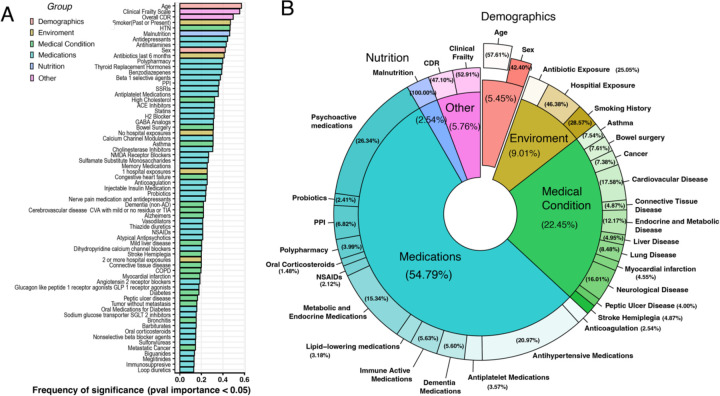
Figure 1:
Figure 1:. Clinical and demographic variables that predict microbiome composition in community dwelling individuals.
MERF modeling results using all demographics and clinical variables (including each medication taken and clinical scoring of frailty, nutrition, and comorbidities) to predict each species abundance from repeated fecal samples. (A) Frequency-based ranking of predictors from MERF models. Significance was determined by running permutated variable importance analysis and using an FDR adjusted p-value of 0.05. (B) Pie chart to illustrate the distribution of the clinical factors found by the modeling to be significantly associated with the GAINS microbiome. Drugs were grouped by treatment class.
Figure 2:
Figure 2:
Spearmen correlation coefficient between each cognitive outcome (ADAS-Cog-13, Memory Z-score and Executive Function Z-scores) and relevant clinical covariates in (A) Cognitively normal, (B) Mildly cognitively impaired and (C) AD diagnosed participants.
Figure 3:
Figure 3:. Mixed-Effect Random Forest (MERF) regression models using species abundance and clinical covariates to predict ADAS-Cog-13 scores.
Actual versus predicted ADAS-Cog-13 values for cognitively normal (A), MCI (B) and AD patient populations (C). Permutated variable importance for the final model for the MCI (D) and AD (E) populations. Bar color (D and E) corresponds to the correlation coefficient of each variable with ADAS-Cog-13 score with red indicating positive correlation and blue indicating negative correlation. Significance of correlation is indicated by either a dashed (where p-value > 0.05) or a solid outline (p-value <= 0.5). Magnitude of correlation is indicated by color of the outline with gray indicating correlation below an absolute value of 0.4 and black indicating the correlation coefficient is great or equal to 0.4.
Figure 4:
Figure 4:. MERF regression models using species abundance and clinical covariates to predict memory z-scores and executive function z-scores.
Actual versus predicted memory z-score values (A) for cognitively normal healthy controls (HC), mild cognitive impairment (MCI), and Alzheimer’s Disease (AD) patient populations. Permutated variable importance for the final model for the MCI (B) and AD (C) population. Actual versus predicted executive function z-score values (D) for HC, MCI, and AD patient populations. Permutated variable importance for the final model for the MCI (E) and AD (F) populations. Bar color (B, C, E, F) corresponds to the correlation coefficient of each variable with memory z-score were red indicates positive correlation and blue indicates negative correlation. Significance of correlation is indicated by either a dashed (where p-value > 0.05) or a solid outline (p-value <= 0.5). Magnitude of correlation is indicated by color of the outline with gray indicating correlation below an absolute value of 0.4 and black indicating the correlation coefficient is great or equal to 0.4.
Figure 5:
Figure 5:. Comparison of rank and correlation of top 15 permutated variables from species abundance based MERF models in each cognitive outcome.
Models trained with the MCI subset (A) and AD subsets (B). Gray coloring of microbial name, circle and number indicate that the correlation is not significant (p-value >= 0.05).
Figure 6:
Figure 6:. Pathway abundance analyses in AD population.
Comparison of rank and correlation of top 15 permutated variables from pathway abundance based MERF models in each cognitive outcome. Models (A) trained with the AD subset to predict ADAS-Cog-13, memory z-score, and executive function z-score. Top 15 predictors (B) from ADAS-Cog-13, memory z-score, and executive function z-score colored for correlation coefficient of each pathway with the identified outcome. Significance of correlation is indicated by either a dashed (where p-value > 0.05) or a solid outline (p-value <= 0.5). Magnitude of correlation is indicated by color of the outline with gray indicating correlation below an absolute value of 0.4 and black indicating the correlation coefficient is great or equal to 0.4. (C) Comparison of rank and correlation of top 15 permutated variables from pathway abundance based MERF models in each cognitive outcome for the AD population. Gray coloring of microbial name, circle and number indicate that the correlation is not significant (p-value >= 0.05).
Figure 7:
Figure 7:. MERF regression models using KEGG Ontology (KO) term abundance and clinical covariates to predict cognitive outcomes in AD patient population.
Actual versus predicted in AD population for models predicting ADAS-Cog-13 (A), memory z-score (B), and executive function z-score (C). Permutated variable importance for the final model for the ADAS-Cog-13 (D), memory z-score (E), and executive function z-score (F). Bar color corresponds to the correlation coefficient of each variable the indicated cognitive outcome. Significance of correlation is indicated by either a dashed (where p-value > 0.05) or a solid outline (p-value <= 0.5). Magnitude of correlation is indicated by color of the outline with gray indicating correlation below an absolute value of 0.4 and black indicating the correlation coefficient is great or equal to 0.4.

References

    1. 2024 Alzheimer's disease facts and figures. Alzheimer's & dementia : the journal of the Alzheimer's Association 20, 3708–3821, doi: 10.1002/alz.13809 (2024). - DOI - PMC - PubMed
    1. Gordon B. A. et al. Spatial patterns of neuroimaging biomarker change in individuals from families with autosomal dominant Alzheimer's disease: a longitudinal study. The Lancet Neurology 17, 241–250, doi: 10.1016/s1474-4422(18)30028-0 (2018). - DOI - PMC - PubMed
    1. Jack C. R. et al. Revised criteria for diagnosis and staging of Alzheimer's disease: Alzheimer's Association Workgroup. Alzheimer's & Dementia 20, 5143–5169, doi: 10.1002/alz.13859 (2024). - DOI - PMC - PubMed
    1. Villemagne V. L. et al. Amyloid β deposition, neurodegeneration, and cognitive decline in sporadic Alzheimer's disease: a prospective cohort study. The Lancet Neurology 12, 357–367, doi: 10.1016/s1474-4422(13)70044-9 (2013). - DOI - PubMed
    1. Markowitsch H. J. & Staniloiu A. Amnesic disorders. The Lancet 380, 1429–1440, doi: 10.1016/s0140-6736(11)61304-4 (2012). - DOI - PubMed

Publication types

LinkOut - more resources
