


AntiFold: improved structure-based antibody design using inverse folding
- PMID: 40170886
- PMCID: PMC11961221
- DOI: 10.1093/bioadv/vbae202
AntiFold: improved structure-based antibody design using inverse folding
Abstract
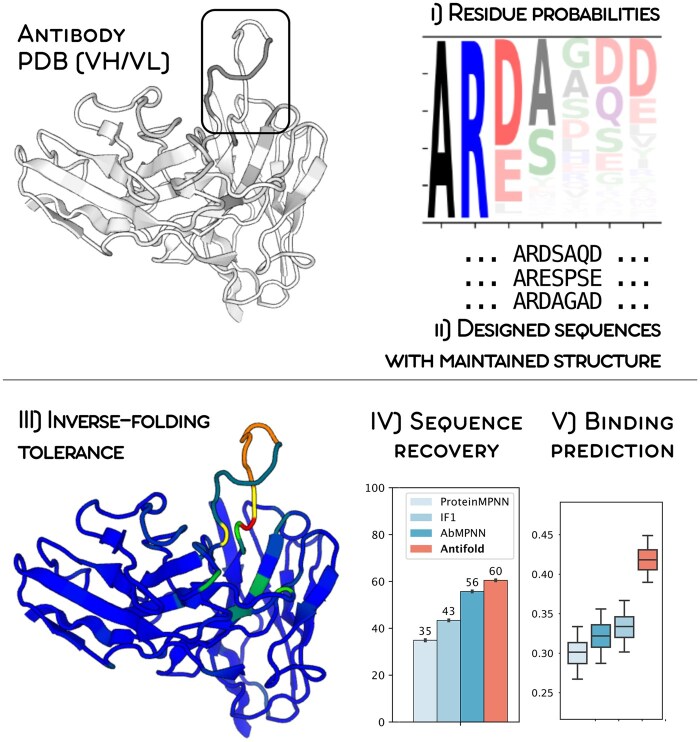
Summary: The design and optimization of antibodies requires an intricate balance across multiple properties. Protein inverse folding models, capable of generating diverse sequences folding into the same structure, are promising tools for maintaining structural integrity during antibody design. Here, we present AntiFold, an antibody-specific inverse folding model, fine-tuned from ESM-IF1 on solved and predicted antibody structures. AntiFold outperforms existing inverse folding tools on sequence recovery across complementarity-determining regions, with designed sequences showing high structural similarity to their solved counterpart. It additionally achieves stronger correlations when predicting antibody-antigen binding affinity in a zero-shot manner. AntiFold assigns low probabilities to mutations that disrupt antigen binding, synergizing with protein language model residue probabilities, and demonstrates promise for guiding antibody optimization while retaining structure-related properties.
Availability and implementation: AntiFold is freely available under the BSD 3-Clause as a web server (https://opig.stats.ox.ac.uk/webapps/antifold/) and pip-installable package (https://github.com/oxpig/AntiFold).
© The Author(s) 2025. Published by Oxford University Press.
Conflict of interest statement
No competing interest is declared.
Figures
References
-
- Dreyer FA, Cutting D, Schneider C et al. Inverse folding for antibody sequence design using deep learning. In: The 2023 ICML Workshop on Computational Biology. 2023.
LinkOut - more resources
Full Text Sources
