


Variations in the branching pattern of the internal iliac artery and its implications in trauma and surgery - a South Indian cadaveric study
- PMID: 40170982
- PMCID: PMC11961128
- DOI: 10.1590/1677-5449.202400752
Variations in the branching pattern of the internal iliac artery and its implications in trauma and surgery - a South Indian cadaveric study
Abstract
Background: The internal iliac artery (IIA) frequently shows variations in its branching pattern. Knowledge of its variations is helpful during gynecological and orthopedic surgical procedures.
Objectives: To observe the branching pattern of IIA in the human pelvises and discuss its clinical implications.
Methods: The study was conducted on 80 male hemipelvises (40 left halves and 40 right halves). The pelvic halves were obtained by making mid-line saw cuts through formalin embalmed adult human cadavers aged approximately 50-80 years. The IIA were dissected and cleaned. Variations of the internal iliac artery and its branches were noted. Relevant photographs were taken. Results were expressed as percentages.
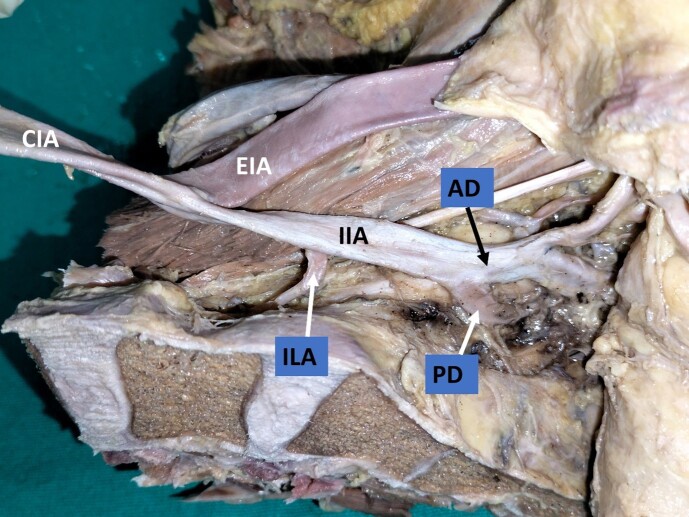
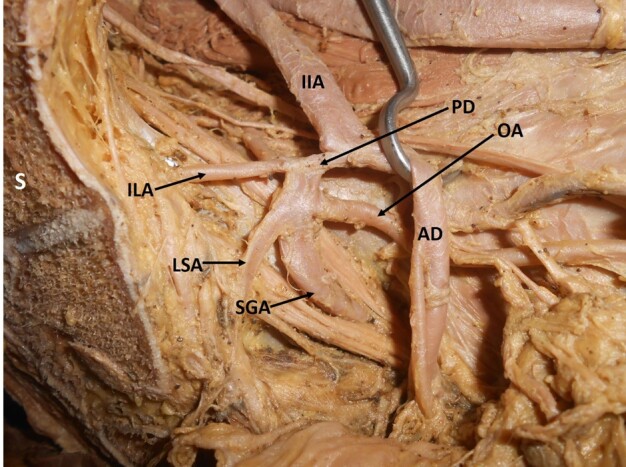
Results: Variations in the branching pattern were observed in 49 (61%) hemipelvises (right: 21, left: 28). Variations were more common (48%) in the branching pattern of the anterior division of IIA than the posterior division (20%). Variations of the main trunk were observed in 29% of cases. In 3% of cases, the IIA did not divide into two divisions. Among the individual branches, the iliolumbar artery showed variations in 29% of cases and the obturator artery in 25%. A common trunk of the internal pudendal and middle rectal arteries was found in 24% of cases and variations of the inferior gluteal artery were seen in 18% of cases.
Conclusions: The study showed a high rate of occurrence of variant IIA branching patterns. Understanding the anatomical variations of the IIA and its branches is essential to minimize intraoperative blood loss and other complications during pelvic surgeries.
Contexto: A artéria ilíaca interna (AII) frequentemente apresenta variações em seus padrões de ramificação. Conhecer suas variações é útil durante procedimentos cirúrgicos ginecológicos e ortopédicos.
Objetivos: Observar o padrão de ramificação da IIA na pelve humana e discutir suas implicações clínicas.
Métodos: O estudo foi realizado em 80 hemipelves masculinas (40 hemipelves esquerdas e 40 hemipelves direitas). As hemipelves foram obtidas através de cortes com serra na linha média em cadáveres humanos adultos de aproximadamente 50-80 anos de idade embalsamados em formaldeído. As AIIs foram dissecadas e limpas. Foram observadas as variações da AII e seus ramos. Obtiveram-se fotografias relevantes. Os resultados foram expressos em porcentagem.
Resultados: Foram encontradas variações no padrão de ramificação em 49 (61%) das hemipelves (direita: 21, esquerda: 28). As variações foram mais comuns (48%) no padrão de ramificação da divisão anterior da AII do que na sua divisão posterior (20%). Variações no tronco principal foram observadas em 29% dos casos. Em 3% dos casos, a AII não estava dividida em duas divisões. Com relação aos ramos individuais, a artéria ileolombar apresentou variações em 29% dos casos, e a artéria obturatória em 25%. Foi encontrado um tronco comum entre as artérias pudenda interna e retal média em 24% dos casos, e variações na artéria glútea inferior foram observadas em 18% dos casos.
Conclusões: O estudo demonstrou uma alta ocorrência de variações no padrão de ramificação da AII. Entender as variações anatômicas da AII e seus ramos é essencial para minimizar a perda sanguínea intraoperatória e outras complicações durante cirurgias pélvicas.
Keywords: iliolumbar artery; internal iliac artery; obturator artery; pelvis; vascular variation.
Copyright© 2025 The authors.
Conflict of interest statement
Conflicts of interest: NIL.
Figures




References
-
- Williams PL, Bannister LH, Berry MM. Gray’s anatomy: the anatomical basis of medicine and surgery. 40th. London: Churchill Livingstone; 2008. 1036
-
- Bangal V, Kwatra A, Raghav S. Role of internal iliac artery ligation in control of pelvic hemorrhage. Pravara Med Rev. 2009;1(2):23–24.
LinkOut - more resources
Full Text Sources