


Prediction of cardiovascular risk: validation of a non-laboratory and a laboratory-based score in a Brazilian community-based cohort of the PURE study
- PMID: 40171144
- PMCID: PMC11959376
- DOI: 10.1016/j.lana.2025.101009
Prediction of cardiovascular risk: validation of a non-laboratory and a laboratory-based score in a Brazilian community-based cohort of the PURE study
Abstract
Background: Risk scores are essential tools for implementing cardiovascular disease (CVD) prevention. Validating risk scores considering regional diversities and disparities is critical for reducing the burden of CVD on global morbidity and mortality. We aimed to validate two cardiovascular risk scores (laboratory and non-laboratory-based) to predict major adverse cardiovascular events in the Brazilian cohort of the PURE study.
Methods: We validated two risk scores derived from the INTERHEART study, the non-laboratory INTERHEART risk score (NL-IHRS) and the laboratory fasting cholesterol INTERHEART risk score (FC-IHRS) using data from 4623 (urban areas) and 1415 (rural areas) participants without CVD in the Brazilian cohort of the PURE study enrolled in 2004 and 2005 and followed up to September 2021. The endpoint was major cardiovascular events (MACE), defined as the composite of myocardial infarction, stroke, heart failure, or death from cardiovascular causes. We evaluated the model performance of IHRS through c-statistic and calibration methods.
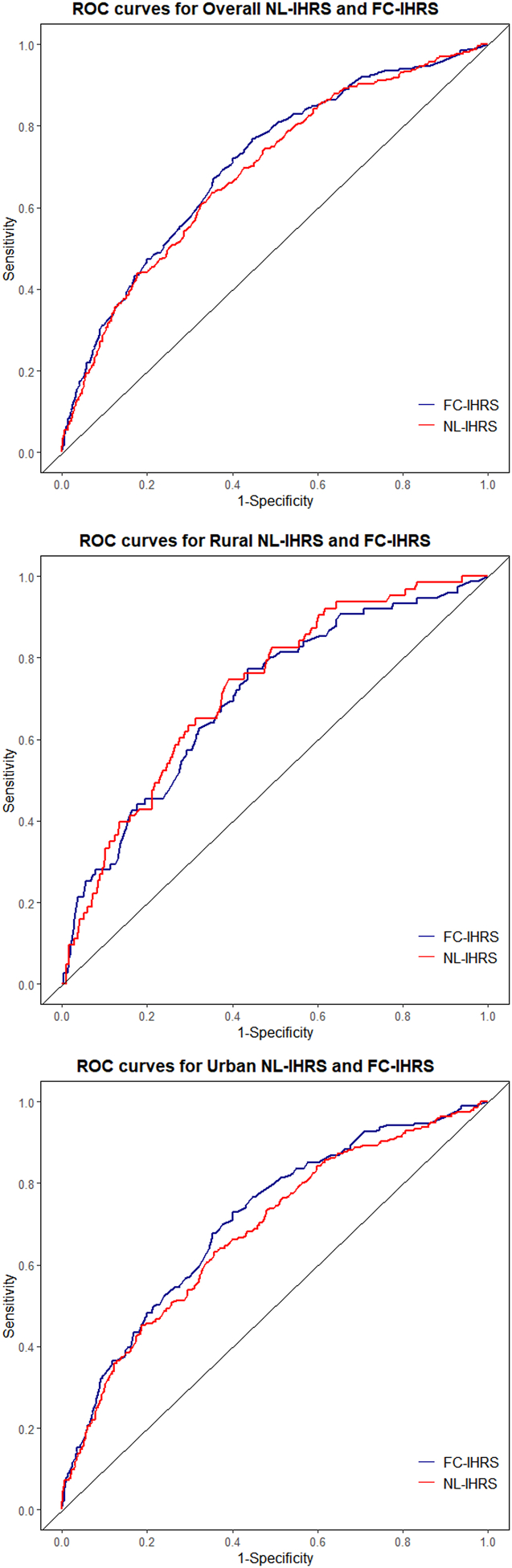
Findings: After a mean follow-up of 8.8 years (range, 0.28-15.1 years), there were 312 cardiovascular events, corresponding to an incidence rate of 0.58% per year (0.56% per year in urban versus 0.64% per year in rural areas). For the NL-IHRS, the c-statistic was 0.69 (95% confidence interval, CI, 0.66-0.72) in the overall cohort, 0.68 (95% CI, 0.64-0.72) in the urban cohort, and 0.72 (95% CI, 0.66-0.78) in the rural cohort. C-statistic values for the recalibrated FC-IHRS were 0.71 (95% CI, 0.67-0.74), 0.71 (95% CI, 0.67-0.75), and 0.70 (95% CI, 0.64-0.76) in the overall, urban, and rural cohorts, respectively.
Interpretation: In this Brazilian community-based prospective cohort, both NL-IHRS and FC-IHRS-based models performed with reasonable discriminative accuracy on the risk estimation of long-term risk of major CVD. A non-laboratory-based CVD risk score may be instrumental in Brazilian communities with limited access to medical resources.
Funding: Population Health Research Institute, Novartis Biociências S.A.
Keywords: Brazil; Cardiovascular disease; Risk factors; Risk score; Validation study.
© 2025 The Author(s).
Conflict of interest statement
Dr. Priscila Raupp da Rosa is an employee of Novartis Biociências Brazil. Prof. Álvaro Avezum has a contract with PHRI for research funding at Hospital Alemão Oswaldo Cruz and is an advisory board member of OPTIMAL DIABETES, OPTIMAL STROKE, ACHIEVE-BP and IMPACT-BP studies. The other authors declare no competing interests related to this research.
Figures
References
-
- Dagenais G.R., Leong D.P., Rangarajan S., et al. Variations in common diseases, hospital admissions, and deaths in middle-aged adults in 21 countries from five continents (PURE): a prospective cohort study. Lancet. 2020;395(10226):785–794. - PubMed
LinkOut - more resources
Full Text Sources
