


Recurrence patterns and management of locally recurrent rectal cancer: a retrospective cohort study
- PMID: 40172684
- PMCID: PMC11965173
- DOI: 10.1007/s00423-025-03692-x
Recurrence patterns and management of locally recurrent rectal cancer: a retrospective cohort study
Abstract
Purpose: Treatment of locally recurrent rectal cancer (LRRC) is still challenging because of inhomogeneous patient cohorts regarding previous treatments as well as different recurrence patterns and locations. The aim of this study was to investigate the treatments and surgical approaches tailored to them.
Methods: We included all patients who were treated for LRRC without distant metastasis at the University Medical Center Mannheim, Germany, between 2010 and 2021. We collected data from our electronic clinical data management system regarding the initial diagnosis and treatment, as well as the locations and treatment of the recurrent tumor.
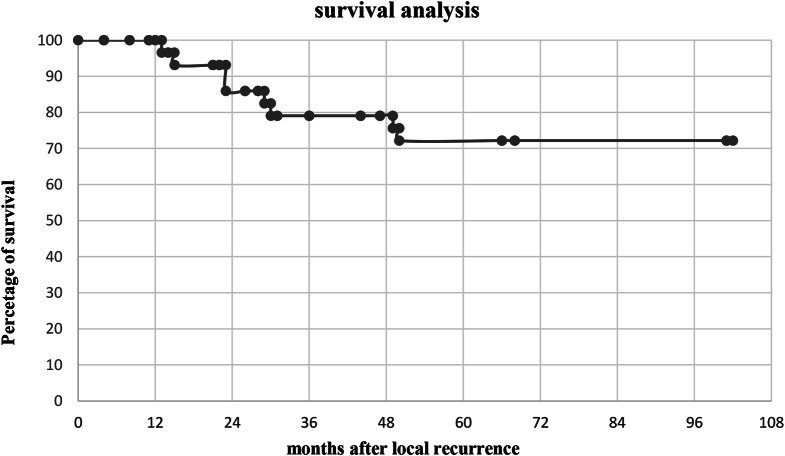
Results: We identified a total of 666 patients who were curatively treated for rectal cancer of whom 36 patients (5.4%) developed LRRC without distant recurrence. Most patients (26/36) had a tailored therapy regimen that included surgery with or without perioperative radiation and/or chemotherapy. The most common site of local relapse was around the former colorectal anastomosis (15/36, 41.7%). The operative procedures ranged from anterior resection to multi-organ resection and exenteration. A complete resection (R0) could be achieved in twelve patients (12/22. 54.5%). The 3- and 5-year overall survival rates were 79% and 72%, respectively.
Conclusion: Most local recurrences occur at the anastomotic site and are mostly eligible for curative surgical therapy with good long-term survival.
Keywords: Abdominoperineal resection; Colorectal cancer; Complications; Recurrent rectal cancer; Survival.
© 2025. The Author(s).
Conflict of interest statement
Declarations. Ethical approval: This study (ID: 2022-812-AF 11) has been approved by the institutional ethics committee, the Ethikkommission II of the University of Heidelberg, Medical Faculty Mannheim, Mannheim, Germany. Competing interests: The authors declare no competing interests.
References
MeSH terms
LinkOut - more resources
Full Text Sources
