


Psychiatric genetics in the diverse landscape of Latin American populations
- PMID: 40175716
- PMCID: PMC12133068
- DOI: 10.1038/s41588-025-02127-z
Psychiatric genetics in the diverse landscape of Latin American populations
Abstract
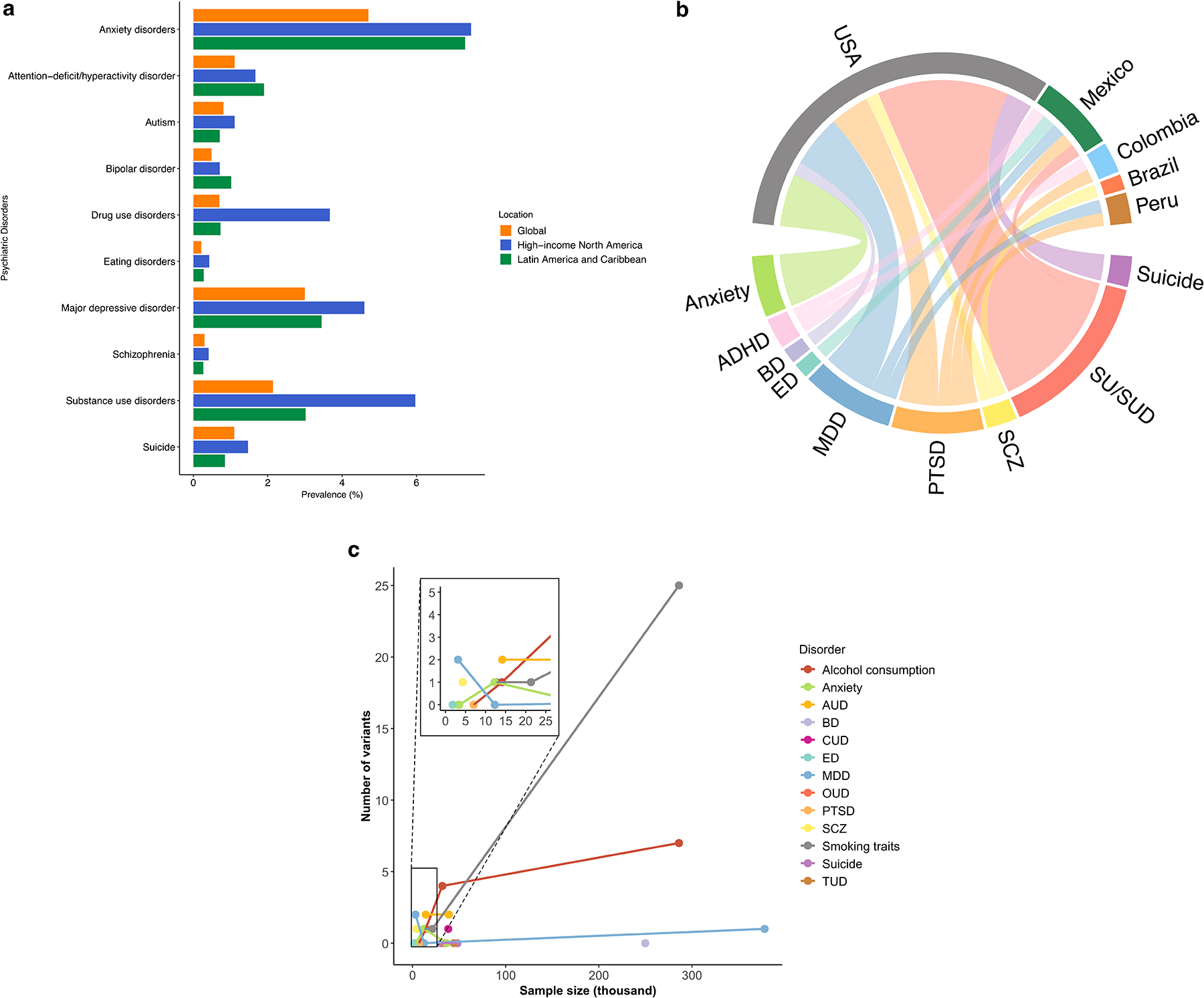
Psychiatric disorders are highly heritable and polygenic, influenced by environmental factors and often comorbid. Large-scale genome-wide association studies (GWASs) through consortium efforts have identified genetic risk loci and revealed the underlying biology of psychiatric disorders and traits. However, over 85% of psychiatric GWAS participants are of European ancestry, limiting the applicability of these findings to non-European populations. Latin America and the Caribbean, regions marked by diverse genetic admixture, distinct environments and healthcare disparities, remain critically understudied in psychiatric genomics. This threatens access to precision psychiatry, where diversity is crucial for innovation and equity. This Review evaluates the current state and advancements in psychiatric genomics within Latin America and the Caribbean, discusses the prevalence and burden of psychiatric disorders, explores contributions to psychiatric GWASs from these regions and highlights methods that account for genetic diversity. We also identify existing gaps and challenges and propose recommendations to promote equity in psychiatric genomics.
© 2025. Springer Nature America, Inc.
Conflict of interest statement
Competing interests: C.M.B. reports receiving royalties from Pearson Education. S.L.-L. is an employee of Novartis Pharma; the statements presented do not necessarily represent the position of the company. E.A.S. reports receiving research funding to his institution from the Ream Foundation, the International OCD Foundation and the NIH. He was a consultant for BrainsWay and Biohaven Pharmaceuticals in the past 12 months. He owns stock less than $5,000 in nView (for distribution of the Y-BOCS and the CY-BOCS). He receives book royalties from Elsevier, Wiley, Oxford, the American Psychological Association, Guildford, Springer, Routledge and Jessica Kingsley. All other authors declare no competing interests.
Figures

References
-
- Ferrari AJ et al. Global incidence, prevalence, years lived with disability (YLDs), disability-adjusted life-years (DALYs), and healthy life expectancy (HALE) for 371 diseases and injuries in 204 countries and territories and 811 subnational locations, 1990–2021: a systematic analysis for the Global Burden of Disease Study 2021. The Lancet 403, 2133–2161 (2024). - PMC - PubMed
-
- Diversity in Genetic Studies – PGC. https://pgc.unc.edu/for-the-public/diversity-in-genetic-studies/.
Publication types
MeSH terms
Grants and funding
- R01MH125938/U.S. Department of Health & Human Services | NIH | National Institute of Mental Health (NIMH)
- R01 MH119084/MH/NIMH NIH HHS/United States
- K01 MH121580/MH/NIMH NIH HHS/United States
- 5R01DA054869/U.S. Department of Health & Human Services | NIH | National Institute on Drug Abuse (NIDA)
- R01 MH134039/MH/NIMH NIH HHS/United States
- R01AA029688/U.S. Department of Health & Human Services | NIH | National Institute on Alcohol Abuse and Alcoholism (NIAAA)
- R01 MH118278/MH/NIMH NIH HHS/United States
- U01 MH125050/MH/NIMH NIH HHS/United States
- R01 HG012869/HG/NHGRI NIH HHS/United States
- R01 AG057234/AG/NIA NIH HHS/United States
- DP1 DA054394/DA/NIDA NIH HHS/United States
- 538-2013-8864/Vetenskapsrådet (Swedish Research Council)
- U01MH125050/U.S. Department of Health & Human Services | NIH | National Institute of Mental Health (NIMH)
- R56 MH129437/MH/NIMH NIH HHS/United States
- U01 MH109528/MH/NIMH NIH HHS/United States
- 2023351083/National Science Foundation (NSF)
- U01MH125062/U.S. Department of Health & Human Services | NIH | National Institute of Mental Health (NIMH)
- R01HG012869/U.S. Department of Health & Human Services | NIH | National Human Genome Research Institute (NHGRI)
- R01 AG075775/AG/NIA NIH HHS/United States
- R01 MH136149/MH/NIMH NIH HHS/United States
- 1DP1DA058737-01/U.S. Department of Health & Human Services | NIH | National Institute on Drug Abuse (NIDA)
- U01 MH125062/MH/NIMH NIH HHS/United States
- DP1DA054394/U.S. Department of Health & Human Services | NIH | National Institute on Drug Abuse (NIDA)
- R01MH131013/U.S. Department of Health & Human Services | NIH | National Institute of Mental Health (NIMH)
- R01 MH131013/MH/NIMH NIH HHS/United States
- R25 MH081482/MH/NIMH NIH HHS/United States
- R01 DA054869/DA/NIDA NIH HHS/United States
- R01 MH120170/MH/NIMH NIH HHS/United States
- 5R25MH081482-17/U.S. Department of Health & Human Services | NIH | National Institute of Mental Health (NIMH)
- DP1 DA054373/DA/NIDA NIH HHS/United States
- R01 MH123451/MH/NIMH NIH HHS/United States
- R01 MH124871/MH/NIMH NIH HHS/United States
- R01 MH125938/MH/NIMH NIH HHS/United States
- R01MH136149;R01MH134039,R56MH129437; R01MH120170; R01MH124871; R01MH119084; R01MH118278; R01MH124871/U.S. Department of Health & Human Services | NIH | National Institute of Mental Health (NIMH)
LinkOut - more resources
Full Text Sources
Medical
