


Allopurinol attenuates development of Porphyromonas gingivalis LPS-induced cardiomyopathy in mice
- PMID: 40179080
- PMCID: PMC11967946
- DOI: 10.1371/journal.pone.0318008
Allopurinol attenuates development of Porphyromonas gingivalis LPS-induced cardiomyopathy in mice
Abstract
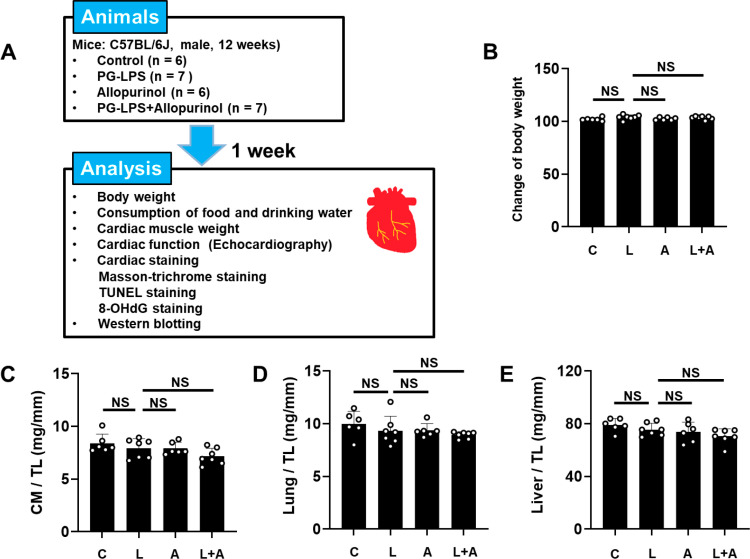
Oxidative stress is involved in the progression of periodontitis, independently of confounding factors such as smoking, and numerous studies suggest that periodontitis is associated with increased risk of cardiovascular disease. In this study, therefore, we examined the effects of the xanthine oxidase inhibitor allopurinol on cardiac dysfunction in mice treated with Porphyromonas gingivalis lipopolysaccharide (PG-LPS) at a dose (0.8 mg/kg/day) equivalent to the circulating level in patients with periodontal disease. Mice were divided into four groups: 1) control, 2) PG-LPS, 3) allopurinol, and 4) PG-LPS + allopurinol. After1 week, we evaluated cardiac function by echocardiography. The left ventricular ejection fraction was significantly decreased in PG-LPS-treated mice compared to the control (from 68 ± 1.3 to 60 ± 2.7%), while allopurinol ameliorated the dysfunction (67 ± 1.1%). The area of cardiac fibrosis was significantly increased (approximately 3.6-fold) and the number of apoptotic myocytes was significantly increased (approximately 7.7-fold) in the heart of the PG-LPS-treated group versus the control, and these changes were suppressed by allopurinol. The impairment of cardiac function in PG-LPS-treated mice was associated with increased production of reactive oxygen species by xanthine oxidase and NADPH oxidase 4, leading to calmodulin kinase II activation with increased ryanodine receptor 2 phosphorylation. These changes were also suppressed by allopurinol. Our results suggest that oxidative stress plays an important role in the PG-LPS-promoted development of cardiac diseases, and further indicate that allopurinol ameliorates Porphyromonas gingivalis LPS-induced cardiac dysfunction.
Copyright: © 2025 Morii et al. This is an open access article distributed under the terms of the Creative Commons Attribution License, which permits unrestricted use, distribution, and reproduction in any medium, provided the original author and source are credited.
Conflict of interest statement
The authors have declared that no competing interests exist.
Figures


References
MeSH terms
Substances
LinkOut - more resources
Full Text Sources
Medical
