


Mechanisms Underlying Range of Motion Improvements Following Acute and Chronic Static Stretching: A Systematic Review, Meta-analysis and Multivariate Meta-regression
- PMID: 40180774
- PMCID: PMC12152101
- DOI: 10.1007/s40279-025-02204-7
Mechanisms Underlying Range of Motion Improvements Following Acute and Chronic Static Stretching: A Systematic Review, Meta-analysis and Multivariate Meta-regression
Abstract
Background: Static stretching (SS) is routinely used in sports and clinical settings to increase joint range of motion (ROM). However, the mechanisms underlying improvements in ROM remain unclear.
Objective: We aimed to determine the effects of a single session (acute) and multiple sessions (chronic) of SS on stretch tolerance, passive stiffness and fascicle length, and whether such effects are moderated by specific training parameters and participant characteristics. A secondary aim was to explore the mechanisms associated with improved ROM.
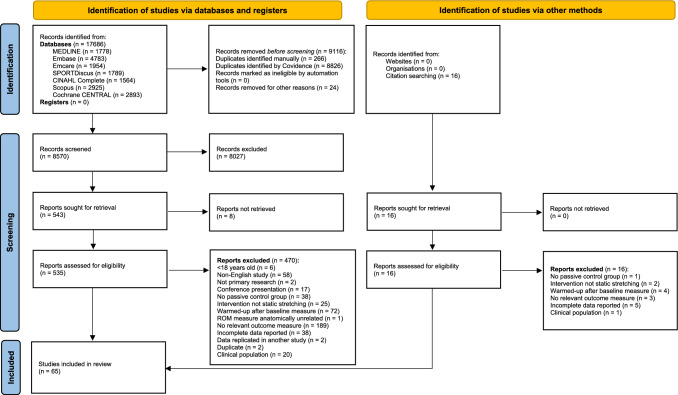
Methods: Seven databases (CINAHL Complete, Cochrane CENTRAL, Embase, Emcare, MEDLINE, Scopus and SPORTDiscus) were systematically searched up to 6 June, 2024. Randomised and non-randomised controlled trials investigating the effects of acute (single session) or chronic (two or more sessions) SS on muscle-tendon unit structure (fascicle length), mechanical properties (stiffness) or stretch tolerance (maximum tolerable passive resistive torque) compared to non-stretching passive controls (adults aged ≥ 18 years) were included. The effects of SS were examined using a multi-level meta-analysis, with associations between changes in maximum tolerable passive resistive torque, stiffness and fascicle length with improvements in ROM examined using multivariate meta-regression.
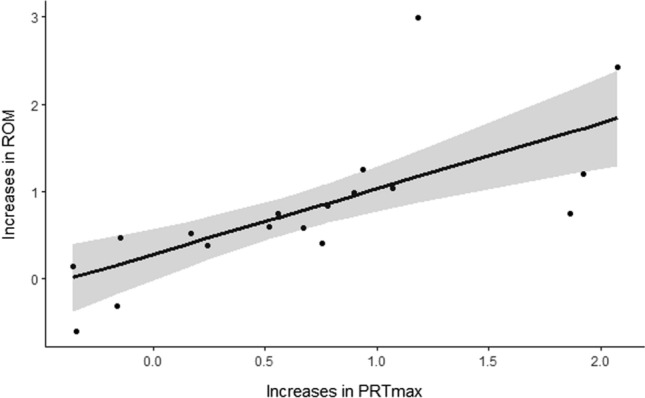
Results: Data from 65 studies representing 1542 adults (71% male; mean ± standard deviation age = 26.1 ± 11 years) were included. We found a small decrease in overall stiffness following both acute (Hedges' g = 0.42, 95% confidence interval [CI] 0.21, 0.63, p < 0.001) and chronic SS (Hedges' g = 0.37, 95% confidence interval 0.18, 0.56, p < 0.001), and a moderate increase in maximum tolerable passive resistive torque following chronic SS (Hedges' g = 0.74, 95% CI 0.38, 1.10, p < 0.001). Neither acute nor chronic SS had a significant effect on fascicle length. For acute SS, greater reductions in overall stiffness were found with moderate (p < 0.002) and high SS intensities (p = 0.02) compared with low-intensity SS, and in individuals with normal flexibility compared with those with poor flexibility at baseline (p < 0.001). Conversely, the effects of chronic SS on overall stiffness and maximum tolerable passive resistive torque were not moderated by stretching intensity, intervention length, baseline flexibility or sex (p > 0.05). Last, improved ROM following chronic SS was significantly associated with both decreased overall stiffness (g = 0.59, 95% CI 0.08, 1.10, p = 0.03) and increased maximum tolerable passive resistive torque (g = 0.74, 95% CI 0.41, 1.09, p < 0.001).
Conclusions: While both acute and chronic SS reduced overall stiffness, stretch tolerance only increased following chronic SS. Neither acute nor chronic SS altered fascicle length. The effect of acute SS on reduced overall stiffness was greater when stretching at a moderate or higher intensity and in those with normal flexibility. Increased ROM was significantly associated with decreased overall stiffness and increased stretch tolerance following chronic SS. Understanding the mechanisms underlying SS will assist coaches and clinicians in deciding whether and when to prescribe SS to their athletes and patients.
Clinical trial registration: PROSPERO CRD42023420168.
© 2025. The Author(s).
Conflict of interest statement
Declarations. Funding: No funding was received for the preparation of this article. Conflicts of Interest: Lewis Ingram, Grant Tomkinson, Noah d’Unienville, Bethany Gower, Sam Gleadhill, Terry Boyle and Hunter Bennett have no conflicts of interest that are directly relevant to the content of this article. Ethics Approval: Not applicable. Consent to Participate: Not applicable. Consent for Publication: Not applicable. Availability of Data and Material: The data and materials necessary to reproduce the findings reported in this article are available at https://osf.io/c9kt2/ . Code Availability: Not applicable. Authors’ Contributions: LI, GT and HB contributed to the conception and design of the review and meta-analysis. LI and HB performed the initial search of databases. LI, GT, ND, BG, SG and HB screened and selected the eligible studies. LI performed the data extraction, which was verified by ND. LI and ND assessed the risk of bias of the included studies. LI and HB performed the GRADE analysis. HB performed the statistical analysis, which was verified by TB. LI, GT and HB drafted the manuscript. All authors reviewed, provided critical revisions, and refined and approved the final manuscript.
Figures

References
-
- Shrier I. Does stretching improve performance? A systematic and critical review of the literature. Clin J Sport Med. 2004;14(5):267–73. - PubMed
-
- Kokkonen J, et al. Chronic static stretching improves exercise performance. Med Sci Sports Exerc. 2007;39(10):1825–31. - PubMed
-
- Woods K, Bishop P, Jones E. Warm-up and stretching in the prevention of muscular injury. Sports Med. 2007;37(12):1089–99. - PubMed
-
- Behm D. The science and physiology of flexibility and stretching: implications and applications in sport performance and health. New York: Taylor & Francis; 2018.
-
- Behm DG, et al. Acute effects of muscle stretching on physical performance, range of motion, and injury incidence in healthy active individuals: a systematic review. Appl Physiol Nutr Metab. 2016;41(1):1–11. - PubMed
Publication types
MeSH terms
LinkOut - more resources
Full Text Sources
