


Open Access Dataset and Common Data Model for Pulse Oximeter Performance Data
- PMID: 40180919
- PMCID: PMC11968964
- DOI: 10.1038/s41597-025-04870-8
Open Access Dataset and Common Data Model for Pulse Oximeter Performance Data
Abstract
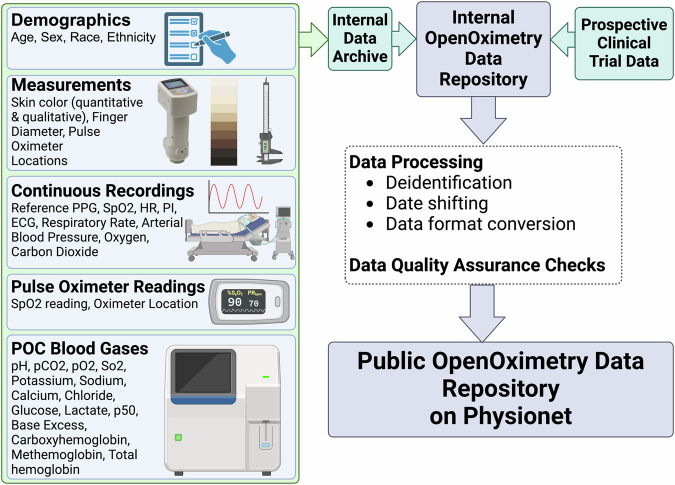
The OpenOximetry Dataset stores clinical and lab pulse oximetry data. It supports measurements of arterial oxygen saturation (SaO2) by arterial blood gas co-oximetry and pulse oximetry (SpO2), alongside processed and unprocessed photoplethysmography (PPG) data and other metadata. This includes skin color measurements, finger diameter, vital signs (e.g., arterial blood pressure, end-tidal carbon dioxide), and arterial blood gas parameters (e.g., acid-base balance, hemoglobin concentration). All data, from desaturation studies to clinical trials, are collected prospectively to ensure accuracy. A common data model and standardized protocols for consistent archival and interpretation ensure consistent data archival and interpretation. The dataset aims to facilitate research on pulse oximeter performance across diverse human characteristics, addressing performance issues and promoting accurate pulse oximeters. The initial release includes controlled lab desaturation studies (CLDS), with ongoing updates planned as further data from clinical trials and CLDS become available.
© 2025. The Author(s).
Conflict of interest statement
Competing interests: The UCSF Hypoxia Research Laboratory receives funding from pulse oximeter manufacturers/sponsors to test the sponsors’ devices for the purposes of product development and regulatory performance testing. Data submitted by the UCSF Hypoxia Lab for this dataset do not include Hypoxia Lab sponsors’ study devices unless the sponsor provides consent to include these data. Otherwise, all UCSF Hypoxia Lab data are collected from devices procured by the Hypoxia Lab for the purposes of independent research. At the time of this publication, no pulse oximeter company provides direct funding for the Open Oximetry Project, participates in study design or analysis, or is involved in the creation of this data dataset. None of the investigators who maintain this database own stock or equity interests in any pulse oximeter device companies. AIW holds equity and management roles in Ataia Medical. Atia Medical was not involved in study design, funding, or any portion of the study. There are no other conflicts of interest to declare.
Figures

Update of
-
Open Access Data Repository and Common Data Model for Pulse Oximeter Performance Data.medRxiv [Preprint]. 2024 Aug 31:2024.08.30.24312744. doi: 10.1101/2024.08.30.24312744. medRxiv. 2024. Update in: Sci Data. 2025 Apr 03;12(1):570. doi: 10.1038/s41597-025-04870-8. PMID: 39252896 Free PMC article. Updated. Preprint.
References
-
- Feiner, J. R., Severinghaus, J. W. & Bickler, P. E. Dark skin decreases the accuracy of pulse oximeters at low oxygen saturation: the effects of oximeter probe type and gender. Anesth. Analg.105, S18–S23 (2007). - PubMed
-
- Bickler, P. E., Feiner, J. R. & Severinghaus, J. W. Effects of skin pigmentation on pulse oximeter accuracy at low saturation. Anesthesiology102, 715–719 (2005). - PubMed
-
- Emery, J. R. Skin pigmentation as an influence on the accuracy of pulse oximetry. J. Perinatol. Off. J. Calif. Perinat. Assoc.7, 329–330 (1987). - PubMed
Publication types
MeSH terms
Grants and funding
- DP2 MH132941/MH/NIMH NIH HHS/United States
- K23 HL169901/HL/NHLBI NIH HHS/United States
- U54MD012530/U.S. Department of Health & Human Services | NIH | National Institute on Minority Health and Health Disparities (NIMHD)
- U54 MD012530/MD/NIMHD NIH HHS/United States
- K23HL169901/U.S. Department of Health & Human Services | NIH | National Heart, Lung, and Blood Institute (NHLBI)
LinkOut - more resources
Full Text Sources
Miscellaneous
