


Wearable sensors for measuring spontaneous upper limb use in children with unilateral cerebral palsy and typical development
- PMID: 40181251
- PMCID: PMC11967128
- DOI: 10.1186/s12984-025-01601-3
Wearable sensors for measuring spontaneous upper limb use in children with unilateral cerebral palsy and typical development
Abstract
Background: Unilateral Cerebral Palsy (UCP) is a clinical condition which mainly involves the movement and muscle tone of one side of the body, often impacting the general manual function. While there are some clinical assessment tools aimed to quantify the Upper Limbs (UpLs) use and the manual abilities, acquiring information regarding the motor abilities outside the clinical environment, such as the UpLs use and their asymmetry during daily life, could provide a more complete evaluation of the child and open a new clinical reasoning. For this purpose, wearable sensors are one of the newest approaches for continuously monitoring UpLs functions without being invasive. The aim of this study was to use wearable sensors to compare spontaneous/daily UpLs usage and asymmetry with the Assisting Hand Assessment (AHA) test, as well as comparing the daily UpLs usage behavior of children with UCP with respect to Typical Developing (TD) peers.
Methods: Eighty children (54 with UCP and 26 TD) wore an Actigraph sensor on each wrist during the AHA test and then at least for the following week of daily life. The amount of use of each hand and the asymmetry were analyzed during both the AHA and the following week of daily life using linear regression analysis and ANOVA models.
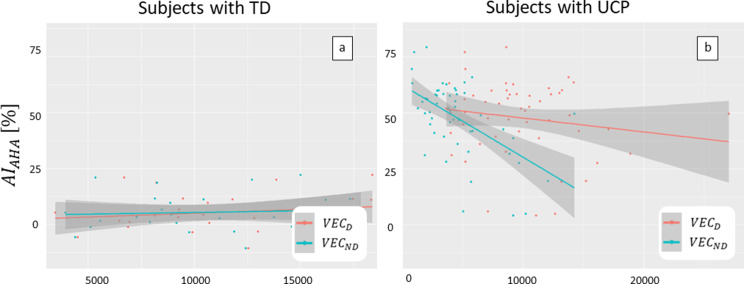
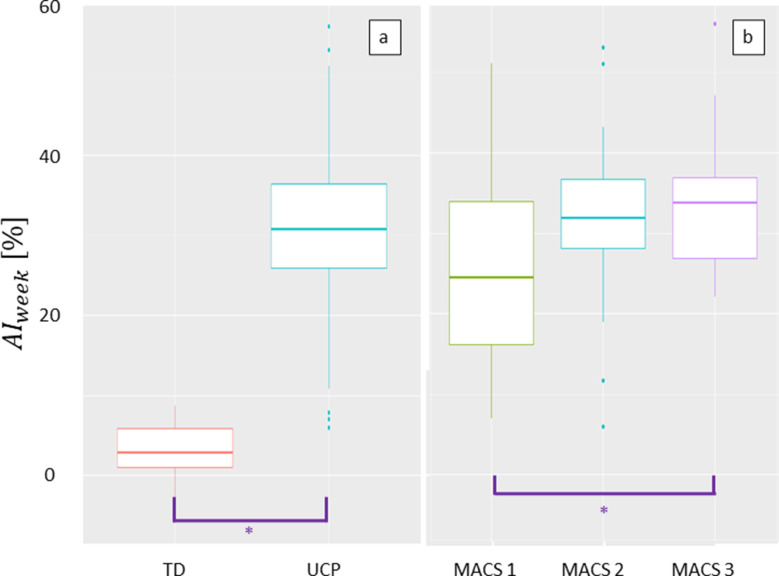
Results: Significant relationships were found between the asymmetry detected during the week and both the AHA scores and the asymmetry detected during the test. UCP and TD children week asymmetry distributions were significantly different; moreover, some differences were found when grouping them by MACS levels.
Conclusion: This paper proposes a new and easy technological methodology for monitoring UpLs behavior in daily life. Through wearable sensor data analysis, we demonstrate a linear correlation between asymmetry measured during smi-structured assessments and daily life. Additionally, we provide evidence of distinct patterns of UpLs usage between typically developing children and children with UCP in daily life.
Trial registration: Clinical Trials.gov (NCT03054441).
Keywords: AHA; Accelerometers; Actigraph; Asymmetry; Cerebral palsy; Daily life; Monitoring; UCP; Upper limb; Wearable sensors.
© 2025. The Author(s).
Conflict of interest statement
Declarations. Ethics approval and consent to participate: All families filled in a written consent to participate in the study. Ethics approval was obtained from the Tuscany Paediatric Ethics Committee, Italy (78/2016). Consent for publication: Not applicable. Competing interests: The authors declare no competing interests.
Figures

References
-
- Burgess A, Boyd RN, Chatfield MD, Ziviani J, Sakzewski L. Self-care performance in children with cerebral palsy: a longitudinal study. Develop Med Child Neuro. 2020;62:1061–7. - PubMed
-
- Öhrvall A-M, Eliasson A-C, Löwing K, Ödman P, Krumlinde-Sundholm L. Self-care and mobility skills in children with cerebral palsy, related to their manual ability and gross motor function classifications: Self-care and mobility skills in children with CP. Dev Med Child Neurol. 2010;52:1048–55. - PubMed
-
- Papadatou-Pastou M, Ntolka E, Schmitz J, Martin M, Munafò MR, Ocklenburg S, et al. Human handedness: A meta-analysis. Psychol Bull. 2020;146:481–524. - PubMed
-
- Cioni G, Sgandurra G. Normal psychomotor development. In: Handbook of clinical neurology [Internet]. Elsevier; 2013 [cited 2022 Feb 9]. pp. 3–15. Available from: https://linkinghub.elsevier.com/retrieve/pii/B9780444528919000014 - PubMed
-
- Michaelsen SM, Dannenbaum R, Levin MF. Task-Specific training with trunk restraint on arm recovery in stroke: randomized control trial. Stroke. 2006;37:186–92. - PubMed
Publication types
MeSH terms
Associated data
Grants and funding
LinkOut - more resources
Full Text Sources
Medical
Miscellaneous
